Keep our news free from ads and paywalls by making a donation to support our work!

Notes from Poland is run by a small editorial team and is published by an independent, non-profit foundation that is funded through donations from our readers. We cannot do what we do without your support.
Lithuania has proposed to Poland that they create Europe’s first cross-border economic zone. It says that the project, which would be located in the strategically important Suwałki Gap, would focus on attracting the defence and technology industries.
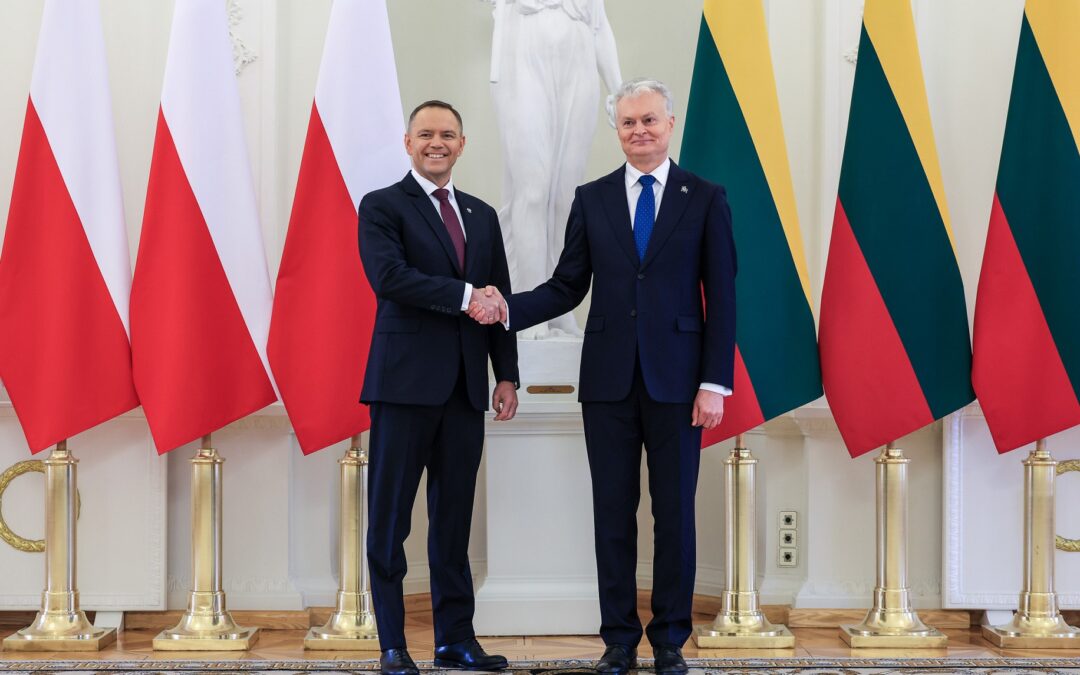
Lithuania’s president, Gitanas Nausėda, raised the idea last week during a visit to Warsaw to meet his Polish counterpart, Karol Nawrocki.
Another traditionally warm meeting with the President of Poland @NawrockiKn.
Discussed joint initiatives to strengthen regional security: more military capabilities, more exercises, more troops. Cross-border regions may share military training range close to the Suwalki… pic.twitter.com/fYPho14CkI
— Gitanas Nausėda (@GitanasNauseda) January 24, 2026
Lithuanian economy and innovation minister Edvinas Grikšas told broadcaster Žinių on Thursday that the idea for the economic zone had been “received positively by both sides”, which were now analysing whether and how it could be implemented.
“This could be a breakthrough,” said Grikšas. “There is no such cross-border special economic zone operating in Europe. The only one [in the world] that is operating, to my knowledge, is in Singapore and Malaysia.”
Grikšas said that one of his deputy ministers, Paulius Petrauskas, was travelling to Singapore to learn more about the special economic zone that it recently established with Malaysia.
“It is interesting to see how they approached this issue, how it works in practice, and how they reconcile the legal issues of the two countries, for example in matters of taxation and profit sharing,” said Petrauskas, quoted by broadcaster ZW.
Petrauskas said that the planned Polish-Lithuanian economic zone could accommodate both firms from the traditional defence industry and those in the technology sector that contribute to arms manufacturing.
Lithuania has proposed locating the zone in the Lazdijai district, which is on the opposite side of the border from the Polish town of Suwałki.
The entire Polish-Lithuanian border sits between Belarus and the Russian exclave of Kaliningrad, making it a strategic chokepoint in a potential conflict.
The mayor of Suwałki, Czesław Renkiewicz, told the Polish Press Agency (PAP) that Lithuania’s proposal is a “good and interesting idea”, which could help make the region more attractive to investors who have been deterred by the “bad PR” it has had due to potential security threats.
“In addition to the typical tax reliefs available in economic zones, other financial instruments should be launched for investors, such as government grants for companies investing in such a zone,” he suggested.
During his visit to Warsaw, Nausėda also called for Poland and Lithuania to establish a joint military training ground in the same area.
“This would be a unique solution in the NATO context, a joint training and exercise ground intended to protect the alliance’s eastern flank,” said the Lithuanian president, quoted by PAP.
Poland and Lithuania have begun military exercises to test their readiness to defend the Suwałki Gap, a stretch of land along their shared border that sits between Russia and Belarus.
Military personnel from the US and Portugal are also taking part https://t.co/ThXCA4Xc6a
— Notes from Poland 🇵🇱 (@notesfrompoland) April 22, 2024
Lithuania and Poland enjoy close historical ties. Between the 16th and 18th centuries, they formed the Polish-Lithuanian Commonwealth, which at its peak was one of the largest and most important states in Europe.
Russia’s full-scale invasion of Ukraine in 2022 has pushed the two countries towards closer cooperation, including holding joint military exercises in the Suwałki Gap.
In October, Nausėda and Nawrocki attended the opening of a new road connection across the Polish-Lithuanian border that will better connect the Baltic states to the rest of the EU. Last year also saw the Baltic states cut their links to Russia’s electricity grid and instead connect to the EU’s network via Poland.
Russians regard Poland and Lithuania as their greatest enemies among a list of 12 countries (not including Ukraine) presented to them in a survey by the Levada Center published this week.
For more on the findings, read our report here: https://t.co/XTcNWragtF pic.twitter.com/oRhspJHW97
— Notes from Poland 🇵🇱 (@notesfrompoland) January 30, 2026
Notes from Poland is run by a small editorial team and published by an independent, non-profit foundation that is funded through donations from our readers. We cannot do what we do without your support.
Main image credit: Mikołaj Bujak/KPRP

Daniel Tilles is editor-in-chief of Notes from Poland. He has written on Polish affairs for a wide range of publications, including Foreign Policy, POLITICO Europe, EUobserver and Dziennik Gazeta Prawna.