Keep our news free from ads and paywalls by making a donation to support our work!

Notes from Poland is run by a small editorial team and is published by an independent, non-profit foundation that is funded through donations from our readers. We cannot do what we do without your support.
Poland’s justice ministry is seeking to change the law so that anyone convicted of “offending religious feelings” cannot receive a prison sentence. The crime currently carries a potential jail term of up to two years.
The ministry says the move is intended to comply with a ruling by the European Court of Human Rights (ECtHR) that Poland violated the rights of a famous pop star, Doda, when she was convicted of blasphemy.
.@GrzegorzKepka: Będzie złagodzenie kar za obrazę uczuć religijnych?@w_zurek: To jest wstępna faza projektu. Musimy rozpocząć tę debatę. pic.twitter.com/IT4kQNmhgh
— Graffiti_PN (@Graffiti_PN) January 8, 2026
Under article 196 of Poland’s penal code, it is a crime to “offend the religious feelings of other people by publicly insulting an object of religious worship or a place intended for the public performance of religious rites”. Those found guilty can be fined, given community service, or jailed for up to two years.
The justice ministry proposes keeping the law on the books, but removing the possibility of a prison sentence for offenders. It says that this solution would “balance freedom of speech with protection of religious feelings”.
“Poland is absolutely not abandoning its protection of religious feelings, and insulting faith will continue to be punished in accordance with the applicable law,” said justice minister Waldemar Żurek. “I am a strong supporter of this, although I realise it is an extremely delicate issue and the boundaries are fluid.”
“However, it is necessary to harmonise Polish law with European standards,” he added. “The changes we are introducing are a response to the judgement of the European Court of Human Rights, not a political decision.”
In 2022, the ECtHR ruled that Poland, where around 70% of people identify as Catholic, had violated the right to free expression of Dorota Rabczewska, one of Poland’s biggest pop stars, better known by her stage name Doda.
Doda had been found guilty in Poland of offending religious feelings by giving an interview in which she said that it was “difficult to believe in” the Bible as it was “written by someone wasted from drinking wine and smoking weed”.
However, it is unclear how Żurek’s proposed changes to the law would satisfy the ECtHR, given that Doda was not given a prison sentence for her offence. She was fined 5,000 zloty (€1,187), which the ECtHR deemed a “particularly severe” punishment. Under Żurek’s proposals, such fines could still be issued.
According to the ministry, between 2020 and 2024, 17 people were given jail terms for offending religious feelings. However, in publicly reported cases, only community service or fines have been issued by courts.
Update: in response to a request from Notes from Poland, the justice ministry sent data showing 12 prison sentences (four of them conditionally suspended) issued for offending religious feelings between 2020 and 2024. It did not respond to a request for specific examples of those sentences.
Polish pop star Doda's blasphemy conviction violated her human rights, the @ECHR_CEDH has ruled
Doda was convicted of offending religious feelings, a crime in Poland, for saying the Bible was "written by someone wasted from drinking wine and smoking weed" https://t.co/iX81CqEYzW
— Notes from Poland 🇵🇱 (@notesfrompoland) September 15, 2022
The justice ministry’s proposed changes still face a long, and likely impossible, path to becoming law. They will now be the subject of inter-ministerial and public consultation, after which they must be approved by the cabinet.
The legislation would then require approval by parliament, where the government has a majority. However, the ruling coalition, which ranges from left to centre-right, contains conservative elements that may not be willing to soften the blasphemy law.
Even if a bill is passed by parliament, it would then require the approval of right-wing President Karol Nawrocki, who has regularly vetoed government legislation. It seems almost certain that he would not sign off on such changes.
Indeed, in 2022, when the national-conservative Law and Justice (PiS) party, with which Nawrocki is aligned, was in power, the then justice minister, Zbigniew Ziobro, proposed moving in the opposite direction, by making the blasphemy law broader and stricter.
Anyone who “publicly insults or ridicules the church” could be jailed for 2 years under a bill submitted by a party in Poland’s ruling coalition
There's "growing aggression toward those who have the courage to admit their faith", says the justice minister https://t.co/iK4oNdoZyv
— Notes from Poland 🇵🇱 (@notesfrompoland) October 7, 2022
Żurek’s plans to soften the blasphemy law have already been criticised by Ordo Iuris, a prominent conservative legal group. “The ministry is showing that these types of crimes will not be taken seriously by authorities subordinate to the government,” Ordo Iuris’s Jędrzej Jabłoński told broadcaster Radio Maryja.
The changes therefore represent “a form of consent, even tacit encouragement, to commit such crimes, which are being committed in growing numbers”, and will “fuel this type of religious unrest in Poland and the attacking of Christians in particular”.
By contrast, Piotr Kładoczny, a legal scholar at the University of Warsaw and deputy president of the Helsinki Foundation for Human Rights, told the Rzeczpospolita daily that the ministry’s proposals do not go far enough. He called for the blasphemy law to be abolished entirely.
He noted that other elements of Polish law already criminalise violence, threats or other forms of abuse motivated by religious affiliation, and argued that the law on offending religious sentiment is “applied too broadly by courts and disproportionately violates freedom of expression”.
In Poland, "offending religious feelings" is a crime carrying up to two years in jail. We asked five experts if it's time to abolish the blasphemy law.@Adbodnar, @moanrosa, @DNadazdin, Filip Wołoszczak (@OrdoIuris) & Dominika Kozłowska (@MiesiecznikZNAK) https://t.co/Fdwd09ao8x
— Notes from Poland 🇵🇱 (@notesfrompoland) March 13, 2021
Notes from Poland is run by a small editorial team and published by an independent, non-profit foundation that is funded through donations from our readers. We cannot do what we do without your support.
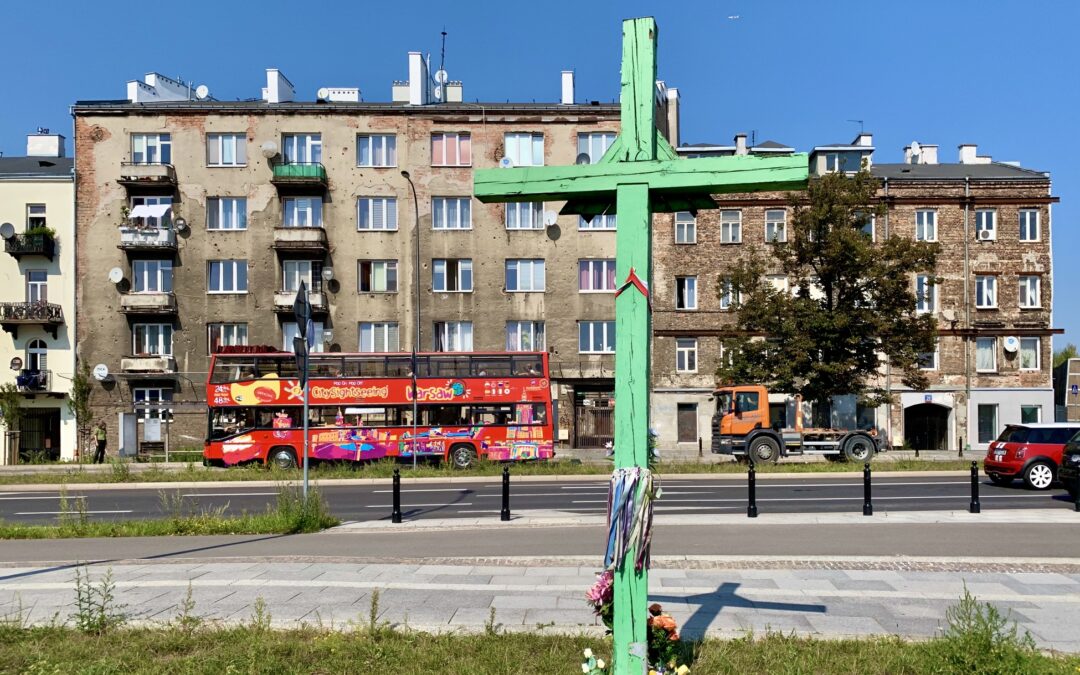
Main image credit: Kgbo/Wikimedia Commons (under CC BY-SA 4.0)

Daniel Tilles is editor-in-chief of Notes from Poland. He has written on Polish affairs for a wide range of publications, including Foreign Policy, POLITICO Europe, EUobserver and Dziennik Gazeta Prawna.