Keep our news free from ads and paywalls by making a donation to support our work!

Notes from Poland is run by a small editorial team and is published by an independent, non-profit foundation that is funded through donations from our readers. We cannot do what we do without your support.
Poland is introducing new measures making it easier to prosecute hate crimes, the number of which rose by over 40% in the first half of 2025.
Waldemar Żurek, who serves as both justice minister and prosecutor general, told news website OKO.press that he will soon issue a regulation designating special units in prosecutor’s offices around the country dedicated to dealing with crimes motivated by prejudice.
“Designated units will specialise in prosecuting hate,” said Żurek. “This will apply to hate in its broadest sense. It doesn’t matter whether the victims are Ukrainians, Jews, Roma or Polish citizens who hold different views.”
Żurek będzie ścigać mowę nienawiści, w tym hejt na Ukraińców. Powoła specjalne zespoły prokuratorów@M_Jaloszewski @MS_GOV_PL #hejt #prokuratura #okopress https://t.co/RgIOXCASFa pic.twitter.com/nH4mNUCOYh
— OKO.press (@oko_press) January 1, 2026
Under Polish law, inciting hatred based on national, ethnic, racial or religious differences or publicly insulting someone based on such differences are crimes punishable by up to three years in prison.
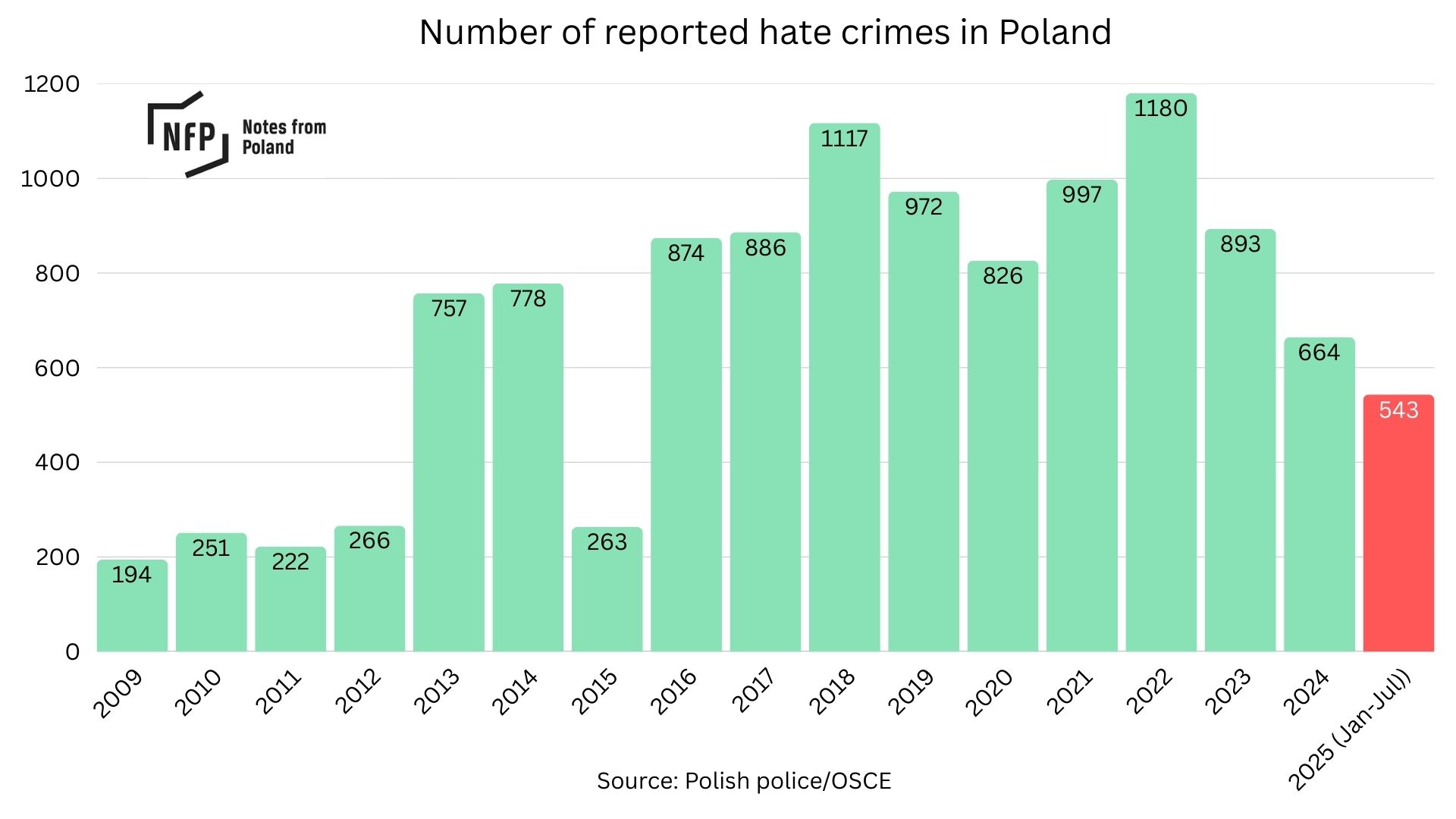
Police data show that, from the start of January to the end of July in 2025, 543 bias-motivated crimes were recorded in Poland. That was a 41% increase on the 384 such crimes reported in the same period of 2024.
“Raising awareness of diversity in its dimensions, including race, ethnicity and religion, as well as preventing and combating bias-motivated crimes, is a key element of the Polish police’s operations,” wrote the police at the time.
Data for the rest of 2025 are not yet available, but the figures from the first seven months of the year suggest that Poland was on track to have one of the highest annual numbers of reported hate crimes on record.
One community that has complained of growing hate is Ukrainians, who are by far the largest immigrant group in Poland, numbering around 1.5 million.
Last month, Ukraine’s foreign minister called on Poland to impose “fair and exemplary” punishment on those who engage in xenophobic behaviour towards Ukrainians, following reports that a Ukrainian schoolgirl was subjected to abuse at a Warsaw school.
In December, Żurek met at the justice ministry with Ukraine’s ambassador, Vasyl Bodnar, and the president of the Ukrainian World Congress, Paul Grod, to discuss combating hate speech and disinformation, which have been stoked in Poland by Russian operatives.
At the meeting, Żurek “reaffirmed Poland’s commitment to supporting Ukrainian citizens” and said that his ministry would develop new legal regulations and prosecutorial competences in combating hate crimes.
According to OKO.pres, Żurek’s plans will see special hate-crime units set up at 11 district prosecutor’s offices in cities around Poland as well as at four in Warsaw. Maciej Młynarczyk, a prosecutor who specialises in hate-speech cases, is expected to play a central role in the new system.
“The state’s failure to effectively respond to aggression motivated by nationality, religion, skin colour or sexual orientation harms society as a whole,” Młynarczyk told OKO.press. “It increases tolerance for violence, reduces respect for the law, undermines social stability, and undermines national security.”
“The state and society cannot afford to be defenceless in this area,” he continued. “A comprehensive solution is necessary: dedicated training and exchange of experience, a methodological manual, and a distribution of workload so that specialised prosecutors handle such cases frequently and quickly gain experience.”
Ukraine’s foreign minister has urged Poland to act against xenophobic behaviour towards Ukrainians following a bullying case at a Warsaw school.
"It is in our common interest to prevent and respond to such hostility,” said @andrii_sybiha https://t.co/LmHaycglpg
— Notes from Poland 🇵🇱 (@notesfrompoland) December 22, 2025
Last year, the government also sought to expand Poland’s hate crime laws so that they also include sexual orientation, sex/gender, age and disability as protected categories.
However, then-President Andrzej Duda, who was aligned with the conservative opposition, refused to sign the measures into law and instead sent them to the Constitutional Tribunal (TK) for review. The TK, which is also aligned with the opposition, deemed the bill unconstitutional, thereby preventing it from coming into force.
Last year also saw a dramatic rise in the visibility and popularity of radical-right leader Grzegorz Braun, whose political activity has centred around anti-Jewish, anti-Ukrainian and anti-LGBT rhetoric. He finished a surprise fourth in the 2025 presidential election and his party has growing support in polls.
In December, Braun went on trial for his 2023 attack on a Jewish religious celebration in Poland’s parliament. He is also being prosecuted for a range of other alleged crimes relating to his anti-Jewish, anti-Ukrainian and anti-LGBT actions.
A new poll shows the party of far-right leader Grzegorz Braun reaching third place for the first time, with support of 11%
The finding continues a dramatic recent rise for Braun, who is currently on trial for attacking a Hanukkah celebration in parliament https://t.co/XeKwJy6YLG
— Notes from Poland 🇵🇱 (@notesfrompoland) December 17, 2025
Notes from Poland is run by a small editorial team and published by an independent, non-profit foundation that is funded through donations from our readers. We cannot do what we do without your support.
Main image credit: Tim Pierce/Flickr (under CC BY 2.0)

Daniel Tilles is editor-in-chief of Notes from Poland. He has written on Polish affairs for a wide range of publications, including Foreign Policy, POLITICO Europe, EUobserver and Dziennik Gazeta Prawna.