Keep our news free from ads and paywalls by making a donation to support our work!

Notes from Poland is run by a small editorial team and is published by an independent, non-profit foundation that is funded through donations from our readers. We cannot do what we do without your support.
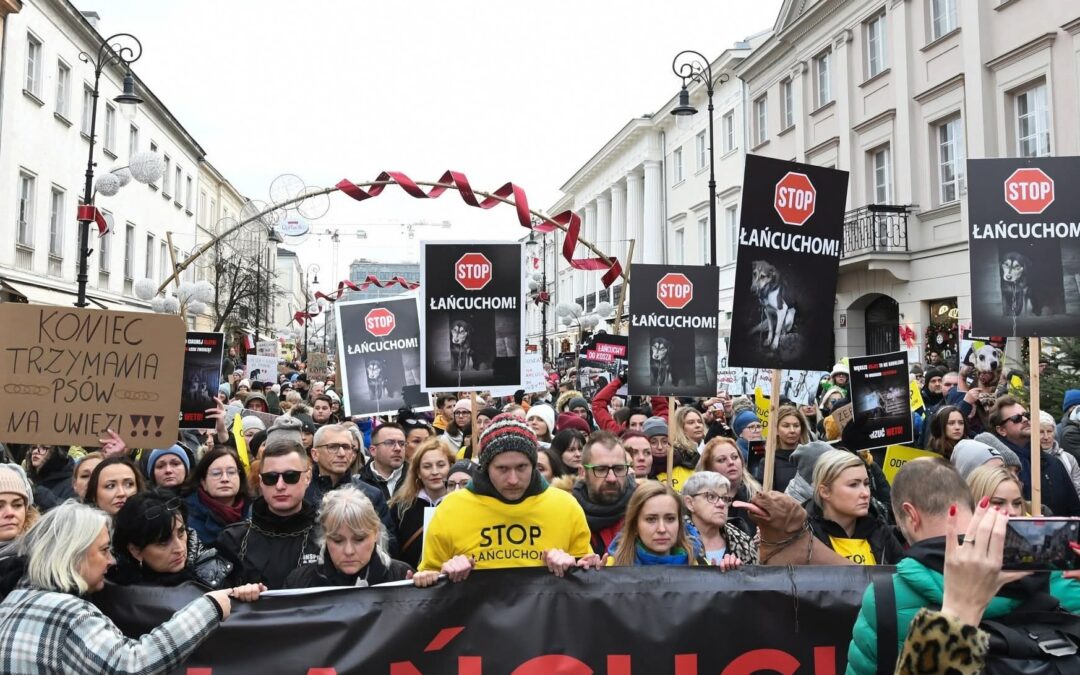
Thousands of people joined a protest in Warsaw on Sunday against President Karol Nawrocki’s decision to veto a law that would have introduced a ban on keeping dogs chained up.
The Great March for Animals passed through the city before ending up outside the presidential palace, where participants, some of whom were accompanied by their own dogs called on parliament to “break the chains, overturn the veto”.
This Wednesday, a vote will be held in parliament on overturning Nawrocki’s veto. That would require a three-fifths majority of MPs, and it remains unclear if that will be possible.
In September, parliament approved a bill that would have banned the chaining of dogs at home and also introduced minimum sizes of kennels that dogs can be kept in.
The measure was supported by Poland’s ruling coalition, which ranges from left to centre-right, but also some MPs from the national-conservative opposition Law and Justice (PiS) party, including its leader, Jarosław Kaczyński.
However, after the bill reached Nawrocki, who is aligned with the right-wing opposition, he decided to exercise his right to veto. Nawrocki argued that, “although the intention – protecting animals – is just and noble, the law itself was poorly drafted”.
In particular, the president said that elements of the legislation introducing minimum sizes for dog kennels – of at least 20m² for the largest dogs – were unrealistic and would “harm farmers, breeders and ordinary rural households”.
Nawrocki submitted his own alternative bill to parliament that includes a ban on chaining dogs at home but not minimum kennel sizes.
However, Włodzimierz Czarzasty, the speaker of the Sejm, the more powerful lower house of parliament, announced that he would instead seek to overturn the president’s veto on the original bill.
That would be an extremely rare occurrence: the last time a presidential veto was overturned by parliament was in 2009. But Czarzasty appeared to have a chance of success given that the dog-chaining ban received the support of over three-fifths of MPs when it was approved by parliament in September.
However, it appears likely that most, if not all, of the PiS MPs who voted in favour of the bill initially will not support overturning the veto of Nawrocki, who was elected this year with PiS’s backing and has generally supported the party’s agenda since taking office. That would likely mean the veto will not be overturned.
The speaker of parliament has announced that he will seek to overturn President Nawrocki’s veto of a law banning the chaining up of dogs.
A veto can be overridden by a three-fifths majority of MPs. But that happens very rarely: the last time was in 2009 https://t.co/VRQ03yoFNy
— Notes from Poland 🇵🇱 (@notesfrompoland) December 3, 2025
In a United Surveys poll published on Sunday by the Wirtualna Polska news website, 61% of respondents said they opposed Nawrocki’s veto while 36% supported it. Participants in Sunday’s march appealed to MPs to vote to overturn it, rather than accept the president’s proposed alternative.
“We stand here today because we refuse to accept suffering, which is still legal in Poland, because a dog on a chain, a dog confined in a cramped area, is a suffering dog,” said Robert Maślak, an expert in animal welfare from the University of Wrocław.
Maślak said that banning chaining alone would not be enough because studies show that dogs kept in confined spaces suffer stress, which leads to behavioural disorders. That in turn can make animals aggressive and more of a threat to humans.
“Replacing the chain with a cramped kennel does not solve the problem,” he warned, quoted by the Polish Press Agency (PAP).
Notes from Poland is run by a small editorial team and published by an independent, non-profit foundation that is funded through donations from our readers. We cannot do what we do without your support.
Main image credit: Fundacja na Rzecz Ochrony Praw Zwierząt Mondo CANE/Facebook

Daniel Tilles is editor-in-chief of Notes from Poland. He has written on Polish affairs for a wide range of publications, including Foreign Policy, POLITICO Europe, EUobserver and Dziennik Gazeta Prawna.