Keep our news free from ads and paywalls by making a donation to support our work!

Notes from Poland is run by a small editorial team and is published by an independent, non-profit foundation that is funded through donations from our readers. We cannot do what we do without your support.
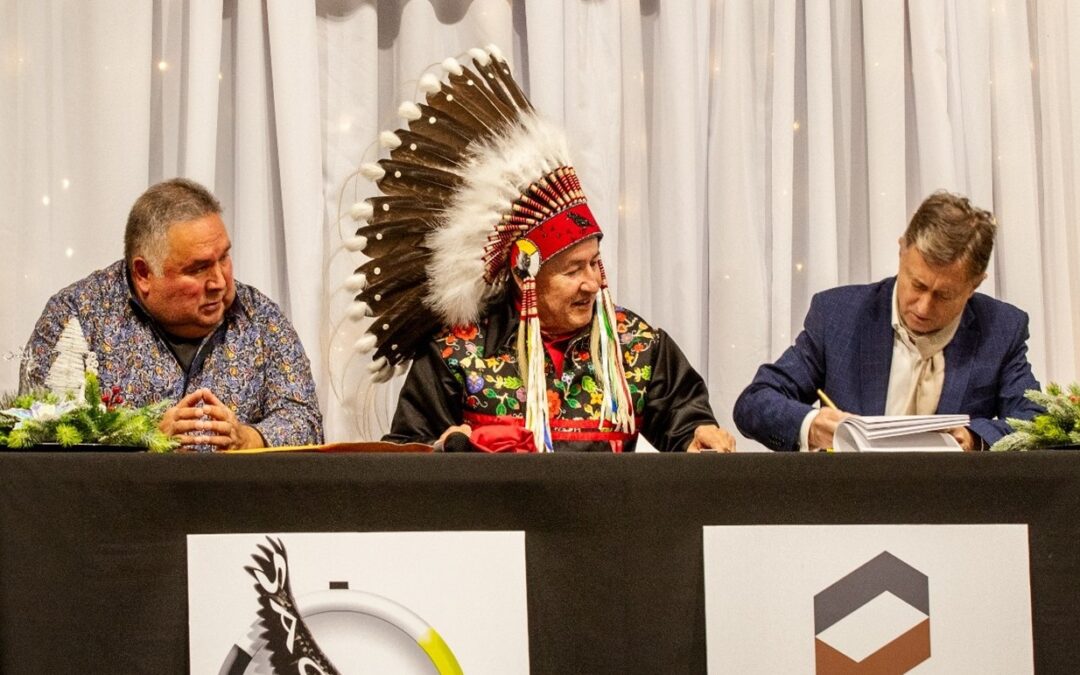
Polish mining firm KGHM has signed an impact and benefit agreement (IBA) with the Sagamok Anishnawbek First Nation in Canada as part of the development of a new copper and nickel mine.
The arrangement provides for members of the community to be involved in development of the mine, which is located near the city of Sudbury in Ontario, as well as in environmental protection relating to it.
Spółka KGHM INTERNATIONAL LTD. oraz Grupa Ludności Rdzennej Sagamok Anishnawbek ogłosiły podpisanie ✍️ umowy o współpracy biznesowej (Impact and Benefit Agreement) dotyczącej ⚒️ kanadyjskiej kopalni Victoria.
W imieniu Sagamok Anishnawbek historyczne porozumienie podpisał Chief… pic.twitter.com/9OG6RWg6wO
— KGHM Polska Miedź (@KGHM_SA) December 8, 2025
The IBA was signed last week by Sagamok Anishnawbek Chief Angus Toulouse and Marek Bednarz, CEO of KGHM International, a Canadian subsidiary of Polish parent company KGHM Polska Miedź.
KGHM, whose largest shareholder is the Polish state, is one of Poland’s biggest firms and one of the world’s largest producers of copper and silver. In 2012, it acquired the Victoria project, a deposit of copper and nickel 35 km west of Sudbury, where KGHM plans to develop a mine.
However, the project was mothballed for years amid a fall in mineral prices, before being revived around three years ago.
Andrzej Szydło, the CEO of KGHM Polska Miedź, described the agreement with Sagamok Anishnawbek as “an important step in the development of our Canadian Victoria project” and “further evidence of [our] commitment to social dialogue and good neighbourly relations, regardless of where we conduct business”.
KGHM notes that it has also been working with Sagamok Anishnawbek, which has around 3,400 members, for over a decade during exploration work at the site and during the process of obtaining permits. Signing the IBA will now “provide KGHM with stable cooperation throughout the lifecycle of the future mine”, says the firm.
It also “offers members of Sagamok Anishnawbek tangible business and development benefits – from the mine construction stage, through the production phase, and through mine closure”, added KGHM, and “guarantees Sagamok Anishnawbek participation in environmental protection activities”.
Last month, news and research website The Conversation noted that Canada, and Ontario in particular, are accelerating efforts to attract global investors in mining projects.
However, it added that those efforts are overshadowed by the fact that First Nations have historically suffered the worst environmental and social costs of such projects while others obtain the benefits. “The path to responsible mining starts with Indigenous consent,” wrote the authors.
The path to responsible mining in northern Ontario starts with Indigenous consenthttps://t.co/EHiKxsqqn4
— Don Richardson (@Don_Richardson) November 15, 2025
Notes from Poland is run by a small editorial team and published by an independent, non-profit foundation that is funded through donations from our readers. We cannot do what we do without your support.
Main image credit: KGHM (press materials)

Daniel Tilles is editor-in-chief of Notes from Poland. He has written on Polish affairs for a wide range of publications, including Foreign Policy, POLITICO Europe, EUobserver and Dziennik Gazeta Prawna.