Keep our news free from ads and paywalls by making a donation to support our work!

Notes from Poland is run by a small editorial team and is published by an independent, non-profit foundation that is funded through donations from our readers. We cannot do what we do without your support.
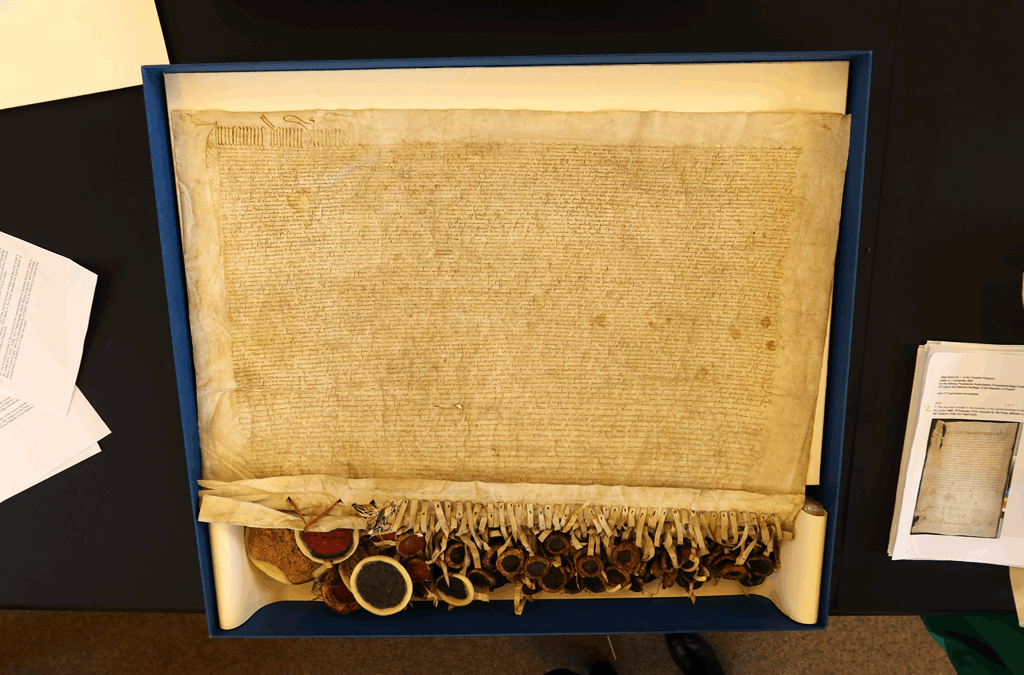
Germany has agreed to return to Poland a collection of 73 documents dating from between the 13th and 15th centuries that were looted during World War Two.
The Polish culture minister called the decision “the most important and valuable return of stolen cultural heritage in modern Polish history”.
„Historyczny dzień!” – nowy etap polsko-niemieckich relacji w obszarze restytucji dóbr kultury
To najważniejszy i najcenniejszy zwrot zrabowanych obiektów dziedzictwa kultury we współczesnej historii Polski. Do kraju wracają 73 dokumenty pergaminowe z XIII-XV w. ze zbiorów… pic.twitter.com/bJf1JV9JO8
— Ministerstwo Kultury i Dziedzictwa Narodowego (@kultura_gov_pl) December 1, 2025
The parchments relate to the Teutonic Order and its relations with Poland. They include documents relating to protections granted by a series of popes, the oldest of which was issued by Pope Innocent III to the Teutonic Order in 1215.
Others are signed by Polish kings, including a 1349 document in which Casimir III the Great marked the border with the Teutonic Order. Another, from 1422, is a copy of the Treaty of Melno, which ended a war the Teutonic Knights had fought against Poland and Lithuania.
Until the 18th century, the documents were stored in Wawel Castle in Kraków, the seat of Polish kings and the country’s former capital. Subsequently, they were transferred to Warsaw, where by the 20th century they were held in the Central Archives of Historical Records (AGAD).
After Nazi Germany invaded and occupied Poland in September 1939, the collection became subject to the mass looting of valuable Polish historical and cultural collections carried out by the occupiers.
The parchments were formally handed over to Nazi Germany in December 1940 and transferred to the Prussian State Archives in Königsberg (now Kaliningrad in Russia) in January 1941. Later, they were moved to the Prussian Secret State Archives in Berlin.
Poland first made efforts to secure their return in 1948, three years after the end of the war. Those were unsuccessful, as were further attempts in the 1990s and 2000s.
Finally, in 2022, Poland submitted a comprehensive restitution request for the first time, including documentation relating to the looting. Last year, the Polish government renewed its push for the documents to be returned.
Poland is seeking the restitution of 73 historical documents – including a 15th-century peace treaty between Poland, Lithuania and the Teutonic Knights – that were looted by Germany in WWII and are currently being held in a Berlin archive https://t.co/nXjusudY6O
— Notes from Poland 🇵🇱 (@notesfrompoland) October 11, 2024
Finally, today, amid bilateral talks in Berlin between the Polish and German governments, culture minister Marta Cienkowska announced that the parchments would be returned, calling it “a historic day”.
She also revealed that the head of a 14th-century sculpture of Saint James the Elder, which was stolen from Malbork Castle in Poland in 1957 and purchased for the collection of the Germanic National Museum in Nuremberg, will be handed back to Poland.
Speaking to the Rzeczpospolita daily, Cienkowska called today’s restitution decision “the most important since 1989”.
She said that it was the current government’s move to “repair relations with our neighbours”, which were often strained under the former Law and Justice (PiS) administration, “that has finally allowed us not only to return to dialogue but also to shift to an offensive on restitution”.
Poland has announced the return of four items looted in WWII and missing until recently being spotted at auction.
Hundreds of thousands of artworks and books disappeared during the German and Soviet occupations of Poland, and many remain unaccounted for https://t.co/Kqqxyp7IDU
— Notes from Poland 🇵🇱 (@notesfrompoland) September 29, 2025
The brutal Nazi-German occupation of Poland from 1939 to 1945 resulted in the deaths of millions of Polish citizens, the destruction of Polish cities, and also the looting and destruction of hundreds of thousands of artistic, historical and scientific items held in Polish collections.
Many of them remain unaccounted for, with the culture ministry’s public database of works it has identified as missing still containing around 70,000 items.
When such objects are identified – for example, in the collections of museums, archives and galleries, or when they come up for sale at auction – the Polish government seeks their return.
Poland has asked Germany to return a ring that once belonged to 16th-century Polish King Sigismund I but was looted during World War Two and is now held in a German museum https://t.co/wHims7bibx
— Notes from Poland 🇵🇱 (@notesfrompoland) June 23, 2025
However, Poland has often expressed frustration at the difficulty of restituting items from Germany. In 2022, it appealed to UNESCO for help on the issue.
Today, Cienkowska said that she had received “a guarantee” from her German counterpart, Wolfram Weimer, “that the processing of our [restitution] applications will be expedited”.
Among the looted items Poland is currently seeking the return of are historical documents held at the Berlin State Library and a ring that belonged to a 16th-century Polish king, Sigismund I the Old.
Notes from Poland is run by a small editorial team and published by an independent, non-profit foundation that is funded through donations from our readers. We cannot do what we do without your support.
Main image credit: MKiDN (under CC BY-NC-ND 3.0 PL)

Daniel Tilles is editor-in-chief of Notes from Poland. He has written on Polish affairs for a wide range of publications, including Foreign Policy, POLITICO Europe, EUobserver and Dziennik Gazeta Prawna.