Keep our news free from ads and paywalls by making a donation to support our work!

Notes from Poland is run by a small editorial team and is published by an independent, non-profit foundation that is funded through donations from our readers. We cannot do what we do without your support.
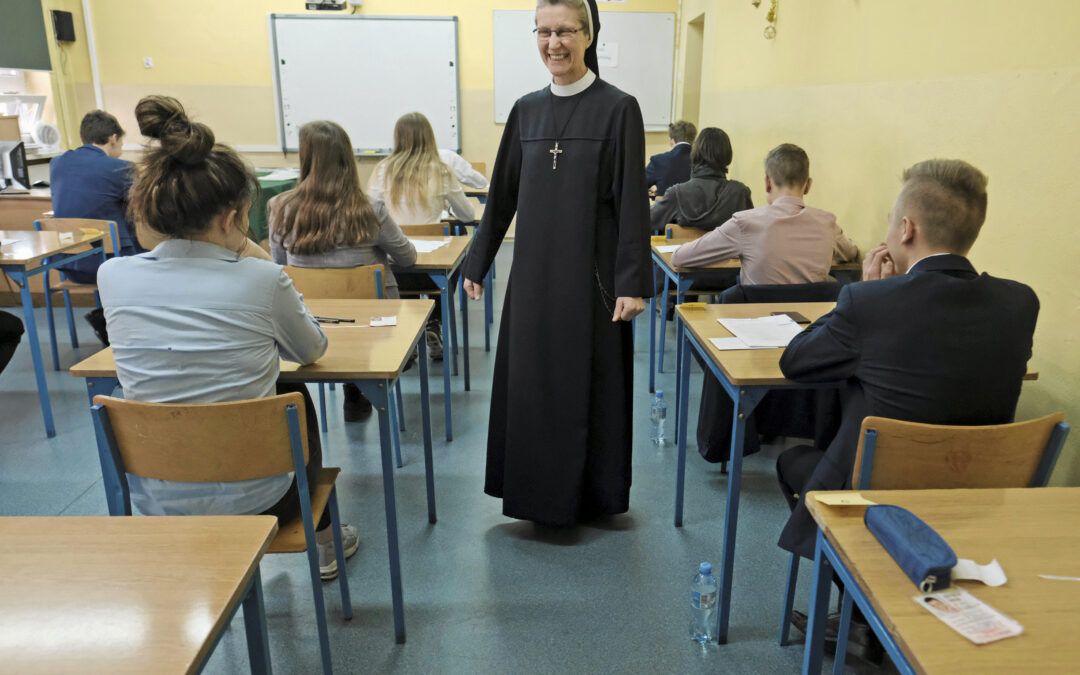
Half of people in Poland believe that religion classes – which consist of optional Catholic catechism teaching run by the church – should continue to take place in public schools, finds a new report on the issue by state research agency CBOS. That is the lowest figure ever recorded by the agency.
Meanwhile, a majority support the current government’s plans to halve the number of hours that such lessons are taught, as well as a recent decision to exclude religion grades from end-of-year averages. Those moves have been strongly opposed by the church and right-wing opposition.
CBOS asked Poles: “In your opinion, should religion be taught in public schools or not?” It has not included that question in its regular polling since 2008, but decided to ask about it now given recent changes introduced and announced by the government that took office last December.
A total of 51% of respondents said they either “definitely” (26%) or “somewhat” (25%) support teaching religion in schools. Meanwhile, a total of 43% were either “definitely” (25%) or “somewhat” (18%) opposed.
CBOS notes that support was the lowest and opposition the strongest since it first started asking about the issue in 1991. The strongest support for religion in schools was found in 2007, when it stood at 72%, with opposition at 24%.
Poparcie dla nauczania religii w szkołach publicznych pic.twitter.com/qZX69lRhTe
— CBOS (@CBOS_Info) October 7, 2024
However, the agency also observed significant differences in opinion depending on factors such as political affiliation and various personal circumstances. For example, among people with school-aged children, 57% support religion in schools while 40% are opposed.
Currently, a majority of children attend religion classes, though the numbers have been falling significantly in recent years.
Meanwhile, a large majority of supporters of right-wing opposition parties support religion classes taking place in schools: 77% in the case of the national-conservative Law and Justice (PiS) party and 67% for the far-right Confederation (Konfederacja).
But among supporters of the three groups that make up the current ruling coalition, only a minority are in favour: 24% in the case of the centrist Civil Coalition (KO); 45% among supporters of the centre-right Third Way (Trzecia Droga); and 15% among voters of The Left (Lewica).
Under a change already made by the government, grades for religion classes have been excluded from end-of-year averages. CBOS found that a large majority, 69%, support that decision. Only 25% think the grades should be included in averages.
The government has also introduced a new policy allowing religion classes from different year groups to be combined if too few students sign up for the lessons in one cohort.
Again, CBOS found support for this idea, with 70% saying they favour combining classes if less than seven students from one year group sign up for religion.
The constitutional court has ordered a halt to planned changes by the government to the organisation of school religion classes.
The measure was requested by Christian churches and is in place until the court issues a ruling on the legality of the changes https://t.co/ASP8TLIbtb
— Notes from Poland 🇵🇱 (@notesfrompoland) August 30, 2024
Finally, the government is planning from the next school year to halve the number of hours religion is taught from two per week to one and to ensure that the lessons take place either at the start or end of the school day (to ensure that children who do not attend do not have gaps in their timetable).
Here, CBOS found a narrower majority, 58%, in favour of cutting the number of hours, with 35% opposed. A large majority, 79%, support holding the classes at the start or end of days, with only 10% opposed.
The government’s policies have been strongly criticised by the church, which even turned to the constitutional court in an effort to prevent some of the changes taking effect at the start of the new school year last month.
Last week, Cardinal Kazimierz Nycz, the archbishop of Warsaw, called for religion classes to not only remain in schools but to be made compulsory for all pupils. However, CBOS’s study found that only 20% of people support that idea.
The archbishop of Warsaw has called for school religion classes – which teach Catholic catechism and are currently optional – to be made compulsory.
"Without knowledge of Christianity, it will be difficult for young people to understand the modern world” https://t.co/MSjveirqPr
— Notes from Poland 🇵🇱 (@notesfrompoland) October 4, 2024
Notes from Poland is run by a small editorial team and published by an independent, non-profit foundation that is funded through donations from our readers. We cannot do what we do without your support.
Main image credit: Piotr Skornicki / Agencja Wyborcza.pl