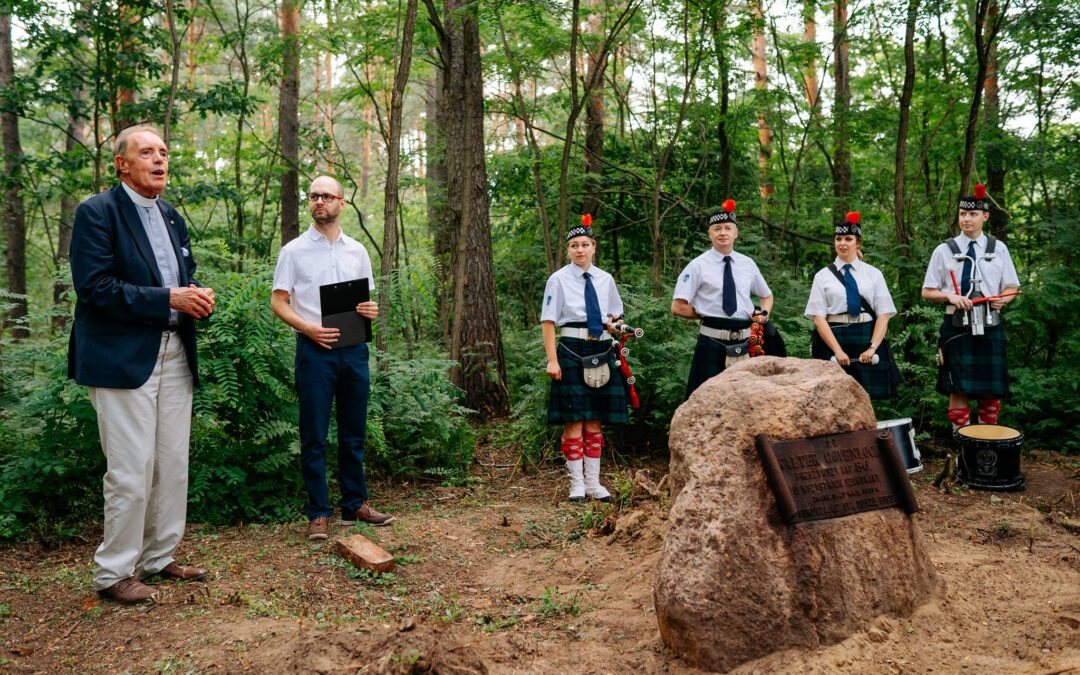
A village in Poland has launched a series of initiatives to commemorate its former Scottish community. This has included restoring its old Scottish cemetery and launching an annual “Scottish Evening” featuring a band of pipers and drummers.
The Scots of Jadów, a village of 1,000 people around 50 kilometres outside Warsaw, were part of a much larger – but today little remembered – Scottish community in Poland, which numbered an estimated 30,000 in the 17th century.
Think it's important us Scots know about our shared history with Poland. Read me on it here: https://t.co/49QwZtP7G1 https://t.co/T85iJDOinB
— Ross 'Teddy' Craig (@RossTeddyCraig) March 29, 2016
In Jadów, the Scots were invited to settle in the 19th century by a nobleman, Stanisław Kostka Zamoyski, and his son Andrzej, who declared they wanted to create “a settlement of various foreign manufacturers and craftsmen”, reports Onet. Previously, they had lived in the Suwałki region of what is now northeastern Poland.
The Scots of Jadów quickly became successful. One, John Dickson, was renowned for the production of Cheshire-type cheese.
But, after the defeated January Uprising of 1863-64 by Poles against Russian rule, Jadów lost its municipal rights and, with their situation deteriorating, the Scots gradually moved on.
One of the few physical traces they left behind was a small cemetery. But, as a result of neglect and looting, it fell into disrepair. By 2016, only two tombstones remained, of which only one was visible.
One belongs to Catherine J. Hay, born near Warsaw in 1833 and who died in the village of Strachówka in 1877. The other is for Walter Govenlock, who died in the area in 1881.
In 2016, local newspaper Gazeta Powiatu Wołomińskiego launched an appeal for the cemetery to be saved and restored. It gathered the support of various local NGOs and the head of the Jadów municipality.
Those efforts gathered pace with the establishment last year of a local historical association, which set about obtaining the necessary permits to restore the cemetery. That work began in April, with pupils from a nearby school helping tidy up the neglected site.
“We were proud that we were able to contribute to such a unique place,” said Szymon Lipiński, a high-school student, quoted by Onet. “Thanks to this, we got to know some stories about [the Scots] in Jadów.”
In July, the local community organised a Scottish Evening, when an information board was unveiled at the cemetery and the Częstochowa Pipes & Drums orchestra played Auld Lang Syne. A Warsaw-based Anglican chaplain, David Brown, also led a prayer.
The rest of the day – organised in cooperation with the St Andrews Foundation, which promotes Scottish culture in Poland – saw further musical performances, a history lecture, and a film screening.
Records show that Scots were trading and settling in Poland as far back as the 14th century. By the 17th century, it is believed that there were around 30,000 spread across the Polish-Lithuanian Commonwealth, then one of Europe’s largest and most diverse countries.
The Scots, many of whom hailed originally from around Dundee and Aberdeen, became a well-integrated part of Polish society – and in some cases a very wealthy one. Robert Porteous, who moved to the town of Krosno in the 17th century, became one of Poland’s richest men.
The history of the Scots in Poland is today relatively little known. However, traces of their presence can still be seen in a number of Polonised Scottish surnames, such as Szynkler (from Sinclair), Machlejd (Macleod), Czamer (Chalmers) and Czochran (Cochrane).
Every year the Polish town of Krosno honours Robert Porteous, a Scot who moved there in the 17th century and became one of the richest men in Poland, using his wealth to improve the town.
Around 30,000 Scots lived in Poland then, many of them merchants https://t.co/dwcvUeyHwC
— Notes from Poland 🇵🇱 (@notesfrompoland) April 8, 2019
Main image credit: Sylwia Suchocka/ Masz Głos

Daniel Tilles is editor-in-chief of Notes from Poland. He has written on Polish affairs for a wide range of publications, including Foreign Policy, POLITICO Europe, EUobserver and Dziennik Gazeta Prawna.