Keep our news free from ads and paywalls by making a donation to support our work!

Notes from Poland is run by a small editorial team and is published by an independent, non-profit foundation that is funded through donations from our readers. We cannot do what we do without your support.
Note: This article has been updated to include later comments from a senior aide to President Karol Nawrocki.
Polish Prime Minister Donald Tusk has condemned as “idiots or traitors” those among the right-wing opposition who have celebrated Sunday’s state election victory by the far-right Alternative for Germany (AfD). However, the response from the Polish right to the election result has so far been relatively muted.
The rise of the AfD has been watched with concern by many in Poland due to the party’s attempts to downplay the significance of Germany’s Nazi history and its sympathy towards Russia.
W Polsce tylko idioci albo zdrajcy mogą się cieszyć z tryumfu AfD w Niemczech. Trochę się ich nazbierało w Konfederacjach i PiS.
— Donald Tusk (@donaldtusk) September 6, 2026
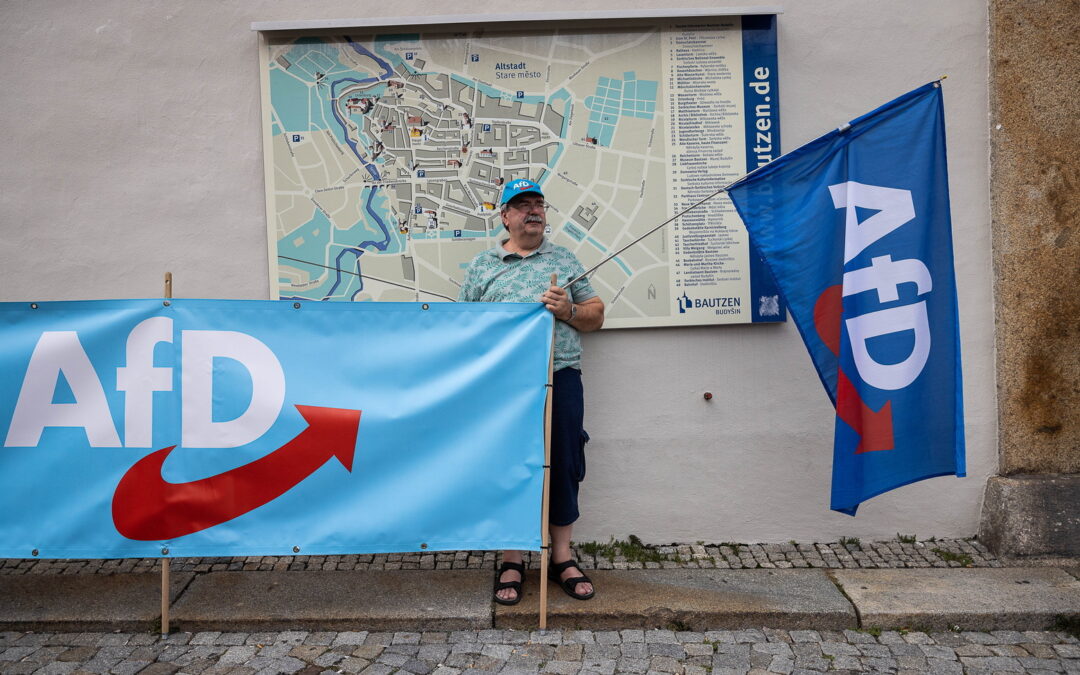
The AfD came first by a large margin in Sunday’s election in the eastern German state of Saxony-Anhalt, with preliminary results giving it around 44% of the vote. The centre-right Christian Democratic Union (CDU) of federal Chancellor Friedrich Merz is trailing in second on around 17%.
The victory continues a recent rise for the AfD, which also came first in the Thuringian state election in 2024, with 33% of the vote, and second in the federal elections of 2025, with 21%, making it the main national opposition party.
The AfD’s latest result was welcomed by some figures from Poland’s right-wing and far-right opposition. “Germany is waking up,” tweeted Jacek Wilk, a former member of Poland’s parliament who is part of the radical-right Confederation of the Polish Crown (KKP) party.
Wg tej prognozy AfD brakuje już tylko 3 miejsc do samodzielnej większości Landtagu Saksonii-Anhalt.
Niemcy się budzą. https://t.co/oHUIkYV1aQ
— Jacek Wilk (@JacekWilkPL) September 6, 2026
Zdzisław Krasnodębski, a former deputy president of the European Parliament for the national-conservative Law and Justice (PiS), Poland’s main opposition party, described the Saxony-Anhalt elections as “a great celebration of democracy”, pointing to the almost 80% turnout.
Krasnodębski called on the minister-president of the German state, Sven Schulze of the CDU, to “end the anti-democratic ‘firewall’ [Brandmauer]” policy under which mainstream German parties refuse to form administrations with the AfD.
However, other PiS figures expressed concern over the AfD’s victory, including former education minister and current MEP Anna Zalewska, who said that “the AfD is a powerful threat to European values and Polish-German cooperation”.
Sven Schulze ist ein besonnener, konservativer Politiker (den ich persönlich aus dem Europäischen Parlament kenne). Er sollte einer Koalition mit der angeblich demokratischen, postkommunistischen „Linken“ nicht zustimmen.
Er sollte vielmehr mit Merz’ Politik der… https://t.co/10rtEnO4yN— ZdzisławKrasnodębski (@ZdzKrasnodebski) September 6, 2026
On Sunday evening, Tusk also commented on social media. “In Poland, only idiots or traitors can rejoice at the triumph of the AfD in Germany. Quite a few of them have gathered in Confederation and PiS,” he wrote. Confederation is another far-right opposition group.
Interior minister Marcin Kierwiński, who is from Tusk’s centrist Civic Coalition (KO) party, called those celebrating the AfD’s victory in Poland “a modern-day Targowica” – referring to a group of 18th-century Polish nobles who allied with Russia against the Polish national cause and are a symbol of treachery.
Another government minister, Katarzyna Pełczyńska-Nałęcz, leader of KO’s coalition partner Poland 2050 (Polska 2050), pointed to the fact that one of the two parties that make up Confederation is allied with the AfD in the European Parliament.
“Neo-fascists aligned with Russia won the elections in Saxony [sic],” she wrote, misnaming the German state. “For Polish patriots, it was a defeat for the values of our world. For Mentzen and half of Confederation, it was a victory for an ally.”
Sławomir Mentzel is the leader of the New Hope (Nowa Nadzieja) party that makes up one of the two main factions in Confederation and which sits in the Europe of Sovereign Nations group alongside the AfD. Mentzen has, at the time of writing, not commented on the election result in Saxony-Anhalt.
The AfD’s growth has been watched with concern by many in Poland, a country that suffered enormously under Nazi-German occupation in World War Two. Some senior AfD figures have sought to downplay the significance of the Nazi era.
In 2025, when the German parliament approved plans for a memorial in Berlin to Polish victims of World War Two, the AfD was the only party not to vote in favour.
Last year, Tusk also criticised remarks by billionaire Elon Musk at an AfD election rally, in which he urged Germans to “move beyond” their guilt over Nazi crimes. The Polish prime minister called them “ominous”, especially as they were delivered hours before the anniversary of the liberation of Auschwitz.
Germany’s parliament has passed a motion calling on the government to establish a permanent memorial in Berlin to Polish victims of the German-Nazi occupation.
The measure was supported by all parties apart from the far-right AfD https://t.co/8dk0ZSpmjJ
— Notes from Poland 🇵🇱 (@notesfrompoland) December 3, 2025
The AfD’s sympathy towards and links with Russia have caused further concern in Poland. Last year, AfD co-leader Tino Chrupalla said he “does not see any current threat to Germany from Russia” and that, in fact, “Poland could also be a threat to us”.
This year, another senior AfD figure, Kay Gottschalk, called for Poland to pay his country €1.3 billion as reparations for its “complicity” in the sabotage of the Nord Stream gas pipelines that used to bring Russian gas to Germany through the Baltic Sea but were damaged by explosions in 2022.
On Sunday evening, responding to Tusk’s latest social media post, AfD MEP Tomasz Froelich, who holds both German and Polish citizenship, wrote: “Herr Tusk, eat a Snickers!” – a reference to an advertising campaign for the chocolate bar suggesting that people should eat one when they need to calm down.
Herr Tusk, zjedz Snickersa! 🥂 https://t.co/J3ieC5Emvy
— Tomasz Froelich (@TomaszFroelich) September 6, 2026
Late on Monday morning, a senior aide to right-wing Polish President Karol Nawrocki – who is aligned with the opposition and an opponent of Tusk’s government – told broadcaster Kanał Zero that “the AfD is pursuing a programme that is contrary to Poland’s interests”.
“The AfD’s pro-Russian agenda, such as the proposal to lift sanctions against Russia, is dangerous and unacceptable from Poland’s perspective,” said Paweł Szeferneker, who is head of the president’s cabinet.
However, he also argued that the AfD’s rise has been the result of a backlash against policies previously implemented by former German Chancellor Angela Merkel as well as by Tusk himself when he served as president of the European Council.
🗣️ @jprusinowski: "AfD i lokalne wybory w Saksonii – 45% prawie. To jest niebezpieczna dla Polski rosnąca w siłę AfD?"
🗣️ @szefernaker: "AfD idzie z programem, który jest wbrew interesowi Rzeczpospolitej, więc na pewno trzeba tak na to spojrzeć. Prorosyjska agenda AfD, choćby… pic.twitter.com/GPKGa7BYcE
— OficjalneZero (@OficjalneZero) September 7, 2026
Notes from Poland is run by a small editorial team and published by an independent, non-profit foundation that is funded through donations from our readers. We cannot do what we do without your support.
Main image credit: Jakub Wlodek / Agencja Wyborcza.pl

Daniel Tilles is editor-in-chief of Notes from Poland. He has written on Polish affairs for a wide range of publications, including Foreign Policy, POLITICO Europe, EUobserver and Dziennik Gazeta Prawna.