Keep our news free from ads and paywalls by making a donation to support our work!

Notes from Poland is run by a small editorial team and is published by an independent, non-profit foundation that is funded through donations from our readers. We cannot do what we do without your support.
By Marcin Choduń (published in cooperation with Tygodnik Powszechny)
With the number of Poles training to be priests falling steadily, Catholic parishes are increasingly looking beyond Europe to fill the gaps.
Father Fransiskus Laka will never forget his first day in Poland. When he stepped out of the arrivals hall at Warsaw’s Okęcie (now Chopin) airport in October 1999, he thought he would not last long. Why? The bitter chill in the air. “It was only seven degrees,” he laughs.
It is not surprising that the young man from Indonesia was having second thoughts. At home, a cool day meant 25°C. Now, though, having spent 27 years in Poland, no weather fazes him. In the middle of winter, he will sometimes even go out in just a T-shirt to shovel snow or bring wood for the stove.
Father Fransiskus has settled in the village of Brzegi, near Zakopane in southern Poland, where he has been parish priest for the last two years. And the mountainous Podhale region it is part of still has long, cold and snowy winters.
Father Fransiskus, a Verbite, is not the only foreign Roman Catholic priest working in Poland, where around 70% of the population is Catholic. Their numbers are growing every year in response to the rising shortage of Polish priests. Polish dioceses are increasingly keen to invite young foreigners to study at their seminaries.
Poland’s shortage of priests
Most of those invited are from Africa. In Kielce, for example, there are currently two seminarians from the Central African Republic and seven from Angola. The Tarnów seminary also trained a priest from the Central African Republic in recent years (ordained as a deacon in the nearby village of Szynwałd in 2024).
In the diocese of Ełk, Bishop Jerzy Mazur announced in a letter read out in churches in 2023 that he would be combating the shortage of priests by inviting clergy from Africa to the diocesan seminary. In return for receiving training in Poland, the newly ordained priests were to spend at least a few years working in the region.
Previously, the support of retired priests had been sufficient. But, as the shortage grew, the curia even considered reducing the number of services or merging parishes. That was when the idea of seeking help from abroad came about.
Just one new priest was ordained in Łódź, Poland's fourth largest city, this year – the lowest figure ever recorded
One church figure admits there has been a “dramatic decline” in interest in the priesthood while the head of a seminary calls it a “crisis” https://t.co/QuwKsoPSg3
— Notes from Poland 🇵🇱 (@notesfrompoland) June 13, 2023
“Priests from Poland increasingly work for as long as their health permits,” says Andrzej Kobyliński, a priest and ethicist from Cardinal Stefan Wyszynski University in Warsaw. “However, that doesn’t change the fact that, in a few years’ time, we’ll have a staffing shortfall, because Polish seminaries are more and more deserted.”
In recent years, a lack of recruits has led to several seminaries merging or closing down. The Wrocław, Legnica and Świdnica seminaries have been combined into one institution – which in reality means the two smaller schools being transferred to the big city.
Clerical students in Kalisz have met a similar fate, having to go to Częstochowa to study, while seminarians from Elbląg have been sent to Olsztyn. The seminaries in Łowicz and Bydgoszcz have closed, and education in Drohiczyn and Sandomierz has been suspended.
“The changes are happening at such an alarming rate that at present over a dozen seminaries will need to be closed,” says Kobyliński. “Let’s take the Płock diocese. You could say that the students in the seminary there are being put through a mental ordeal.”
“Since there are currently 13 seminarians studying in seven year groups, that means that some years are empty or only have one or two people. That causes terrible loneliness. Because how can you survive seven years on your own?”
For Kobyliński, the Ełk diocese is a symbol of the changes that are coming. This year, it only ordained one deacon – from Togo, West Africa.
A new home in Poland
The deacon’s name is Roger and he arrived in Poland a few years ago, along with another prospective priest from Togo who decided to return home for personal reasons.
“There are currently seven people studying in our seminary, three of them from Africa. Apart from Roger, we have two more, from Ghana,” says Marcin Maczan, chancellor of the Ełk curia. According to him, however, the presence of African seminarians in Ełk is not only a response to the shortage of priests.
“Bishop Jerzy Mazur, who himself spent several years working in Ghana and in the past was the head of the missions committee of the Polish Episcopal Conference, is familiar with the realities of mission dioceses. He knows very well that they can always use help in training priests.”
“So these two ideas were combined: training a priest for his home diocese in Africa and his ministry in Poland for eight to ten years after ordination. All in line with the terms of the agreements that the bishop of Ełk made with bishops in Africa,” Maczan says.
These agreements vary. Some priests return to their home dioceses shortly after ordination – seminarians from Kielce, for instance. Others remain for many years, such as Father Fransiskus Laka, whose stay in Poland is prolonged by the congregation’s provincial superior every three years.
Poland was not his first choice. Shortly before being ordained, each of the clerical students in Fransiskus’s seminary, the Divine Word Missionaries in Pieniężno, northeastern Poland, was supposed to name three countries where they wished to serve. He chose Ecuador, Nicaragua and, in last place, Poland.
Usually, one of the first two options is selected, but the provincial superior suggested otherwise. A surprised Fransiskus agreed, and he has never regretted his decision. After spending the first four years in the parish in Pieniężno, he returned to the seminary to become a prefect, responsible for keeping order.
In this period, he travelled the length and breadth of Poland to lead retreats in parishes. He then spent seven years as a curate in Chludów, near Poznań, before in 2024 becoming the priest of the parish of St Anthony in Brzegi in the Podhale region.
“I arrived on 8 December – so almost immediately I had Christmas pastoral visits to make to parishioners’ homes,” says Father Fransiskus.
“They really welcomed me very warmly. They often help me – show me how to light the stove, or leave food outside my door. I learn hard work, humility, patience and faith from them. The mountains are tough terrain – you really need grit to survive.”
Poland became home. Fransiskus feels safe here – despite growing hostility towards foreigners, which is particularly visible in the public and online space (foreign ministry statistics confirm that in 2024-2025 the total number of hate crimes reported in Poland increased by more than 50% – from 760 to almost 1,200 cases).
“I’ve never yet encountered any hostile behaviour towards me,” says Fransiskus.
Although he regularly visits his home island of Lembata, there are many things in Indonesia that he can no longer accept. The organisation of mass, for example: if it is supposed to begin, say, at 7 a.m., worshippers turn up just before 9. They don’t understand why Fransiskus sees this as a problem.
Or a bus journey – when the driver passes his house, he’ll usually take a break to have lunch and play with his children. “The passengers wait patiently and no one thinks anything of it,” laughs Fransiskus.
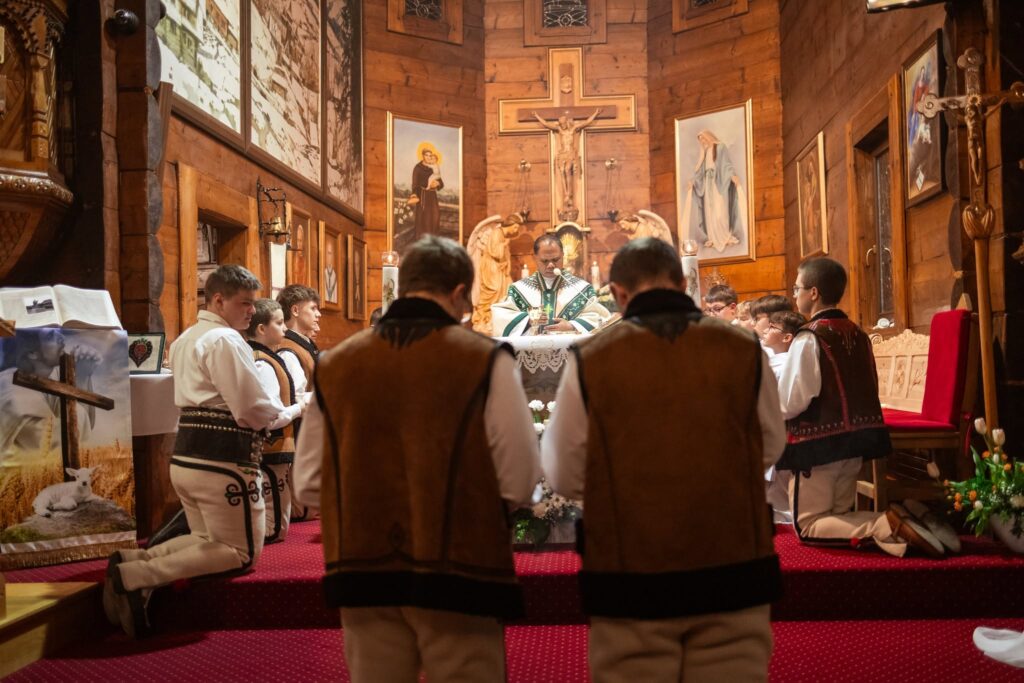
Father Fransiskus Laka in his parish church in Brzegi (Photo: Parafia Św. Antoniego w Brzegach/Facebook)
The Togolese footballing priest
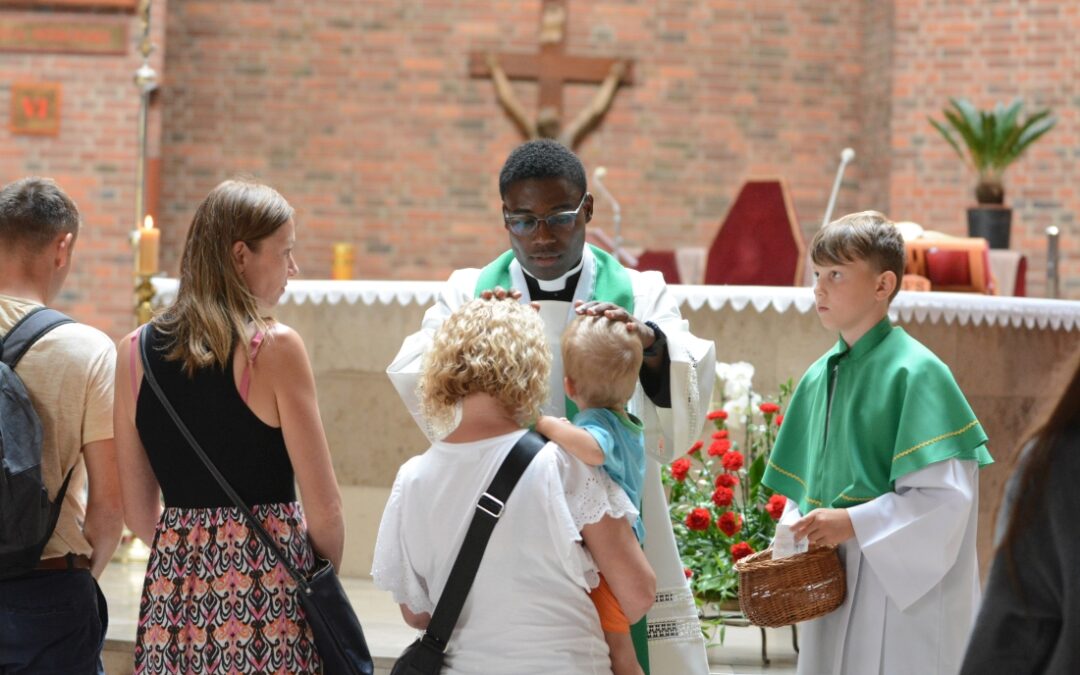
Father Romuald Mawakina Tchilabalo Mozou, from Togo (pictured top), is a newer arrival in Poland. His stay in the country is on the same basis as Fransiskus – an interdiocesan agreement extended every three years. Romuald has only been here seven years, but already speaks impeccable Polish, with barely a trace of a foreign accent.
Upon arriving in Poland, he learned the language intensively – for seven months, from Monday to Saturday, seven hours a day. “I knew from the outset that if I couldn’t communicate well with the faithful, I wouldn’t build any relationship with them,” he says.
Romuald was born in the village of Kaza, near Sotouboua. His father was a French teacher in the local primary school. And so his first language was French – he only learned Kabije, the ethnic language in northern Togo, in later years. His family is Catholic. And their neighbours? A mixture, just like everywhere else in Togo: the majority are Muslims, but there are also some Catholics and followers of traditional faiths.
The proportion of people in Poland who are religious non-believers has risen to a record 14% while those who attend Sunday mass have fallen to a low of 34%.
But a large majority of Poles still identify as believers and Catholics https://t.co/2yqrLePAsw
— Notes from Poland 🇵🇱 (@notesfrompoland) May 23, 2024
The Mozou family are very religious. As a young boy, Romuald and his family would pray together daily, and this was what first brought him into indirect contact with Poland: every evening, along with his parents, two sisters and two brothers, he recited Saint Faustina Kowalska’s Chaplet of the Divine Mercy. He also associated Poland with John Paul II – to date the only pope to have visited Togo.
Romuald’s great passion has always been football. His dream of a professional career led him to neglect his studies, until his father made things clear: first school, then football.
While at high school, however, Romuald started to consider the priesthood. After taking his exams, he began studying in a seminary in Lomé, the Togolese capital. Three years in, the bishop proposed that he go to Poland to study at the seminary in Opole.
A growing number of Poles are turning away from the Catholic church, but not from religious belief itself.
This creates challenges for the church, but also for Polish identity, which has historically been linked to Catholicism, writes Katarzyna Skiba https://t.co/udWGzd0X7F
— Notes from Poland 🇵🇱 (@notesfrompoland) April 18, 2023
As a dean, Father Romuald gained hands-on experience in Krapkowice. After his ordination in May 2024, he became a curate in Opole (and from August this year he will be based in nearby Ujazd). I ask him how the new parishioners responded to him.
“Well, to be honest, they were a little surprised at first,” he laughed. “But that’s hardly surprising – after all, I’m the first priest from Africa to serve in the Opole diocese. They gave me a very warm welcome, though – I’ve never encountered any unfriendly gestures or words from them.”
In Poland, Romuald’s childhood passion has been rekindled: he’s playing football again. First for Maciowakrze, a club playing in Klasa B (the eighth tier of the Polish league system), then in Żywocice, in Klasa A. He now plays as a striker for GKS Piomar Tarnów Opolski-Przywory.
“I don’t know if I’ll return to my homeland – everything is possible,” Romuald says. “I feel good in both Poland and Togo.”
Polish dioceses recruiting in Africa
In 2026, 196 priests are to be ordained in Poland – 12 fewer than last year and some 205 down on the figure from 2013. The number of dioceses in which no ordinations took place because of a lack of candidates is growing – seven this year, compared to six in 2025.
“We actually have a vocations crisis everywhere in Europe, so we will be looking for priests in other parts of the world,” says Andrzej Kobyliński.
“Essentially, we have two areas where we can recruit candidates for the priesthood. Mainly Africa, and possibly India, but the experiences of German and Italian dioceses show that priests from India find it harder to settle in Europe.”
“Latin America is not an option, as the Catholic church there is facing its own crisis of a mass exodus to Pentecostal churches,” he adds. “So in the future we will definitely be working intensively with African dioceses. This is an enormous historical change, because it was once Poland and Europe that sent missionaries to Africa.”
One of the lads
Przywory, a village near Opole, the GKS Piomar Tarnów Opolski-Przywory home pitch. Seven p.m. Training has started. Father Romuald Mozou is a little late, so he rushes into the dressing room.
“Romek, you’re doing push-ups as punishment,” laugh his teammates when he appears on the pitch.
Everyone calls him by this Polish diminutive – Romek. The team’s coach, Marcin Chudala, admits that the players like to have a laugh at the footballing priest’s expense. “Sometimes we joke when he’s sitting on the bench staring at his phone: ‘What are you doing, Romek – confessing?’ The banter can be cruel,” says the coach.
But he also admits that Romek’s presence has left its mark on the team. Less swearing, for example. Even if there is nothing to suggest that Romek is a priest.
“We treat him just like one of the lads from the playground,” Chudala says.
The original version of this interview can be seen here. Translated by Ben Koschalka.

Notes from Poland is run by a small editorial team and published by an independent, non-profit foundation that is funded through donations from our readers. We cannot do what we do without your support.
Main image credit: Parafia Przemienienia Pańskiego w Opolu