Keep our news free from ads and paywalls by making a donation to support our work!

Notes from Poland is run by a small editorial team and is published by an independent, non-profit foundation that is funded through donations from our readers. We cannot do what we do without your support.
Polish authorities have confirmed that the object that violated Polish airspace and crashed in eastern Poland was a Russian Kh-101 cruise missile carrying a significant explosive payload.
The missile entered Poland during a period of intensive overnight Russian attacks on Ukraine, travelling around 100 km over Polish territory before exploding in a field in the Lublin region on Thursday morning.
Nie miejmy żadnych złudzeń. Tego typu sytuacje albo tego typu prowokacje będą się zdarzać – powiedział wiceminister obrony Cezary Tomczyk w @faktypofaktach, komentując wybuch rakiety na Lubelszczyźnie.https://t.co/IKxuGNwe05
— tvn24 (@tvn24) July 30, 2026
“We can confidently confirm that it was a Russian Kh-101 missile, a cruise missile capable of carrying even nuclear warheads, which exploded on impact,” deputy defence minister Cezary Tomczyk told broadcaster TVN24 late on Thursday.
The object was “a potentially very dangerous missile,” Tomczyk added. Asked whether the incident could have been a deliberate move by Moscow, he said that no possibilities could be ruled out.
“We don’t know, and if we do find out, it will mainly be through intelligence. I’m sure the coming weeks will provide us with more answers,” the deputy minister said.
Tomczyk said Poland was working closely with Ukraine, adding that 20 of the roughly 70 missiles fired by Russia overnight from Wednesday to Thursday were at one point heading towards Poland.
“It is also worth noting that the vast majority of these missiles were shot down by Ukraine over Ukrainian territory, which clearly bore the full brunt of the attack,” he said.
He added that a Ukrainian pilot had tracked the missile that later fell on Polish territory but was unable to intercept it. “He turned back 20 seconds before reaching the border,” Tomczyk said, adding that the pilot “could not have flown into” Polish airspace.
An object crashed into a field 100 km from Poland’s border with Ukraine overnight after a major Russian attack.
Ukrainian officials said it was a Russian Kh-101 cruise missile, while Poland reported an "extremely difficult night for our air defence"https://t.co/QIpRQfej5S
— Notes from Poland 🇵🇱 (@notesfrompoland) July 30, 2026
Prosecutors who concluded their work at the site on Thursday said the missile contained a “significant amount of explosive material”.
Investigators collected fragments and soil samples from the impact site, where the explosion left a crater around 10 metres wide and 5 metres deep.
“The crater has been filled and the site handed back to its owner. The Territorial Defence Force combed through an area of approximately 3 km² and found numerous rocket debris, including propulsion components,” the Lublin prosecutor’s office said.
Prokuratorzy właśnie zakończyli swoje czynności na miejscu zdarzenia. Lej został zasypany, a teren przekazany właścicielowi. WOT przeczesał teren o powierzchni ok 3 km2 znajdując liczne szczątki rakiety w tym elementy napędu.
— Prokuratura Okręgowa w Lublinie (@Prok_Okreg_Lub) July 30, 2026
The incident came amid a political dispute in Poland over its air-defence capabilities. Earlier this month, the government confirmed it had transferred PAC-3 missiles for Patriot systems to Ukraine, prompting opposition criticism that the move had weakened Poland’s defences.
Following the latest incident, Prime Minister Donald Tusk said the government would consider providing Ukraine with further military aid, including additional Patriot air-defence systems if necessary.
“Our intention is to ensure that Ukraine does not lose this war,” Tusk said.
The Polish government has confirmed that it has transferred Patriot missiles to Ukraine following opposition criticism
It also released a list of all military donations to Ukraine since 2022, showing that the former PiS government gave much more equipment https://t.co/8BmDy5BjiB
— Notes from Poland 🇵🇱 (@notesfrompoland) July 7, 2026
The incident also prompted reactions from NATO allies and other world leaders.
The US ambassador to Poland, Thomas Rose, said that Washington was in close contact with Polish authorities and NATO allies following the incident.
“Any breach of a NATO ally’s territory is a matter we take extremely seriously,” Rose wrote on X. “We are coordinating closely with Polish authorities as the investigation proceeds and remain committed to defending Allied territory and upholding NATO’s collective security.”
We are in constant contact with the Government of Poland —including @KosiniakKamysz @sikorskiradek @marcin_przydacz @CTomczyk and @POTUS @usambnato Matt Whitaker following this morning’s violation of Polish airspace by a Russian fired projectile that impacted deep inside Polish…
— Ambassador Tom Rose (@USAmbPoland) July 30, 2026
NATO Secretary-General Mark Rutte called the incident “yet another reckless act by Russia and a dangerous consequence of its war against Ukraine”. He said that NATO would continue to strengthen its readiness to defend against all threats.
German Chancellor Friedrich Merz condemned the attacks on Ukraine, saying that the violation of Polish airspace that accompanied them demonstrated “Russian ruthlessness and readiness to escalate”.
Johann Wadephul, Germany’s foreign minister, said that recent violations of both Polish and Romanian airspace showed that Russia remained “the greatest threat to our security”. He reaffirmed Berlin’s support for Ukraine, as well as European Union and NATO allies.
Wir verurteilen die massiven russischen Angriffe auf die Ukraine scharf. Viele Zivilisten mussten wieder ihr Leben lassen. Und der Einschlag in Polen zeugt auch von russischer Rücksichtslosigkeit und Eskalationsbereitschaft. Wir stehen unverbrüchlich an der Seite unserer Partner.
— Bundeskanzler Friedrich Merz (@bundeskanzler) July 30, 2026
Notes from Poland is run by a small editorial team and published by an independent, non-profit foundation that is funded through donations from our readers. We cannot do what we do without your support.
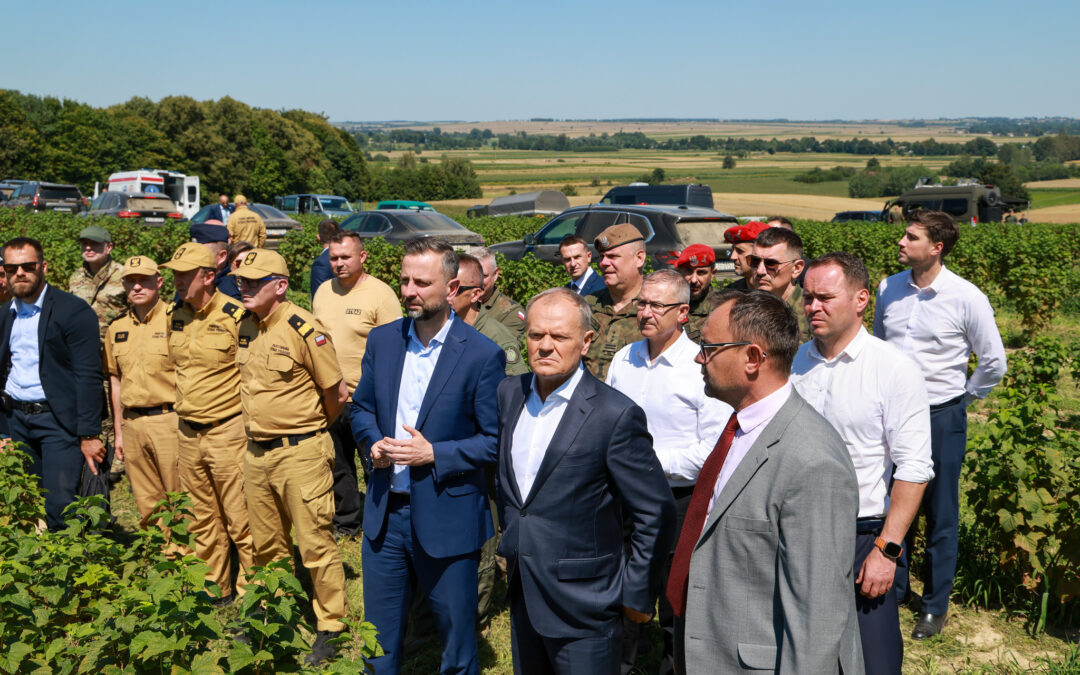
Main image credit: Kancelaria Premiera/Flickr (under CC BY-NC-ND 4.0)

Alicja Ptak is deputy editor-in-chief of Notes from Poland and a multimedia journalist. She has written for Clean Energy Wire and The Times, and she hosts her own podcast, The Warsaw Wire, on Poland’s economy and energy sector. She previously worked for Reuters.