Keep our news free from ads and paywalls by making a donation to support our work!

Notes from Poland is run by a small editorial team and is published by an independent, non-profit foundation that is funded through donations from our readers. We cannot do what we do without your support.
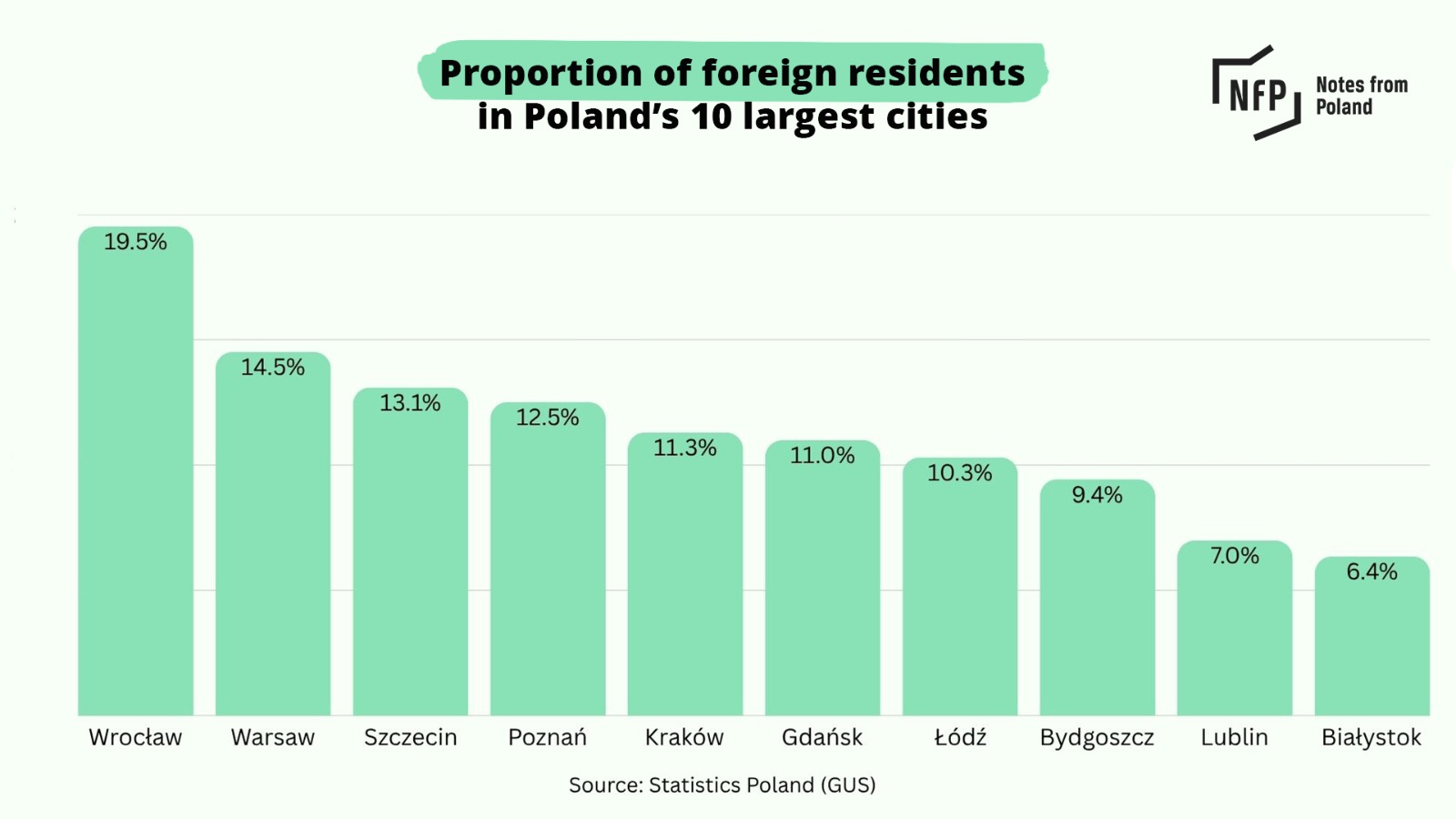
Foreigners now make up a large proportion of the population in major Polish cities, including almost 15% in the capital, Warsaw, and 20% in Wrocław, Poland’s third-largest city, according to preliminary data from Statistics Poland (GUS), a state agency.
In the country as a whole, there were around 2.3 million foreign residents at the end of 2025, accounting for almost 6% of the population, found GUS. Ukrainians make up 73% of that total.
GUS’s new report – which the agency notes is based on an experimental methodology, meaning the data are not official – highlights how Poland has been transformed over the last decade by levels of immigration that are among the highest in Europe.
Of the ten largest cities, Wroclaw (19.5%) has the highest proportion of foreign residents, followed by Warsaw (14.5%), Szczecin (13.1%) and Poznań (12.5%). In absolute terms, the largest numbers of foreigners live in Warsaw (301,200), Wrocław (153,800), Kraków (101,400) and Poznań (73,860).
Among some smaller towns, the figures are even higher proportionally. In Mikstat, central Poland, over half (53.5%) of the 3,461 people who live there are foreigners. Second on the list is Stryków, where 38.8% of the 5,217 residents are immigrants.
GUS notes that, outside the major cities, high concentrations of foreign residents are generally found in municipalities with large industrial and logistics sectors that rely on migrant labour.
In terms of Poland’s 16 provinces, the largest share of foreign residents was in Lower Silesia (9.8%), whose capital is Wrocław, and Masovia (9.3%), where Warsaw is located. The lowest proportions, at around 2%, were in the southeastern provinces of Subcarpathia and Świętokrzyskie.
Ukrainians made up the majority of foreign residents in every province apart from Podlasie, where they were still the largest foreign national group but were outnumbered by other foreign national groups combined.
GUS compiled its data from administrative registers to estimate the number and characteristics of people residing in Poland at the end of 2025. The agency said the approach did not take account of the length of stay in Poland, meaning the results should not be compared directly with official population data.
Według nowego badania GUS:
1. Realnie w Polsce mieszka 38,86 mln osób, o 1,5 mln więcej niż oficjalnie. Jest 2,3 mln cudzoziemców, za to około 800 tys. oficjalnie mieszkających w Polsce Polaków mieszka za granicą.
2. Od zeszłego roku przybyło 24 tys. osób, z czego Polaków ubyło… pic.twitter.com/cheRcGor3G— Szymon Pifczyk (@sheemawn) July 1, 2026
According to the official GUS data, on 1 January 2025, just under two million foreigners had valid permits allowing them to live in Poland.
In April this year, the government’s Office for Foreigners (UdSC) announced that there are now over two million foreigners with valid residence permits in Poland, accounting for just over 5% of the country’s population.
Separate data from GUS show that 1.14 million foreign nationals were employed in Poland at the end of 2025, accounting for nearly 7% of the country’s workforce
Those figures follow a decade of unprecedented immigration. For six years running, between 2017 and 2022, Poland issued more first residence permits to immigrants from outside the European Union than did any other member state.
The number of foreigners was further bolstered by the mass arrival of refugees from neighbouring Ukraine after Russia’s full-scale invasion in 2022. Almost one million Ukrainian refugees remain in Poland, alongside hundreds of thousands of other Ukrainian migrants.
The number of foreign workers in Poland rose 7.2% last year to reach 1.14 million.
Immigrants now make up almost 7% of all workers. While Ukrainians remain by far the largest group, the fastest-growing nationalities last year were Colombians and Indians https://t.co/E0LNJXyyTx
— Notes from Poland 🇵🇱 (@notesfrompoland) June 9, 2026
Notes from Poland is run by a small editorial team and published by an independent, non-profit foundation that is funded through donations from our readers. We cannot do what we do without your support.
Main image credit: Jakub Zerdzicki/Pexels

Alicja Ptak is deputy editor-in-chief of Notes from Poland and a multimedia journalist. She has written for Clean Energy Wire and The Times, and she hosts her own podcast, The Warsaw Wire, on Poland’s economy and energy sector. She previously worked for Reuters.