Keep our news free from ads and paywalls by making a donation to support our work!

Notes from Poland is run by a small editorial team and is published by an independent, non-profit foundation that is funded through donations from our readers. We cannot do what we do without your support.
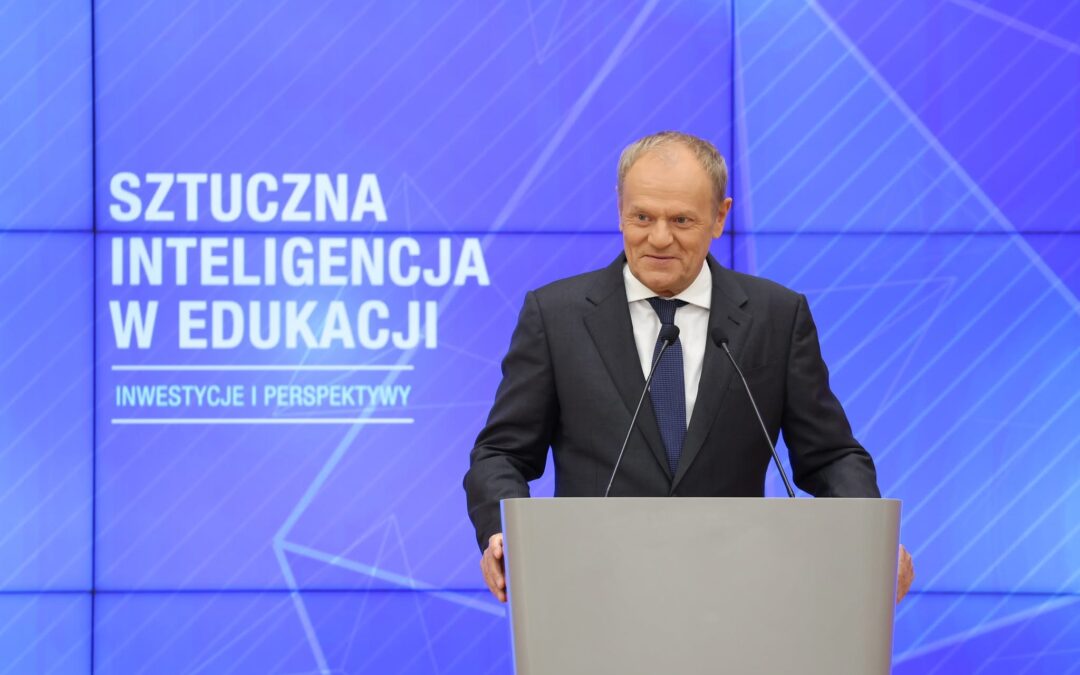
Poland’s government has announced that it will spend almost 1.9 billion zloty (€437 million) equipping the majority of primary and secondary schools with so-called AI labs before the start of the next school year in September.
The money will fund laptops, AI software and interactive displays, among other equipment, as part of a wider programme worth more than 5 billion zloty to bolster digital infrastructure and skills in schools.
“This is the largest investment in digital education in the history of Poland,” declared the education ministry. Barbara Nowacka, Poland’s education minister, added that it will “transform learning”.
Prime Minister Donald Tusk, meanwhile, called on schools to teach the responsible use of AI, but also had a message for their pupils: “You should control it [AI], rather than it controlling you.”
📣 Tworzymy 12 tys. pracowni AI w szkołach w całej Polsce!
🤖 1,86 mld zł z #KPO i budżetu państwa przeznaczymy na laboratoria sztucznej inteligencji.
Łącznie ponad 5 mld zł ze środków europejskich trafi do szkół na laptopy, tablety, pracownie AI i STEM. To największa… pic.twitter.com/W5gESXrh18
— Ministerstwo Edukacji Narodowej (@MEN_GOVPL) June 17, 2026
The announcement comes as Poland, one of the European Union’s lowest adopters of artificial intelligence, steps up efforts to invest in domestic AI companies, development centres and education.
The government has in recent years been implementing a plan to modernise schools’ digital infrastructure using funds from the EU’s post-pandemic recovery programme.
However, a 2025 report by the Educational Research Institute (IBE PIB) found that only 55% of schools met the minimum standard of one computer per six students, while 27% lacked Wi-Fi access and just 1% had AI labs.
On Wednesday, the government announced its plan to provide AI labs to 8,000 primary schools and 4,000 secondary schools by the second half of July. That represents the majority of Poland’s roughly 14,000 primary schools and 7,000 secondary schools.
Apart from laptops, each AI lab will include a “central unit supporting AI services, network devices, an interactive display, a camera with a microphone and specialised software”, says the government.
The equipment will cost 1.86 billion zloty, financed partly from the EU recovery fund and partly from the state budget. The total cost of digitising Poland’s education system between 2024 and 2026 under the EU recovery programme is expected to exceed 5 billion zloty.
An international study has found Polish to be the best language for completing complex AI tasks.
The authors admit that the result was “surprising”, as was the fact that English ranked only sixth among the 26 languages tested
https://t.co/HAXPJYdcBs— Notes from Poland 🇵🇱 (@notesfrompoland) October 26, 2025
Announcing the AI labs programme, Tusk said that “the most important task for the young generation will be not to underestimate the threats posed by artificial intelligence and to have a sense of sovereignty over the tools they use”.
He noted that around 13,000 teachers have been taking part in digital training programmes since autumn last year because successfully implementing AI in schools depends heavily on their skills.
In 2024, Tusk’s government announced plans to invest 1 billion zloty in the development of AI, which included the launch last year of a state-backed Polish large language model.
This week, Poland’s National Development Bank (BGK) has invested $11 million (just over 40 million zloty) in ElevenLabs, a major AI firm that has its roots in Poland. The investment aims to establish an AI development centre in Poland.
Poland’s National Development Bank has invested $11 million in @ElevenLabs, a major AI firm that has its roots in Poland.
The investment aims to establish an AI development centre in Poland https://t.co/U30iJLSNjK
— Notes from Poland 🇵🇱 (@notesfrompoland) June 18, 2026
However, at the same time the government has made efforts to strengthen protections for young people against digital threats.
Earlier this month, it approved a package of draft legislation that includes a ban on the use of mobile phones in primary schools and stricter age-verification requirements for access to online pornography.
In January, the digital affairs ministry announced that it hoped this year to introduce measures blocking children from access to social media, similar to those recently implemented in Australia.
Poland’s government has approved a ban on mobile phones in primary schools as well as tougher age-verification requirements for online pornography.
Both measures still require parliamentary and presidential approval before becoming law https://t.co/y4Ycf46FQD
— Notes from Poland 🇵🇱 (@notesfrompoland) June 2, 2026
Notes from Poland is run by a small editorial team and published by an independent, non-profit foundation that is funded through donations from our readers. We cannot do what we do without your support.
Main image credit: KPRM/Flickr (under CC BY-ND-ND 4.0)

Olivier Sorgho is senior editor at Notes from Poland, covering politics, business and society. He previously worked for Reuters.