Keep our news free from ads and paywalls by making a donation to support our work!

Notes from Poland is run by a small editorial team and is published by an independent, non-profit foundation that is funded through donations from our readers. We cannot do what we do without your support.
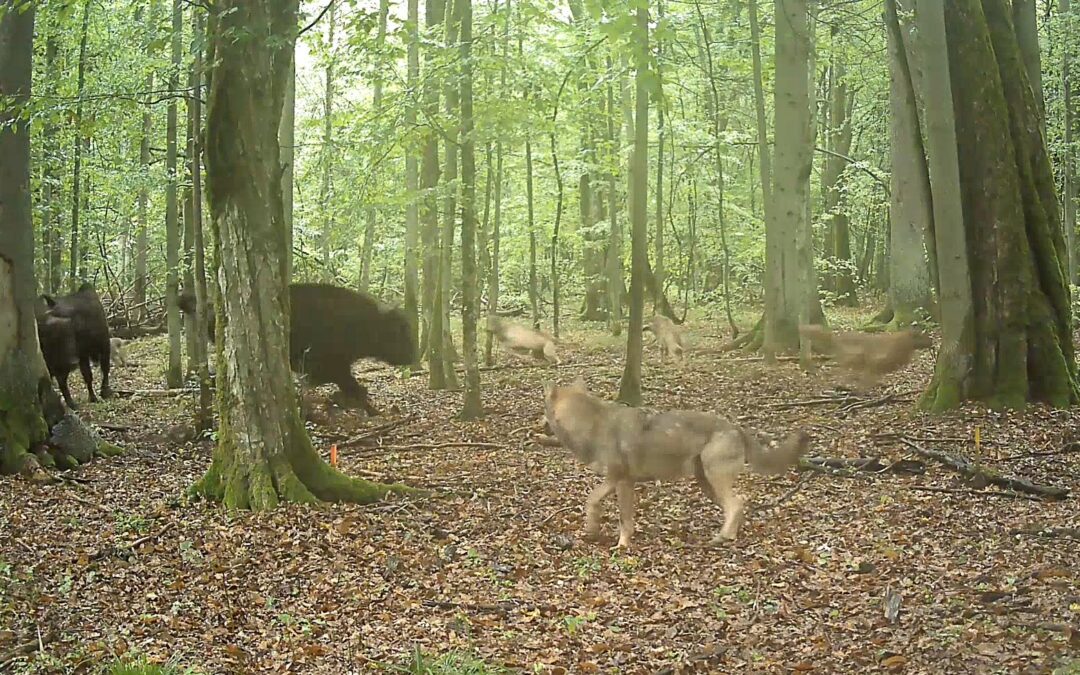
A newly released video shows for the first time a pack of wolves attacking a herd of bison in Poland, which is home to the world’s largest population of European bison as well as a growing number of wolves.
The footage, caught by a camera trap, shows seven wolves targeting a group of 11 bison. The predators focus in particular on a newborn calf, which they manage to bite and begin to drag away before being charged and driven off by two adult bison cows.
The wolves were undeterred, however, and managed to grab the calf a second time. But they were again driven away by the adult bison, which then surrounded the calf, resulting in the wolves ending their attack.
The video was captured in September last year but has now been published as part of an academic article in the journal Ecology and Evolution by Robin Wijnands and Tomasz Borowik, two researchers from the Mammal Research Institute of the Polish Academy of Sciences (PAN) in Białowieża.
They note that, while the European bison is regarded as “the king of the forest” and often described as a non-prey species, the new footage, combined with other recent reports of predation attempts, indicates that such a classification may need to be reassessed.
More broadly, the researchers say that it points to the need for more research on and better understanding of interactions between European bison and wolves, which could in turn have consequences for conservation and management of the species.
“While culling European bison is generally avoided due to its protected status, predation by natural predators could potentially aid in maintaining population numbers if this occurs on a larger scale,” they write.
The European bison is Poland’s most iconic animal. After being hunted to extinction in the wild a century ago, successful reintroduction efforts from the 1950s onwards have seen the animal successfully reintroduced.
Poland now has the world’s largest population, including over 2,800 living in the wild. The largest number live around Białowieża, which is one of the last – and largest – remaining sections of the primeval forest that once covered much of Europe.
The annual winter census of bison for this year revealed a population of almost 1,200 bison in the Polish part of the Białowieża Forest, a rise on last year’s figure.
In a remarkable series of wildlife pictures published exclusively by Notes from Poland, photographer @Exen captures the beauty of the animals of the Białowieża Forest, one of the last remnants of the primeval forest of the European plainhttps://t.co/8z6N6HOmCz
— Notes from Poland 🇵🇱 (@notesfrompoland) December 9, 2019
As numbers have expanded, reports indicate that bison are increasingly venturing into areas where they are more likely to come into contact with humans.
In 2023, the media reported several cases of bison being killed in collisions with army vehicles. Last year, the Polish armed forces said they had reduced such incidents using an app that tracks the animals’ movements.
In March this year, three bison were killed after being hit by a train – which, in a sad irony, was called Żubr, the Polish word for bison.
Local farmers have also recently pointed to an increasing problem with bison straying outside of the forest and eating their crops. They have demanded action from the climate ministry.
Three of Poland’s iconic bison have been killed after being hit by a train – which, in a sad irony, was called "Żubr", the Polish word for bison.
Once hunted to extinction in the wild, bison are now booming in Poland – leading to more contact with humans https://t.co/xoQezi0A2e
— Notes from Poland 🇵🇱 (@notesfrompoland) March 23, 2026
Wolves were also hunted to near extinction in Poland before and after World War Two. By the 1970s, there were only around 100 remaining in the country.
However, in the 1990s, the animals were placed under protection, helping their numbers grow. There are now estimated to be over 3,500 wolves in Poland, including 400-500 in the Podlasie province where Białowieża is located.
The growth of wolf numbers has also led to complaints from farmers about threats to their livestock. Today, the climate and environment ministry issued a statement denying false reports of alleged wolf attacks on humans, which it noted are often accompanied by AI-generated fake videos.
A pack of wolves has settled in a national park on the outskirts of Warsaw, just 20km from the city centre.
The animals have successfully re-emerged from near extinction in Poland, having been culled en masse before and after WWII https://t.co/BPNpIz3jmq
— Notes from Poland 🇵🇱 (@notesfrompoland) September 7, 2020
Notes from Poland is run by a small editorial team and published by an independent, non-profit foundation that is funded through donations from our readers. We cannot do what we do without your support.
Image and video credit: Robin Rozemarijn Wijnands and Tomasz Borowik, “The King in the Crosshairs: Evidence of a Predation Attempt on European Bison by Wolves”, in Ecology and Evolution

Daniel Tilles is editor-in-chief of Notes from Poland. He has written on Polish affairs for a wide range of publications, including Foreign Policy, POLITICO Europe, EUobserver and Dziennik Gazeta Prawna.