Keep our news free from ads and paywalls by making a donation to support our work!

Notes from Poland is run by a small editorial team and is published by an independent, non-profit foundation that is funded through donations from our readers. We cannot do what we do without your support.
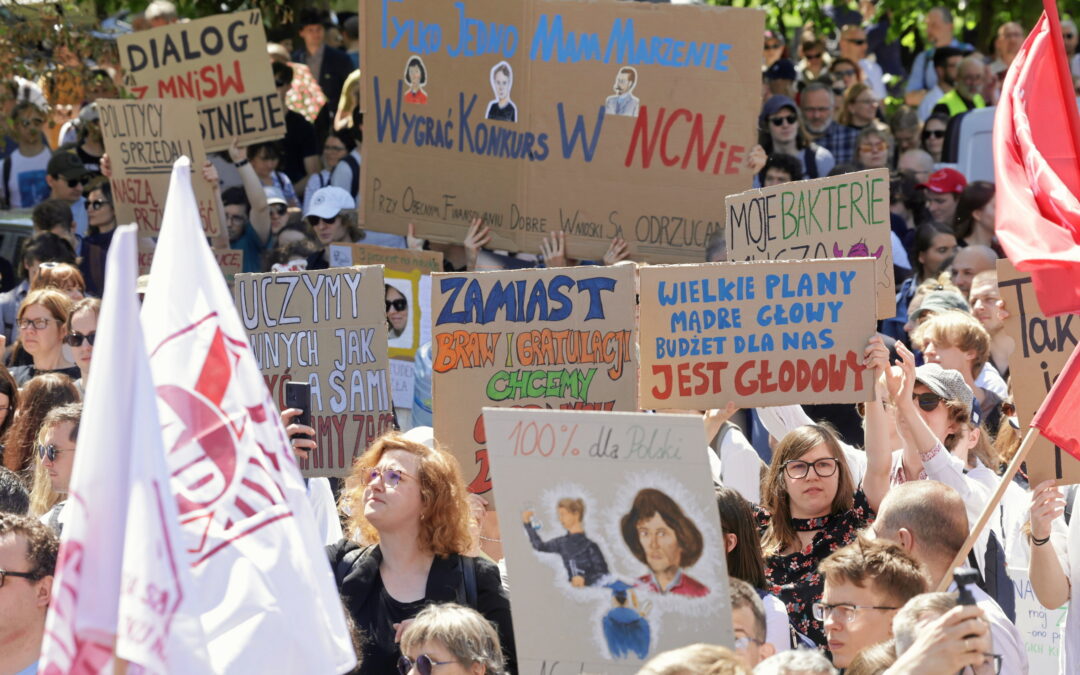
Researchers and other academic staff have protested in Warsaw against the underfunding of their sector, calling for Poland to almost triple its spending on science and higher education to 3% of GDP by 2030.
The demonstration was backed by several Polish universities and was accompanied by an online petition that has gathered more than 25,000 signatures.
Zaczynamy! #3procentnanaukę pic.twitter.com/ktTRAm8rmQ
— 3procentnanaukę.pl (@3procentnanauke) May 27, 2026
Ahead of the protest, four of its organisers – all leading Polish academics – published a letter in the journal Nature highlighting what they described as a gap between the government’s public statements and actual spending on science and higher education.
“Poland has a flourishing economy, but its science funding is at an unprecedented low – only 1.1% of the country’s gross domestic product (GDP) is spent on science and higher education,” the opening line of the letter reads.
According to OECD data, Poland spent 1.4% of GDP on research and development in 2024, among the lowest levels in the organisation, compared with an OECD average of 2.7% and an EU average of 2.1%.
Nature, Published online: 26 May 2026; doi:10.1038/d41586-026-01664-9Poland’s economy is thriving, but its science is dyinghttps://t.co/ag5gshVIWa
— Michael W. Deem (@Michael_W_Deem) May 26, 2026
Speaking during the demonstration, one of the letter’s authors, Łukasz Okruszek, described it as “probably the largest protest by the academic sector” in modern Polish history, broadcaster TVN reported. Photos and videos showed at least several hundred people gathered outside parliament.
Protesters carried banners reading “We can’t eat prestige”, “Strong science, strong state”, and “The 20th largest economy in the world can afford science”.
In the petition published before the protest, and signed so far by just over 25,400 people, organisers said science should not be treated as a luxury and argued that stronger funding was needed to ensure social and economic development, particularly during a period of war, pandemics and climate crises.
As a result of underfunding, “salaries in the academic sector have become extremely uncompetitive”, note the organisers of the petition. They point to the fact that someone with a PhD holding the lowest level of academic position, known as asystent in Polish, earns little more than the minimum wage.
In addition to low pay, they say that it is also hard for Polish academics to access grants to fund their research.
“To genuinely strengthen Polish science, it is essential to steadily increase the basic funding for institutions, based on reliable evaluation mechanisms, so that grants strengthen the research potential of institutions rather than serving as a substitute for their staffing policies,” they wrote.
Seven Polish universities have been ranked among the best 1,000 in the latest Academic Ranking of World Universities – one fewer than in 2024 and two fewer than in 2023.
Only the University of Warsaw was ranked in the top 500.https://t.co/A1VxICbsZZ
— Notes from Poland 🇵🇱 (@notesfrompoland) August 21, 2025
The demonstration was backed by a number of academic institutions, including Warsaw University of Technology, the Jagiellonian University in Kraków and the Conference of Rectors of Academic Schools in Poland (KRASP), an association of 110 Polish tertiary educational institutions.
Science communicator Konrad Skotnicki, known online as Doktor z TikToka (Doctor from TikTok), who encouraged the public to join the protest, said a minimum-wage offer from his former research institute, despite him holding a PhD, contributed to his decision to leave academia.
“This has worked out well for me, but not for Polish science, which is constantly losing people who would like to do this but are physically unable to support themselves [on these wages],” he said in a video posted on social media.
View this post on Instagram
The science and higher education ministry says it is currently in talks with the finance ministry on a gradual increase in funding, which it wants to reach 2% of GDP within five years, reports the Polish Press Agency (PAP).
The ministry also said it was considering expanding funding sources to include bond issuances by state development bank BGK and an amount equivalent to 1% of corporate income tax revenues from private entities.
However, both right-wing and left-wing opposition parties criticised the government over low spending on science.
“You have driven scientists and eminent researchers onto the streets because you allowed Poland to cut back on basic research; you allowed hundreds of talented scientists to leave the country,” said Adrian Zandberg, leader of the left-wing Together (Razem) party, quoted by news website Gazeta.pl.
Łukasz Schreiber, a lawmaker from the national-conservative Law and Justice (PiS), said his party had submitted a bill to increase science spending to 3% of GDP within eight years. However, critics noted that PiS had not come anywhere near that target when it ruled Poland from 2015 to 2023.
W ciągu najbliższych pięciu lat chcemy osiągnąć 2 proc. PKB na naukę – zapowiedział w Sejmie szef @MNiSW_GOV__PL @MarcinKulasek. Zaapelował o dialog i dobrą wolę „wszystkich stron” w dyskusji o przyszłości polskiej nauki. #3procentNaNaukęhttps://t.co/TIMkDHBv6h
— Nauka w Polsce (@naukawpolsce) May 27, 2026
Notes from Poland is run by a small editorial team and published by an independent, non-profit foundation that is funded through donations from our readers. We cannot do what we do without your support.
Main image credit: Kuba Atys / Agencja Wyborcza.pl

Alicja Ptak is deputy editor-in-chief of Notes from Poland and a multimedia journalist. She has written for Clean Energy Wire and The Times, and she hosts her own podcast, The Warsaw Wire, on Poland’s economy and energy sector. She previously worked for Reuters.