Keep our news free from ads and paywalls by making a donation to support our work!

Notes from Poland is run by a small editorial team and is published by an independent, non-profit foundation that is funded through donations from our readers. We cannot do what we do without your support.
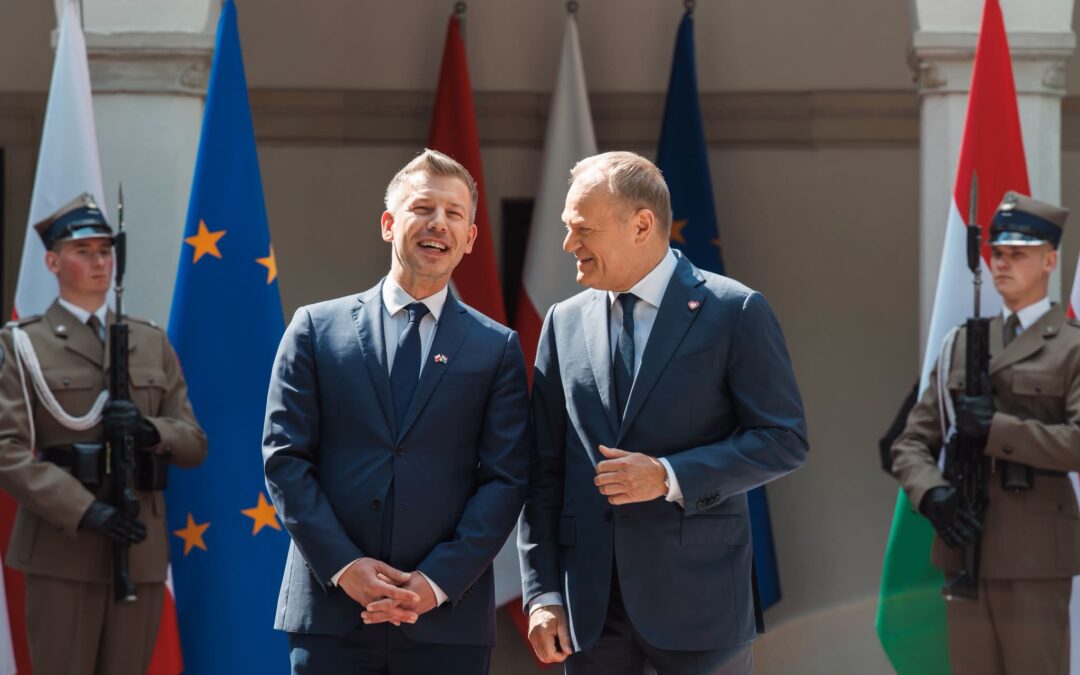
New Hungarian Prime Minister Péter Magyar has visited Poland on his first foreign trip since taking office. Speaking alongside Polish counterpart Donald Tusk, he declared that his government can “learn from Poland” on restoring the rule of law, recovering frozen EU funds, and fighting corruption.
Tusk, meanwhile, hailed Magyar’s “historic victory”, which he said marked “Hungary’s return to Europe” after years of “problematic” rule by Viktor Orbán.
💬 Premier @donaldtusk:
To, co udało nam się zrobić w 2023 roku i Twoje błyskotliwe zwycięstwo, są świadectwami, że są ludzie gotowi bronić wartości demokracji, rządów prawa i wolności.#PLHU pic.twitter.com/zWixIZEi0r— Kancelaria Premiera (@PremierRP) May 20, 2026
After Magyar won his landslide election victory in April, he confirmed that his first foreign trip as prime minister would be to Poland, which has longstanding ties with Hungary and where Tusk’s centrist, pro-EU government is closely aligned with Magyar’s Tisza party.
Unusually for a visiting foreign leader, Magyar first visited Kraków, Poland’s second-largest city, which was, in the second half of the 19th century and up to 1918, part of the Austro-Hungarian empire. There, he visited a number of historical sites connected to Hungary.
Magyar subsequently travelled to Warsaw by train, saying that this gave him an “opportunity to show Hungarians what infrastructure investments have been made” with the support of EU funds.
“Unfortunately, in Hungary over the last 20 years, we haven’t experienced this,” he added, referring to the record of Orbán’s former government.
Kipróbáltuk a vasútvonalat, amiről a legtöbbet beszéltem. És a zsureket is, amit nem lehet elrontani😎 pic.twitter.com/Z1sXyb5Zvb
— Magyar Péter (Ne féljetek) (@magyarpeterMP) May 19, 2026
On Wednesday morning, Magyar met with Tusk, after which the pair spoke at a joint press conference. The Polish prime minister, who also met with Magyar during his election campaign, welcomed his counterpart’s victory.
“It is a sign of hope for millions of people in Europe and around the world that democracy, the rule of law, decency and morality in politics are not lost causes,” declared Tusk, likening it to when his own coalition unseated the national-conservative Law and Justice (PiS) government, an Orbán ally, in 2023.
Tusk said that Poland and Hungary would now be able to “act as one, both in Brussels, on geopolitical matters, and in pursuing various common interests”.
Both he and Magyar indicated the Visegrad Group – a regional forum comprising Poland, Hungary, Slovakia and the Czech Republic, which has been largely moribund in recent years – could now be “renewed and revitalised”, in Tusk’s words.
This, in turn, would help strengthen the region’s voice in the European Union, “to make Europe more like us, because we have a lot to offer Europe”, said the Polish prime minister.
“The heart of Europe beats in Central and Eastern Europe,” added Magyar, who said that he hoped to expand Visegrad’s cooperation to also include Nordic and Balkan countries, as well as Austria.
💬 Premier @donaldtusk:
Rewitalizacja Grupy Wyszehradzkiej, to szerszy projekt, aby Europa środkowo-wschodnia stała się miejscem, gdzie rozstrzygają się losy Europy. Znamy Unię Europejską i bez żadnych kompleksów przywrócimy znaczenie tego regionu. Polska i Węgry są do tego… pic.twitter.com/U7Dv36oHC5
— Kancelaria Premiera (@PremierRP) May 20, 2026
The Hungarian prime minister, who is being accompanied on his trip to Poland by six of his ministers, said that his government would seek to follow the example of Tusk in restoring the rule of law, recovering frozen EU funds, and fighting corruption.
“Poland is a bit ahead [of us],” said Magyar. “Poland is at the forefront of all these countries [in central Europe]…It is a regional power…I’m very much counting on the [Tusk’s] experience, on the experience of the Polish government, the Polish nation.”
Tusk, meanwhile, said that Poland is “ready to provide assistance” in helping Hungary wean itself off reliance on Russian energy, as Poland itself has done in recent years.
He also expressed hope that, with Magyar in power, it would be easier to “work on a common European position towards Ukraine”. Orbán, a close ally of Moscow, often prevented the EU from taking a common stance in support of Ukraine.
Serduszko: edycja węgierska 🇵🇱🇭🇺 pic.twitter.com/VpNZcwElP0
— Donald Tusk (@donaldtusk) May 20, 2026
After meeting Tusk, Magyar headed for talks with Polish President Karol Nawrocki, who is aligned with PiS and controversially visited Orbán shortly before the Hungarian elections.
Nawrocki’s office revealed that the pair were due to discuss bilateral relations, regional security and cooperation, and Polish support for Hungary’s efforts to become independent of Russian energy. However, no joint press conference was scheduled.
Subsequently, Magyar will travel onwards to the city of Gdańsk on Poland’s northern Baltic coast, which is Tusk’s hometown. The two prime ministers will meet there with Lech Wałęsa, the former Polish president, anti-communist leader, and Nobel Peace Prize winner.
W Belwederze Prezydent RP @NawrockiKn przyjął Premiera Węgier Pétera Magyara.
Głównymi tematami pierwszego spotkania Prezydenta RP oraz Premiera Węgier były relacje polsko–węgierskie, w tym współpraca gospodarcza, a także wsparcie węgierskich starań o uniezależnienie się od… pic.twitter.com/UUDkFRJ3pj
— Kancelaria Prezydenta RP (@prezydentpl) May 20, 2026
Notes from Poland is run by a small editorial team and published by an independent, non-profit foundation that is funded through donations from our readers. We cannot do what we do without your support.
Main image credit: KPRM (under CC BY-SA 4.0)

Daniel Tilles is editor-in-chief of Notes from Poland. He has written on Polish affairs for a wide range of publications, including Foreign Policy, POLITICO Europe, EUobserver and Dziennik Gazeta Prawna.