Keep our news free from ads and paywalls by making a donation to support our work!

Notes from Poland is run by a small editorial team and is published by an independent, non-profit foundation that is funded through donations from our readers. We cannot do what we do without your support.
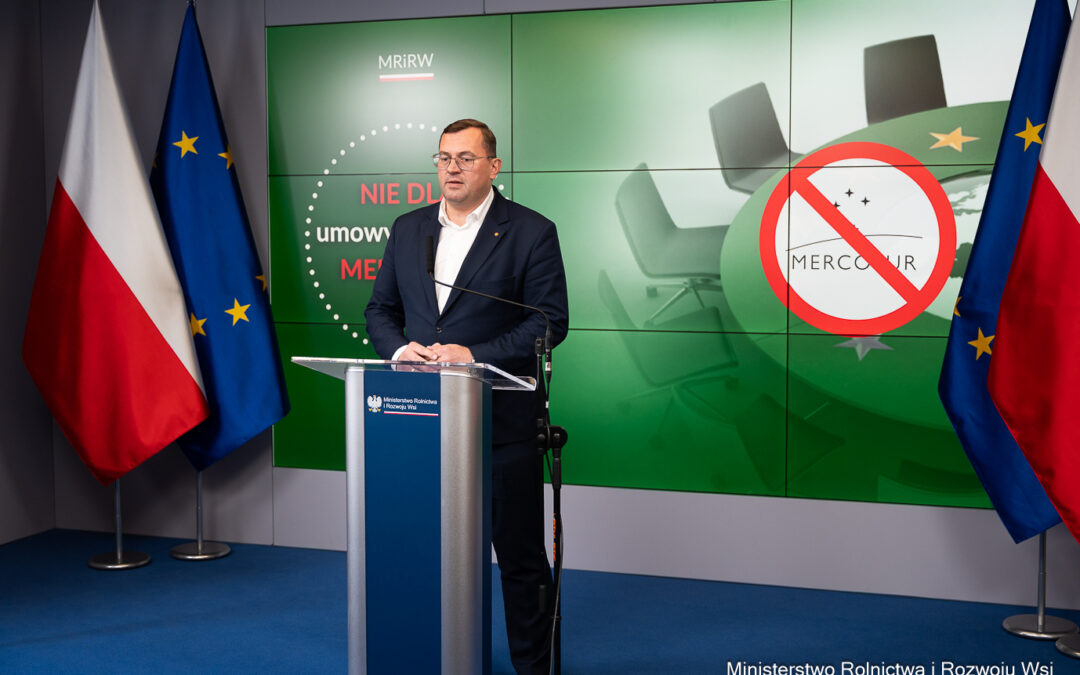
Poland’s government has filed a complaint to the Court of Justice of the European Union (CJEU) against the free-trade deal between the EU and the South American Mercosur bloc that recently went into provisional force. It wants the agreement to be suspended until the court issues a ruling.
Warsaw has long been critical of the agreement, in particular over the potential negative impact that imports of agriculture products from Mercosur, which includes Argentina, Brazil, Paraguay and Uruguay, could have on Polish farmers.
After Poland was outvoted in January when the trade agreement was approved by a majority of EU member states, the government pledged that it would launch a legal challenge.
Obiecaliśmy i zrobiliśmy to. Polska jako jedyny kraj w Unii Europejskiej zaskarżyła umowę Mercosur do Trybunału Sprawiedliwości!
Dla polskiego rządu bezpieczeństwo naszych rolników i konsumentów jest najważniejsze. Nasi rolnicy nie boją się konkurencji, ale musi być ona…
— Stefan Krajewski (@StefanKrajewski) May 11, 2026
“We promised and we have delivered,” wrote agriculture minister Stefan Krajewski on social media on Monday morning. “Poland is the only country in the European Union that has challenged the Mercosur agreement before the Court of Justice!”
“For the Polish government, the security of our farmers and consumers is the top priority,” he added. “Our farmers are not afraid of competition, but it must be FAIR. We’re fighting for equal trade rules and the highest standards. The Polish countryside can count on us!”
Speaking later to the Polish Press Agency (PAP), deputy foreign minister Marcin Bosacki confirmed that Poland had filed its challenge to the Luxembourg court on Sunday evening. He added that Warsaw wants “implementation and execution of this agreement to be suspended” while the case is considered.
In January, 21 of the EU’s 27 member states voted to approve the Mercosur agreement. Poland was opposed, alongside Austria, France, Hungary and Ireland, while Belgium abstained.
Later that month, the European Parliament submitted a request to the CJEU to assess whether the free-trade deal conforms to the EU treaties. In February, it also approved tougher safeguards that will trigger intervention if the prices of agricultural products drop by more than 5%.
Even though the trade deal has not yet received final ratification – still requiring approval from the European Parliament and national parliaments – it nevertheless went into provisional force on 1 May. It greatly reduces tariffs on industrial and agricultural goods traded between the EU and Mercosur.
Farmers from Poland and some other member states have protested against the deal, arguing that the influx of South American produce will not only undercut European producers but also harm consumers, because Mercosur countries have lower environmental and safety standards.
The EU-Mercosur free-trade deal took provisional effect in May and is expected to boost EU exports to the Mercosur region by 39% by 2040, but how do the benefits compare with growing criticism?#EuropeInMotion explains. pic.twitter.com/CTmnTtiIra
— euronews (@euronews) May 11, 2026
News website Gazeta.pl reports that Poland’s complaint to the CJEU is partly procedural – concerning the fact that the agreement went into provisional force despite lacking ratification – but also substantive: it argues that Mercosur farmers will not face the same standards as EU ones, giving them an unfair advantage.
“We are fighting to prevent food from reaching Poland from South America that does not meet EU standards,” said Krajewski earlier this month. “We care about the health of consumers and the competitiveness of Polish farms.”
Broadcaster Polskie Radio notes that there are still two weeks remaining for other countries to file complaints against the Mercosur agreement to the CJEU, but that none have indicated an intention to do so.
Any decision by the European court would take a year or more to be made, it adds. RMF, another broadcaster, estimates that both Poland and the European Parliament’s complaints could take around 20 months to be ruled upon.
EU member states have approved a major free trade agreement with the South American Mercosur bloc, despite Poland, France, Austria, Hungary and Ireland voting against it.
The Polish government says it plans to challenge the deal at the EU's top court https://t.co/pvec7hOaCj
— Notes from Poland 🇵🇱 (@notesfrompoland) January 9, 2026
Notes from Poland is run by a small editorial team and published by an independent, non-profit foundation that is funded through donations from our readers. We cannot do what we do without your support.
Main image credit: MRiRM (under CC BY-SA 4.0)

Daniel Tilles is editor-in-chief of Notes from Poland. He has written on Polish affairs for a wide range of publications, including Foreign Policy, POLITICO Europe, EUobserver and Dziennik Gazeta Prawna.