Keep our news free from ads and paywalls by making a donation to support our work!

Notes from Poland is run by a small editorial team and is published by an independent, non-profit foundation that is funded through donations from our readers. We cannot do what we do without your support.
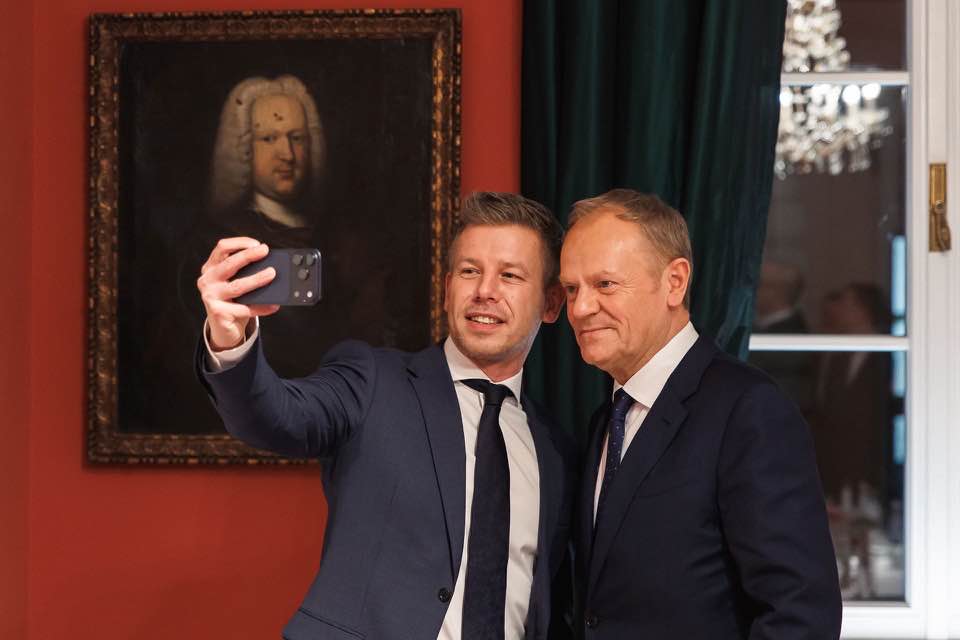
Following his resounding election victory over Viktor Orbán on Sunday, Hungary’s newly elected leader, Péter Magyar, has confirmed that his first foreign trip as prime minister will be to Poland.
Magyar’s success has been hailed by Polish Prime Minister Donald Tusk, who says he is “glad that our part of Europe is showing we are not doomed to corrupt and authoritarian governments”.
Meanwhile, the change in administration in Budapest will raise questions over the fate of two Polish opposition politicians granted asylum there by Orbán. Magyar recently promised to extradite them on his first day in office, but the situation is not quite so simple.
Welcome back to Europe! 🇵🇱🇭🇺 pic.twitter.com/OycXLz1p6u
— Donald Tusk (@donaldtusk) April 13, 2026
On Sunday evening, as ongoing vote counting made it clear that the opposition Tisza party would triumph, Magyar revealed that Orbán had called him to concede defeat.
By Monday morning, near-complete results showed Tisza on course for a landslide victory, including a vital two-thirds majority in parliament that would allow the new government to change the constitution.
After casting his own vote on Sunday, Magyar told the media that, if he emerged victorious, “my first trip abroad will be to Warsaw, as agreed with Donald Tusk”. Subsequently, he intends to visit Vienna and Brussels.
Péter Magyar:
We will renew and put on a strong foundation—and if possible, expand—the cooperation of the Visegrád Four.
In this spirit, my first trip will be to Poland, to strengthen the thousand-year-old Polish-Hungarian friendship.
My second trip will lead to Vienna, and… pic.twitter.com/ebFQ6Gv94F
— Clash Report (@clashreport) April 12, 2026
Tusk, meanwhile, had just arrived in South Korea for a state visit. However, when asked by a reporter about his upcoming talks in Seoul, Tusk replied: “Let’s not kid ourselves. Right now, I only have Hungary on my mind and in my heart, and joy, because for us it was very important for many reasons.”
He said that he had already spoken with Magyar to congratulate him and briefly discuss his visit to Warsaw. Tusk shared a video of part of the call on social media, in which he was heard telling Magyar, “I think I’m happier than you, you know”.
Speaking to the press, Tusk expressed hope that the change in government in Budapest would lead to the release of EU funds for Poland and Ukraine that Orbán had blocked. But Tusk also noted that the Hungarian election result had much broader significance, showing that there is “no authoritarian trend”.
Pointing to his own coalition’s ousting of the national-conservative Law and Justice (PiS) in Poland in 2023, as well as recent victories for pro-EU forces in Romania and Moldova, Tusk said he was “glad this part of Europe is showing that we’re not doomed to corrupt and authoritarian governments”.
In February, Tusk and Magyar met on the sidelines of the World Economic Forum in Davos. Shortly afterwards, Magyar announced that, “on the first day” of his future government, he would seek to extradite two PiS politicians who have been granted asylum in Hungary.
Former deputy justice minister Marcin Romanowski fled Poland in 2024 as prosecutors moved to bring charges against him for 11 alleged crimes – including participating in an organised criminal group, using crime as a source of income, and abuse of power – from his time serving in the PiS government.
He was followed in 2025 by Zbigniew Ziobro, who served as justice minister and prosecutor general throughout PiS’s eight years in power. Ziobro is accused of 26 crimes, including leading a criminal group, abusing his powers and approving the unlawful purchase of Pegasus spyware.
Hungarian opposition leader Péter Magyar has declared that, if he wins April's elections, his government would extradite former Polish justice minister Zbigniew Ziobro, who was recently granted asylum in Hungary, back to Poland on its first day in office https://t.co/lMi3oF2U7x
— Notes from Poland 🇵🇱 (@notesfrompoland) February 16, 2026
However, extraditing the pair back to Poland – if indeed they now remain in Hungary – will not be quite so simple. Poland, for example, has not yet even issued a European Arrest Warrant (EAW) against Ziobro, which would be the basis for any extradition.
Meanwhile, Polish broadcaster TVN notes that a new law came into force in Hungary at the start of this year prohibiting the extradition of individuals under an EAW if they have asylum, as both Ziobro and Romanowski do.
Ziobro has not yet publicly commented on the election result. But Romanowski spoke about it to Polish broadcaster Republika.
He noted that, however much Magyar has tried to portray extradition as a government decision, it will be “up to a court to decide” on the issue. Romanowski added that he “would not reveal [my] new address and plan of action”.
PiS, which has long been a close ally of Orbán’s Fidesz party, had strongly supported the Hungarian prime minister’s reelection campaign. Earlier this month, PiS leader Jarosław Kaczyński said that an Orbán victory was vital to prevent the EU from becoming an instrument for “German neo-imperialism”.
Kaczyński acknowledged that his strongly anti-Russian party differed from the Moscow-friendly Fidesz on certain issues. But he argued that Orbán “has no choice” but to maintain good relations with Vladimir Putin because of Hungary’s dependence on Russian energy.
A delegation of PiS MPs also travelled to Budapest on Friday to express their support for Orbán’s campaign.
Jarosław Kaczyński says it is vital for Viktor Orbán to win re-election so that the European right can fight "German neo-imperialism".
He also defended Orbán’s ties with Russia, saying he “has no choice” because of Hungary’s dependence on Russian energyhttps://t.co/CXqAsUAvzk
— Notes from Poland 🇵🇱 (@notesfrompoland) March 30, 2026
Poland’s right-wing president, Karol Nawrocki, visited Orbán in Budapest last month. However, he notably made no endorsement of the Hungarian leader, nor indeed issued any statement about the visit.
Late on Sunday, after Magyar’s victory had become clear, Nawrocki’s chief security advisor, Sławomir Cenckiewicz, wrote on social media that, while Orbán had been an ally against the “cosmopolitans and centralists in the EU”, in others areas – particularly on Russia and energy – he was “completely at odds with our interests”.
The fact that many on the Polish right had tried to “relativise” these concerns “was a mistake (to put it mildly)”, wrote Cenkiewicz.
Był sojusznikiem Polski jedynie w rozgrywce z kosmopolitami i centralistami w UE oraz w kwestii migracji.
To było ważne, ale za mało. Poza tym jedynie pogłębiał sprzeczności – inna percepcja zagrożeń rosyjskich, różnice w postrzeganiu sojuszu północnoatlantyckiego (o roli… https://t.co/udaNpa1gAC
— Sławomir Cenckiewicz (@Cenckiewicz) April 12, 2026
Notes from Poland is run by a small editorial team and published by an independent, non-profit foundation that is funded through donations from our readers. We cannot do what we do without your support.
Main image credit: Peter Magyar/X

Daniel Tilles is editor-in-chief of Notes from Poland. He has written on Polish affairs for a wide range of publications, including Foreign Policy, POLITICO Europe, EUobserver and Dziennik Gazeta Prawna.