Keep our news free from ads and paywalls by making a donation to support our work!

Notes from Poland is run by a small editorial team and is published by an independent, non-profit foundation that is funded through donations from our readers. We cannot do what we do without your support.
Poland’s government has launched its “plan B” to obtain almost €44 billion (188 billion zloty) in loans for defence spending from the European Union’s SAFE programme, after President Karol Nawrocki, who is aligned with the right-wing opposition, yesterday vetoed a law intended to facilitate the funds.
While the government insists that the money will still arrive, it has warned that, without the measures blocked by Nawrocki, it may not be possible to spend all of the funds. The president’s chief of staff, meanwhile, has criticised the government for trying to “circumvent the law”.
Weto Prezydenta nas nie zatrzyma. Program #PolskaZbrojna będzie realizowany. pic.twitter.com/sIhtGYOVZV
— Donald Tusk (@donaldtusk) March 13, 2026
Nawrocki announced his veto on Thursday evening, claiming that the SAFE programme would indebt Poles for decades on uncertain terms and that national sovereignty would be undermined by giving Brussels influence over Polish defence spending.
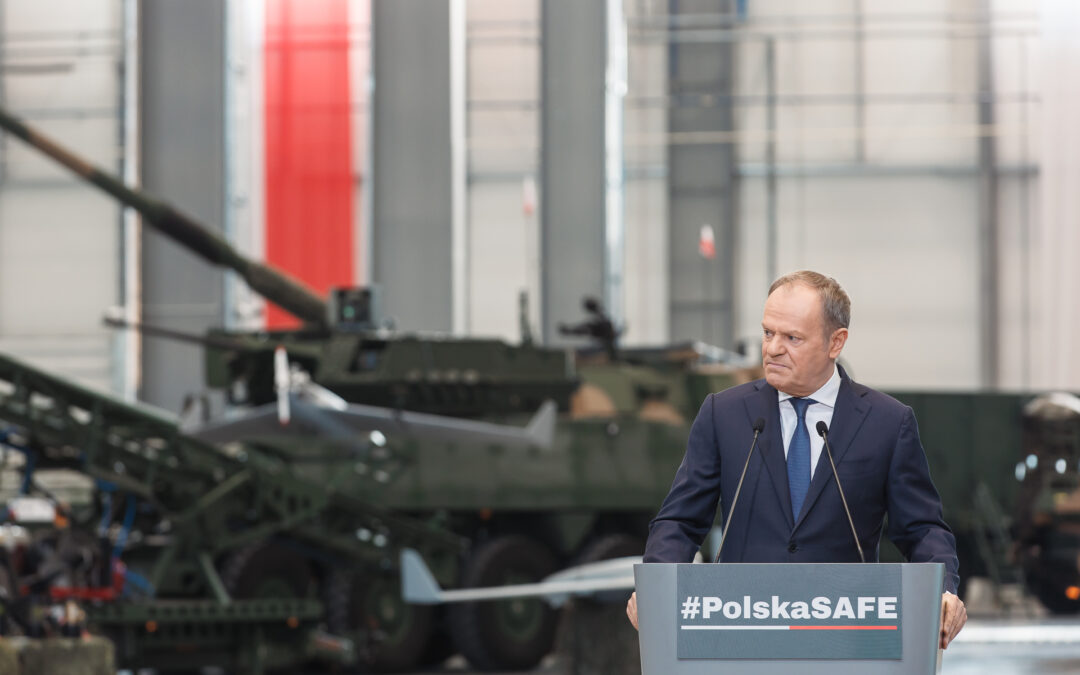
At the start of a hastily called cabinet meeting on Friday morning, Prime Minister Donald Tusk condemned the president’s decision, saying that it had left “Poles wondering whether this is treason, the work of lobbyists, or a lack of common sense”.
The reference to lobbyists stems from accusations by the ruling coalition that Nawrocki, who is a close ally of Donald Trump, opposes SAFE because most of the funds need to be spent in Europe, which threatens the interests of US defence firms.
Tusk added that, although the veto “is a serious impediment”, the government was “prepared for this eventuality” and would today adopt a resolution confirming the receipt of the SAFE funds even without the vetoed law.
President Nawrocki has vetoed a government bill intended to facilitate Poland's receipt of €44bn in loans for defence spending from the EU's SAFE programme.
He argued that the loans would indebt Poles for decades and threaten national sovereignty https://t.co/XSDjR8f6CX
— Notes from Poland 🇵🇱 (@notesfrompoland) March 12, 2026
Speaking to financial news website Money.pl, Piotr Arak, the former head of the Polish Economic Institute (PIE) and now chief economist at VeloBank, confirmed that Poland can receive the SAFE loans even without the law vetoed by Nawrocki.
The money would be transferred to and managed by Poland’s National Development Bank (BGK) and then spent through the Armed Forces Support Fund. However, that means that the funds cannot be used for non-military purposes, such as civilian or border security, notes Arak.
As a consequence, the 7.1 billion zloty designated in Poland’s SAFE plan for non-military agencies such as the police, border guard and security services cannot be allocated to them, reports news website Onet. A further 9.2 billion zloty for security infrastructure is also at risk.
Onet also reports that, without the measures that were vetoed by Nawrocki, the SAFE funds will not be exempt from VAT, thereby increasing the cost of spending them.
On Friday morning, defence minister Władysław Kosiniak-Kamysz confirmed that the government’s “plan B” would “make use of existing instruments” such as the Armed Forces Support Fund, which was set up in 2022 under the former Law and Justice (PiS) government.
However, Nawrocki’s chief of staff, Zbigniew Bogucki, said that the government’s plans were “unacceptable” and amounted to a “de facto circumvention of the law”.
He said that the government’s resolution on implementing SAFE should be reviewed by the Constitutional Tribunal (TK). Nawrocki already made clear on Thursday evening that he regards the SAFE programme as unconstitutional because it gives a foreign entity, the EU, influence over Poland’s national defence.
Jarosław Kaczyński, the leader of the national-conservative opposition Law and Justice (PiS) party, went even further, saying that Tusk is “implementing a plan for German domination”.
„Obecny polski premier jest jednym z wykonawców”
Kaczyński o ''planach niemieckiej dominacji''#300POLITYKALIVEhttps://t.co/Vm0Xqgxikg
— 300Polityka 🇵🇱 (@300polityka) March 13, 2026
Shortly after midday on Friday, the prime minister’s office announced that the government had adopted a resolution on receiving the SAFE funds, which it said would be transferred to the BGK for subsequent use by the Armed Forces Support Fund.
The next step will be to sign an agreement with the European Commission, which would unlock an immediate 15% of Poland’s funds, around €6.6 billion. Earlier this week, a commission spokesman said that they were ready to sign it.
Meanwhile, Nawrocki has also submitted to parliament his own “sovereign” alternative to SAFE, which he says would provide the same amount of funds but interest-free from the central bank.
The government has so far been dismissive of the plan, saying that it fails to make clear how the money would be generated. Many economists have also questioned the viability, and even legality, of the proposal.
President Nawrocki has vetoed a government bill intended to facilitate Poland's receipt of €44bn in loans for defence spending from the EU's SAFE programme.
He argued that the loans would indebt Poles for decades and threaten national sovereignty https://t.co/XSDjR8f6CX
— Notes from Poland 🇵🇱 (@notesfrompoland) March 12, 2026
Notes from Poland is run by a small editorial team and published by an independent, non-profit foundation that is funded through donations from our readers. We cannot do what we do without your support.
Main image credit: KPRM/Flickr (under CC BY-NC-ND 4.0)

Daniel Tilles is editor-in-chief of Notes from Poland. He has written on Polish affairs for a wide range of publications, including Foreign Policy, POLITICO Europe, EUobserver and Dziennik Gazeta Prawna.