Keep our news free from ads and paywalls by making a donation to support our work!

Notes from Poland is run by a small editorial team and is published by an independent, non-profit foundation that is funded through donations from our readers. We cannot do what we do without your support.
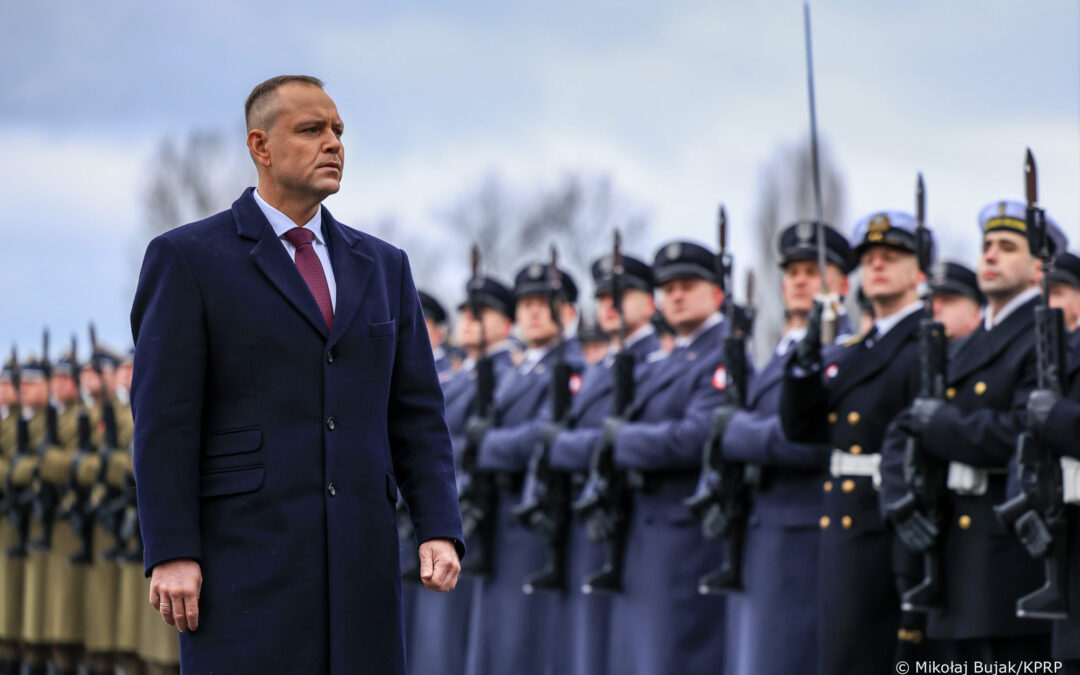
President Karol Nawrocki, who is aligned with the right-wing opposition, has vetoed a government bill intended to facilitate Poland’s receipt of almost €44 billion in loans to fund defence spending from the European Union’s SAFE programme.
He argued that the loans would indebt Poles for decades, that the funds could be withdrawn on the whim of Brussels, and that giving the EU influence over defence spending would threaten Poland’s sovereignty and violate the constitution.
The president’s decision was immediately condemned by figures from the more liberal, pro-EU government, who said that it would harm Poland’s national security. They insist that, despite the veto, the EU funds will still come to Poland, but that it will be impossible to spend all of them without the law in place.
Prezydent RP @NawrockiKn: Podjąłem decyzję, że nie podpiszę ustawy, która pozwala na zaciągnięcie przez Polskę pożyczki SAFE.
Nigdy bowiem nie podpiszę ustawy, która uderza w naszą suwerenność, niezależność, bezpieczeństwo ekonomiczne i militarne. pic.twitter.com/6i1vrEUzwL
— Kancelaria Prezydenta RP (@prezydentpl) March 12, 2026
Last month, the EU gave final approval for Poland’s €43.7 billion share of the SAFE funds, which is the largest among all member states. Shortly after, the government’s majority in parliament adopted a bill setting up a mechanism for Poland’s National Development Bank (BGK) to receive and disburse the money.
However, the right-wing opposition voted against the legislation and urged the president to exercise his right to veto it. Nawrocki himself has also repeatedly expressed concern over SAFE.
Last week, the president proposed his own “sovereign” alternative, which he said would provide the same amount of money for defence spending, but from Poland’s own central bank, thereby avoiding the dangers of large, long-term EU loans.
On Tuesday this week, Nawrocki hosted Prime Minister Donald Tusk for talks at the presidential palace over the issue, but the two failed to reach an agreement. Tusk said that he had been told by unnamed sources that the president would issue a veto.
A meeting between PM @donaldtusk and President @NawrockiKn failed to bring an agreement on Poland's receipt of €44 billion in loans for defence spending through the EU's SAFE programme.
Nawrocki has submitted his own "sovereign" alternative to parliament https://t.co/HFON2HLcqA
— Notes from Poland 🇵🇱 (@notesfrompoland) March 11, 2026
In a recorded address published late on Thursday evening, Nawrocki confirmed that he would not sign the government’s SAFE bill, which he described as “a huge foreign loan…that will burden our children and grandchildren for years to come” while “Western banks and financial institutions profit from this”.
He also warned that, once Poland takes the loan, “Brussels can arbitrarily withhold funding” if it wishes. “Poland’s security cannot depend on foreign decisions,” declared Nawrocki, who said that allowing this to happen would violate the country’s constitution.
The president also accused the government of failing to heed his calls for “broad, cross-party dialogue” on the issue and instead choosing “confrontation, social polarisation and creating divisions among Poles”.
Nawrocki urged all political groups to begin work on a bill that he submitted to parliament this week intended to implement his alternative to the EU programme. He has dubbed his proposed scheme “Polish SAFE 0%”, based on the claim that it would incur no interest, unlike the EU loans.
However, the government has ridiculed Nawrocki’s proposal, saying that, while it creates new mechanisms to spend central bank profits on defence, it does nothing to clarify how those funds would be generated. The central bank has not made a profit since 2021.
Nawrocki and the central bank governor, Adam Glapiński, who is also associated with the opposition, have said the money would come from profits on the bank’s gold reserves. However, many experts have expressed scepticism about how this would work in practice and its potential negative financial and legal effects.
Ekonomiści ostro o pomyśle prezydenta i szefa NBP. "Nie ma czegoś takiego" https://t.co/xSK1N1rVi7
— Business Insider Polska 🇵🇱 (@BIPolska) March 12, 2026
Nawrocki’s veto was immediately criticised by Prime Minister Donald Tusk, who said that “the president has lost the chance to act like a patriot”. He announced that the government’s response would be presented on Friday morning.
Defence minister Władysław Kosiniak Kamysz wrote the president’s decision was a “veto not against the government, but against Poland’s security”. However, he said that the government would now “implement plan B”.
The ruling coalition has always insisted that, even if Nawrocki were to veto their SAFE bill, the funds would still arrive from the EU. They say that the money is vital to bolster national security and will also strengthen Poland’s defence industry as almost 90% of it will be spent domestically.
Pan Prezydent @NawrockiKn miał niepowtarzalną okazję, by wesprzeć w znaczący sposób modernizację Wojska Polskiego. Środki z programu SAFE gwarantują wcześniejsze zakończenie bardzo ważnych etapów transformacji naszej armii i szybsze zbudowanie najsilniejszej armii w Europie.…
— Władysław Kosiniak-Kamysz (@KosiniakKamysz) March 12, 2026
Government spokesman Adam Szłapka said earlier this week that details of their “plan B” would be unveiled only if and when a veto was issued.
However, he and other officials have warned that, without the SAFE bill being adopted, it will be impossible to spend all of the EU funds. For example, the billions of zloty designated for non-military security spending (such as for the border guard and security services) could not be used.
On Thursday, European Commission spokesman Thomas Regnier confirmed that “the next step will be signing an individual loan agreement” with Poland, which has “a very solid plan” for spending the money. Once that is signed, 15% of Poland’s funds, around €6.5 billion, would be immediately released.
A further 18 EU member states have also been designated funds from the SAFE programme.
KE o Polsce i SAFE. Wiadomo, jaką zaliczkę możemy dostać po podpisaniu umowyhttps://t.co/7df95PGiNF
— Fakty RMF FM (@RMF24pl) March 11, 2026
Meanwhile, Nawrocki’s veto was welcomed by the right-wing opposition.
Mateusz Morawiecki, deputy leader of the national-conservative Law and Justice (PiS) party, called it the “right decision” and urged Tusk’s government to now support the president’s alternative plan.
Sławomir Mentzen, one of the leaders of the far-right Confederation (Konfederacja), likewise said that “it is good that the president vetoed the SAFE act”. However, he warned that the government still plans to “illegally saddle us with debt while increasing the EU’s competences”.
“Tusk and his lackeys should stand trial for this!” added Mentzen.
Dobrze, że Prezydent zawetował ustawę o SAFE.
Niestety to nic nie zmieni, bo w tej ustawie nie było słowa o zgodzie na wzięcie tego kredytu. Dotyczyła spraw księgowych i organizacyjnych, nie było w niej wyrażenia zgody przez Sejm na wzięcie kredytu.
Rząd Tuska nielegalnie…
— Sławomir Mentzen (@SlawomirMentzen) March 12, 2026
Notes from Poland is run by a small editorial team and published by an independent, non-profit foundation that is funded through donations from our readers. We cannot do what we do without your support.
Main image credit: Mikołaj Bujak/KPRP

Daniel Tilles is editor-in-chief of Notes from Poland. He has written on Polish affairs for a wide range of publications, including Foreign Policy, POLITICO Europe, EUobserver and Dziennik Gazeta Prawna.