Keep our news free from ads and paywalls by making a donation to support our work!

Notes from Poland is run by a small editorial team and is published by an independent, non-profit foundation that is funded through donations from our readers. We cannot do what we do without your support.
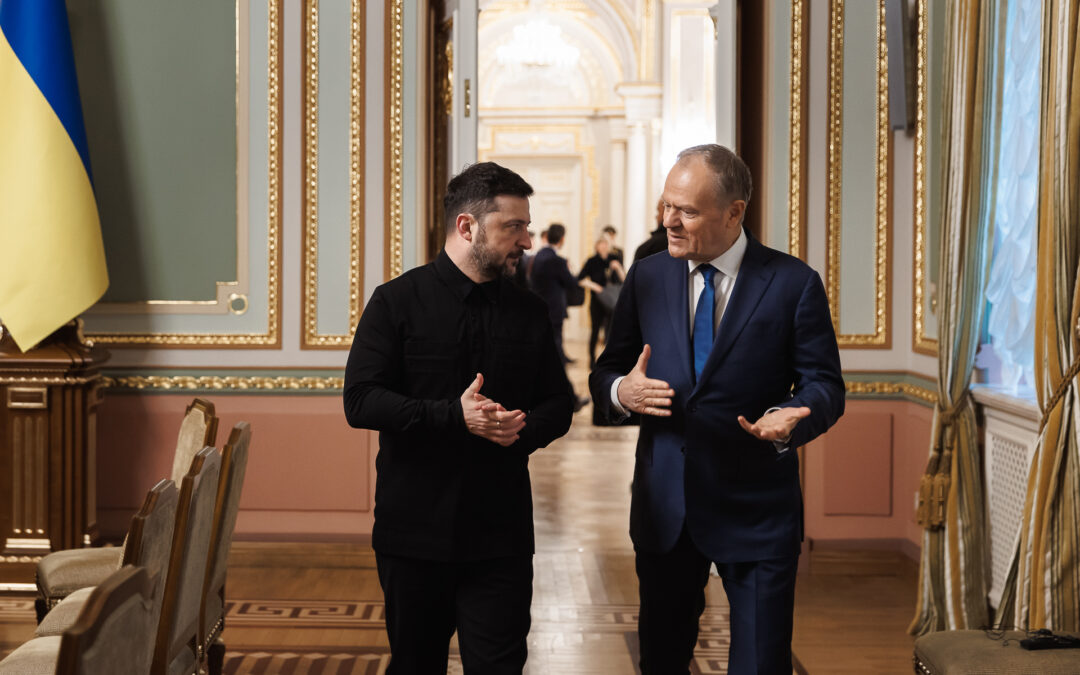
Polish Prime Minister Donald Tusk visited Kyiv today for talks with Ukrainian President Volodymyr Zelensky on an international conference to be held in Poland in June on the postwar reconstruction of Ukraine.
The pair also discussed deepening energy and defence cooperation amid Ukraine’s ongoing war with Russia and Poland’s efforts to bolster its own security, including against Russian drones.
Today, I had a substantive discussion with @donaldtusk. I thank Poland for its support for Ukraine – both now, as we defend ourselves against the Russian invasion, and throughout all the years since our independence was restored.
I briefed him on the situation in our country –… pic.twitter.com/mo3cUigoT4
— Volodymyr Zelenskyy / Володимир Зеленський (@ZelenskyyUa) February 5, 2026
The Ukraine Recovery Conference (URC, formerly known as the Ukraine Reform Conference) is an annual event that will this year be hosted in the Polish city of Gdańsk, Tusk’s hometown.
Preparations are being led by Poland’s finance minister, Andrzej Domański, who accompanied Tusk on his visit to Kyiv today.
“I’m convinced that this conference will be exceptional in every respect,” declared Tusk, speaking alongside Zelensky after their meeting. The Ukrainian president, meanwhile, expressed hope that the URC would produce “very strong, concrete results”.
💬 Premier @DonaldTusk ⤵️
Konferencja Odbudowy Ukrainy to światowe przedsięwzięcie, które będzie miało miejsce w Gdańsku, w moim rodzinnym mieście. pic.twitter.com/llc3FSCS1p
— Kancelaria Premiera (@PremierRP) February 5, 2026
Poland, which is already the primary hub for transporting arms, aid and people in and out of Ukraine, has long sought to position itself as a key partner in Ukraine’s post-war reconstruction.
In 2022, more than 400 Polish companies signed up to a government-backed programme to take part in rebuilding efforts, particularly in sectors such as construction, transport, energy and IT.
A 2022 report by Pekao, a Polish bank, estimated that Ukraine’s postwar recovery could bring Poland’s economy 190 billion zloty (then €38.9 billion) over time, linked to reconstruction work and Ukraine’s integration with the European Union.
Speaking today, Tusk said that the countries at the conference would also discuss “further deliveries of arms and aid to Ukraine in its war with Russia” as well as expanding energy cooperation.
“This is another good example of how aid can also be a good economic venture for both sides,” said the Polish prime minister. “Ukraine today needs more energy and Poland is becoming, or has become, a key partner in terms of gas supplies and supplementing your electricity deficits.”
His comments came days after Poland’s gas exports reached a new record daily high, with the majority accounted for by growing deliveries to Ukraine via a recently expanded cross-border connection.
“There is still a lot to be done here, and I declare my full commitment to this, especially since we are talking about a situation in which we not only help each other, but also earn good money,” Tusk added. Zelensky echoed his remarks, saying that this is an area “that can strengthen both our countries”.
Poland has recorded its highest-ever daily level of gas exports amid rising demand from Ukraine.
The record came days after Poland increased export capacity to Ukraine, which has been suffering a winter energy crisis amid Russian attacks https://t.co/oF6izrOgft
— Notes from Poland 🇵🇱 (@notesfrompoland) February 5, 2026
The two leaders also signed a letter of intent on cooperation in the joint production of ammunition and military equipment, as well as the development of defence technologies.
Tusk said negotiations on the issue had been underway for months and had focused on making “the idea of joint production of weapons and ammunition in plants in both Poland and Ukraine a reality, finding financing, and removing barriers that prevented or hindered the exchange of technology”.
The Polish prime minister also said that they would work on ensuring that money from the European Union’s SAFE programme – which provides €150 billion of loans to support defence spending, including to help Ukraine – “can be used as effectively as possible for joint security”.
Zelensky likewise expressed hope that plans for joint production of weapons, especially drones, under the SAFE programme, will materialise.
Last September, shortly after multiple Russian drones violated Polish airspace, Poland and Ukraine signed an agreement to set up a joint working group to share experience and expertise in drone warfare.
Poland has signed an agreement for a new anti-drone system that it claims will be the first of its kind in Europe.
The network is intended to protect Poland’s eastern borders, where last year around 20 Russian drones crossed in an unprecedented incursion https://t.co/WhWhJxDwXA
— Notes from Poland 🇵🇱 (@notesfrompoland) January 30, 2026
Speaking today, Tusk also referred to peace negotiations underway this week in Abu Dhabi between Ukrainian, American and Russian delegations, saying that Poland “will certainly not accept any solution that would be contrary to Ukraine’s interests.”
Zelensky, meanwhile, thanked Poland and its people for their support since Russia’s full-scale invasion, including most recently the transfer of hundreds of power generators and heaters to help Ukraine cope with Russian attacks on energy infrastructure during freezing winter temperatures.
Notes from Poland is run by a small editorial team and published by an independent, non-profit foundation that is funded through donations from our readers. We cannot do what we do without your support.
Main image credit: KPRM/Flickr (under CC BY-NC-ND 4.0)

Alicja Ptak is deputy editor-in-chief of Notes from Poland and a multimedia journalist. She has written for Clean Energy Wire and The Times, and she hosts her own podcast, The Warsaw Wire, on Poland’s economy and energy sector. She previously worked for Reuters.