Keep our news free from ads and paywalls by making a donation to support our work!

Notes from Poland is run by a small editorial team and is published by an independent, non-profit foundation that is funded through donations from our readers. We cannot do what we do without your support.
The centrist Poland 2050 party, a junior partner in the ruling coalition, has invalidated the results of its leadership election after technical problems disrupted online voting, with officials saying there had been attempts at “external interference”.
Meanwhile, the party’s current leader, Szymon Hołownia, who was meant to be stepping down once a successor was chosen in the election, has now said that he does not rule out reversing course and standing in a newly called leadership election.
Z powodu nieprzewidzianych problemów technicznych, niezależnych od Krajowej Komisji Wyborczej, doszło do przedwczesnego zamknięcia systemu głosowania. W związku z tym II tura wyborów Przewodniczącego Partii Polska 2050 z 12 stycznia 2026 r. została w całości unieważniona.
— Marcin Skonieczka (@m_skonieczka) January 12, 2026
Poland 2050 is part of the coalition, led by Prime Minister Donald Tusk and his Civic Coalition (KO) party, that took power in December 2023. It has 31 of the coalition’s 240 members of the Sejm, the more powerful lower house of parliament.
In September, the party’s founder and leader, Szymon Hołownia, announced that he would step down when his term ended in January. That prompted a contest to choose his successor.
In a first-round vote, held on Saturday, none of the five candidates won a majority of votes, meaning that the two most popular – Katarzyna Pełczyńska-Nałęcz, the minister for funds and regional policy, and climate minister Paulina Hennig-Kloska – stood in a run-off election on Monday.
The results were due to be announced at 10 p.m. But, after a delay, the party revealed that the election had been invalidated because of technical issues with the online voting system.
“At some point, the voting system stopped working and some politicians received links that did not work,” Ignacy Niemczycki, a deputy foreign minister from Poland 2050, told broadcaster RMF.
“It could have been a system error, but we don’t rule out external interference or a hacker attack,” one of the party’s MPs, Kamil Wnuk, told the Wprost newspaper.
That was then confirmed by Hołownia himself, who said that “everything indicates there was an external attempt to disrupt our electoral process”.
“Over 20,000 attempts to access the system have been recorded,” he added, quoted by the Polish Press Agency (PAP). “The company providing this service is investigating how this happened and who is behind it.”
❗,,Doszło do zewnętrznej ingerencji w nasz proces wyborczy. Zanotowaliśmy ponad 20 tys. nielegalnych prób wpłynięcia na wynik wyborów w partii" – mówi @szymon_holownia @RadioMaryja @TV_Trwam pic.twitter.com/2FceHwpqh6
— Michał Rybka (@PanMicha5) January 13, 2026
Business Insider Polska (BIP) reports that the party used Interankiety, a commercial survey platform. BIP suggested that the administrators of the vote may not have enabled all of the necessary safeguards on the service to ensure the security of voting.
Broadcaster TVN reported that problems had already emerged during the first round on Saturday, with some delegates unable to access the voting link. TVN’s reporter, Michał Gołębiowski, found that only 656 votes were cast out of more than 800 eligible delegates.
Regarding what will happen next, Hołownia today outlined two possible scenarios: a repeat of the second round of voting or a repeat of the entire election. He said the party’s leadership would meet on Friday to decide how to proceed.
Asked if he would now reverse his decision to step down and stand in the leadership election, if a new one is called, Hołownia did not rule it out. “If it turns out that this is a solution that will help Poland in 2050, I will not shirk it,” he said.
When he announced in September that he would stand down as leader, Hołownia also revealed that he was applying to become the new UN High Commissioner for Refugees. However, in December, Iraqi Barham Salih was chosen for the role, taking up the post on 1 January.
💬 "Nie wiem. Nie podjąłem jeszcze tej decyzji, ale to rozważam. Nie wykluczam startu na szefa partii"@szymon_holownia, odpowiadając na pytanie o swój start w ewentualnych, powtórzonych wyborach. ⤵️ pic.twitter.com/I35OdGlvbM
— tvp.info 🇵🇱 (@tvp_info) January 13, 2026
The confusion over Poland 2050’s leadership election was met with mockery and disbelief by other politicians, including some partners in the ruling coalition.
“Couldn’t you vote normally at the [party] convention/congress? Who will believe these results now?” wrote Anna-Maria Żukowska, who is chairwoman of the parliamentary caucus of The Left (Lewica), one of Poland’s ruling groups.
“These people rule Poland…A comedy drama,” commented Olga Semeniuk-Patkowska, an MP from the national-conservative opposition Law and Justice (PiS) party.
Ci ludzie rządzą Polską…Komediodramat. pic.twitter.com/chSOVfPYJ2
— Olga Semeniuk-Patkowska 🇵🇱 (@OlgaEwaSemeniuk) January 12, 2026
The leadership contest comes as Poland 2050’s support has fallen well below the threshold of 5% needed at elections to enter parliament. Over the last few months, the party has been polling around 2% support.
In the 2023 parliamentary elections, Poland 2050 stood jointly with the centre-right Polish People’s Party (PSL) under the name Third Way, winning 14.4% of the vote.
However, they decided to split last year, while both remaining part of Tusk’s ruling coalition. PSL is also polling poorly, on around 2.5%.
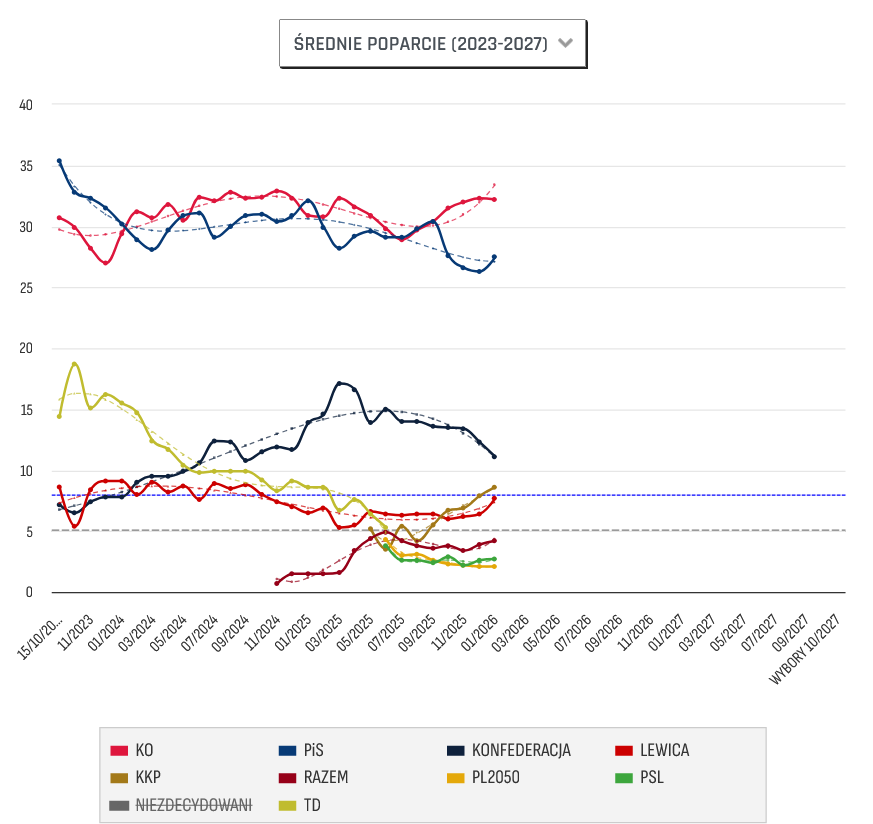
Monthly polling averages for political parties in Poland (source: ewybory.eu)
Notes from Poland is run by a small editorial team and published by an independent, non-profit foundation that is funded through donations from our readers. We cannot do what we do without your support.
Main image credit: Kancelaria Premiera/Flickr (under CC BY-NC-ND 4.0)

Alicja Ptak is deputy editor-in-chief of Notes from Poland and a multimedia journalist. She has written for Clean Energy Wire and The Times, and she hosts her own podcast, The Warsaw Wire, on Poland’s economy and energy sector. She previously worked for Reuters.