
Keep our news free from ads and paywalls by making a donation to support our work!

Notes from Poland is run by a small editorial team and is published by an independent, non-profit foundation that is funded through donations from our readers. We cannot do what we do without your support.
The government’s majority in parliament has approved a proposed law recognising Silesian – which is spoken in the historical area of Silesia in southwest Poland – as an official regional language.
But it remains possible that President Karol Nawrocki – who is aligned with the right-wing opposition, which voted against the bill – will veto the law, as his predecessor Andrzej Duda did in 2024. Duda argued that Silesian is a dialect, not a language, and said that recognising it could threaten national security.
In the most recent national census, around 460,000 people in Poland said they use Silesian as their main tongue at home. That is far more than the 87,600 who speak Kashubian, a language native to northern Poland that is currently the country’s only recognised regional language.
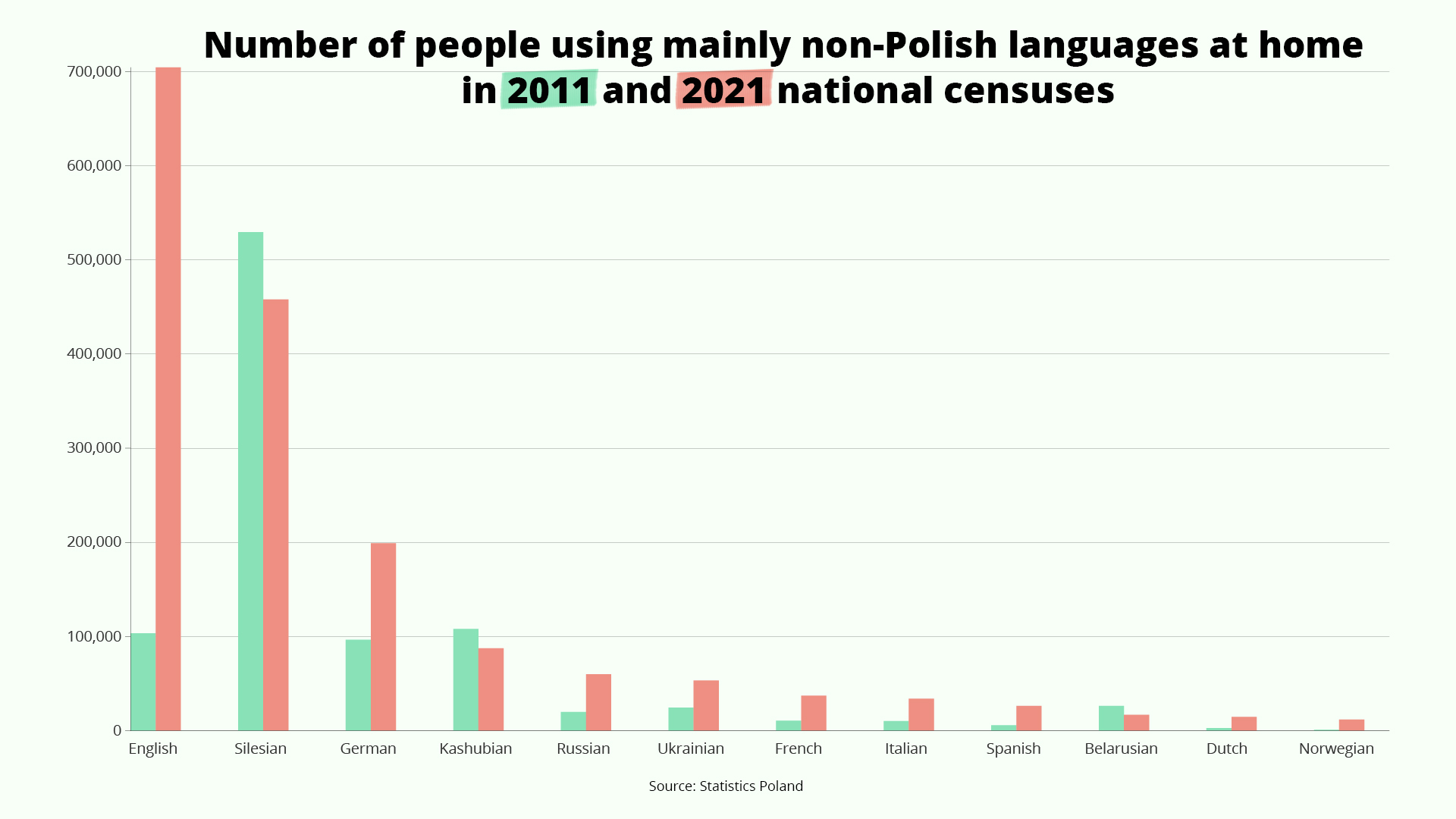
Such official recognition allows a language to be taught in schools and used in local administration in municipalities where at least 20% of the population declared in the last census that they speak it. It also provides additional funding for preserving the language.
In a vote on Friday in the Sejm, the more powerful lower house of parliament, a majority of 244 MPs supported the bill. They came almost entirely from Prime Minister Donald Tusk’s ruling coalition, which stretches from left to centre right.
The 196 votes against the bill came from the right-wing opposition, made up of the national-conservative Law and Justice (PiS), far-right Confederation (Konfederacja) and some smaller factions.
“Recognising Silesian as a regional language is not a symbolic or political gesture – it is an act of justice, consistency and respect for facts,” declared Danuta Jazłowiecka, an MP from Tusk’s centrist Civic Coalition (KO) who is from Silesia and represents a Silesian district in the Sejm.
“Recognising Silesian does not threaten the unity of the state,” she added. “On the contrary, it strengthens it, showing that the republic is a community that is open, respecting its internal richness and diversity.”
However, Witold Tumanowicz of Confederation declared that “Silesian is a branch of the Polish language, a natural element of its richness, and not an entity that must be artificially separated out by an administrative decision”.
“The linguistic bureaucrats want to regulate people’s speech, create new commissions, change laws, and impose further obligations. But why?” he asked.
Silesian, which is spoken in southwest Poland, has been added as a language on Google Translate.
The decision comes shortly after Poland’s own president vetoed a law recognising Silesian as a language. He says it is actually a dialect of Polish https://t.co/mXhmFgbchU
— Notes from Poland 🇵🇱 (@notesfrompoland) June 30, 2024
The bill now passes to the upper-house Senate, where the government also has a majority and which can in any case only delay, rather than block, the legislation. If approved by parliament, it then moves to the desk of President Nawrocki, who was elected last year with the support of PiS.
When, in 2024, Tusk’s coalition passed a previous bill recognising Silesian, it was vetoed by PiS-aligned President Duda, who claimed that it is an “ethnolect” that does not meet the criteria of a language laid out in the 2005 law regulating Poland’s recognised ethnic minorities and regional languages.
Duda also voiced his concern that, if Silesian were recognised as a regional language, it could “result in similar expectations among representatives of other regional groups who want to cultivate their local tongues”.
Finally, the president also cited national security concerns in relation to the “current social and geopolitical situation…related to the war being waged on the eastern border”. At such a time, there must be “special care to preserve national identity”, including “cultivating the native language”.
The president’s decision to veto a law recognising Silesian as a language has reignited a debate that is ostensibly linguistic but at its heart is a struggle over culture, identity and, for some, the integrity of the Polish state itself https://t.co/HNgQ2436G7
— Notes from Poland 🇵🇱 (@notesfrompoland) July 9, 2024
Neither Nawrocki nor his office have so far commented on what his decision may be. However, given how his right-wing allies in parliament voted, and given Duda’s earlier veto, it appears likely that Nawrocki will refuse to sign the bill.
In October, Nawrocki vetoed a bill that would have recognised Wymysorys, which is spoken by less than 100 people in one small Polish town, as an official regional language. He cited linguists’ doubts over whether Wymysorys is a language or an ethnolect.
A presidential veto can only be overturned with a three-fifths majority in the Sejm, something that would be impossible to achieve in this case of the Silesian language law, as the ruling coalition has only a narrow majority in parliament.
President @NawrockiKn has vetoed a bill that would have recognised Wymysorys, which is spoken in a single, small Polish town, as an official regional language.
In Poland's last census, just ten people recorded themselves as speaking Wymysorys at home https://t.co/Xj8nG01twH
— Notes from Poland 🇵🇱 (@notesfrompoland) October 17, 2025
Notes from Poland is run by a small editorial team and published by an independent, non-profit foundation that is funded through donations from our readers. We cannot do what we do without your support.
Main image credit: Kris Duda/Flickr (under CC BY 2.0)

Daniel Tilles is editor-in-chief of Notes from Poland. He has written on Polish affairs for a wide range of publications, including Foreign Policy, POLITICO Europe, EUobserver and Dziennik Gazeta Prawna.