Keep our news free from ads and paywalls by making a donation to support our work!

Notes from Poland is run by a small editorial team and is published by an independent, non-profit foundation that is funded through donations from our readers. We cannot do what we do without your support.
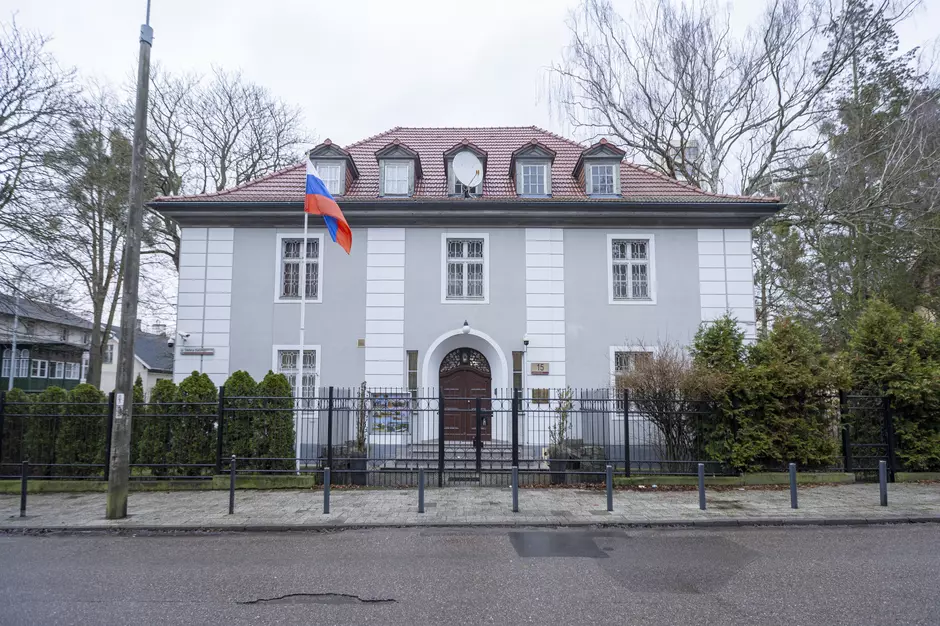
Russia is refusing to hand over the building in Gdańsk that houses its consulate, despite Poland ordering the facility to close in response to the sabotage of a rail line last month by agents working on behalf of Moscow. Russia says it still has legal right to the property, but that claim is rejected by city hall.
The Polish foreign ministry ordered the consulate to close by the end of 23 December, with employees required to leave Poland. The Russians, however, plan to leave a single “administrative and technical employee” at the premises after that date to “ensure the inviolability” of the building, which they claim is legally theirs.
PILNE! Rosjanie nie zamierzają oddać konsulatu w Gdańsku! Argumentują, że należy się im bo został zakupiony na polecenie … cara Piotra I 👇👇👇@sikorskiradek @gdansk #Rosja #CarPiotrI #konsulatGdańsk https://t.co/PKer2ecsGJ
— Dziennik Bałtycki (@dz_baltycki) December 22, 2025
The villa on Batorego Street has been occupued by Kremlin diplomats since 1951, when Poland’s communist authorities agreed to allow the Soviets to use the building for free, reports broadcaster TVN.
Previously, since the times of Tsar Peter the Great, Russia (and later the Soviet Union) had operated a consulate elsewhere in Gdańsk. But it was seized by Nazi Germany in 1941, after Hitler declared war on the Soviet Union, then destroyed in 1945 during the Red Army’s advance into the city.
“We believe this is our property,” Andrei Ordash, charge d’affaires of the Russian embassy in Warsaw, told TVN. “This building was transferred to us in the early 1950s as compensation for property lost by the Soviet Union during the war; it is our property.”
Russia has maintained this position for years. In 2013, Gdańsk began charging fees for the building’s use, but the consulate refused to pay. The city estimates unpaid fees from 2013 to 2023 at around 5.5 million zloty (€1.3 million), with interest adding another 3 million zloty.
Gdańsk officials call Russia’s position “incomprehensible”, saying that available documentation does not support Moscow’s claims. According to the land and mortgage registers, the building is owned by the Polish state treasury.
The city’s deputy mayor, Emilia Lodzińska, announced on Monday that the city would pursue legal measures to reclaim the property.
“After obtaining a court ruling favourable to the Polish side, bailiff proceedings will be carried out, resulting in the seizure of the property,” she said. “I would like to stress very clearly that we are acting and will continue to act within the framework of a democratic state governed by the rule of law.”
Poland has ordered Russia to close its consulate in Gdańsk in response to last week's sabotage of a rail line by agents working for Moscow.
It means that all of Russia's consulates in Poland have now been shut, with only the embassy in Warsaw remaining https://t.co/Ba0ALlhcpA
— Notes from Poland 🇵🇱 (@notesfrompoland) November 19, 2025
The city emphasised that the building would lose its protected status under the Vienna Convention on Consular Relations at midnight on 23 December. However, the city estimates that recovering the building through legal means may in practice take two or three years.
“Following a relevant court ruling and transfer to the state treasury, the property will be available for reuse,” said Emil Rojek, deputy governor of the Pomerania province in which Gdańsk is located.
“Before we make any decisions regarding the future use of this building, we must familiarise ourselves with its technical condition, what we will find there, and examine it in terms of safety. Then we will decide whether this property will be used for the needs of state authorities or in another way, for example commercially,” he added.
Warsaw has announced it will renovate a former Russian diplomatic compound known as “Spyville” and turn it into flats for public servants.
The city had hoped to hand it over to the Ukrainian community but could not owing to the building's poor conditionhttps://t.co/J9438EMMFK
— Notes from Poland 🇵🇱 (@notesfrompoland) January 21, 2025
In 2022, shortly after Russia’s full-scale invasion of Ukraine, the municipal authorities in Warsaw seized a former Russian diplomatic compound that had likewise been claimed by Moscow as part of a long-running legal dispute.
Warsaw had initially hoped to hand over the building to the local Ukrainian community. However, that proved unfeasible due to the poor condition of the site. It will instead be redeveloped into housing for municipal employees.
In 2022, Poland’s State Forests likewise seized a property that Russia had refused to vacate despite failing to pay rent.
Since last year, Poland has successively closed down all three of Russia’s consulates in response to Moscow’s campaign of sabotage on Polish territory. After the Gdańsk consulate ceases to operate tomorrow, only the embassy in Warsaw will remain.
In retaliation, Moscow has ordered all of Poland’s consulates on its territory to close.
Polish authorities have seized a property from the Russian embassy after the lease was terminated for unpaid rent but the Russians refused to vacate the premises.
The buildings were found to be "completely devastated", with even wiring removed from walls https://t.co/4s0BxnRSW4
— Notes from Poland 🇵🇱 (@notesfrompoland) November 3, 2022
Notes from Poland is run by a small editorial team and published by an independent, non-profit foundation that is funded through donations from our readers. We cannot do what we do without your support.
Main image credit: Piotr Wittman/gdansk.pl

Alicja Ptak is deputy editor-in-chief of Notes from Poland and a multimedia journalist. She has written for Clean Energy Wire and The Times, and she hosts her own podcast, The Warsaw Wire, on Poland’s economy and energy sector. She previously worked for Reuters.