Keep our news free from ads and paywalls by making a donation to support our work!

Notes from Poland is run by a small editorial team and is published by an independent, non-profit foundation that is funded through donations from our readers. We cannot do what we do without your support.
By Aleks Szczerbiak
After recovering from the shock of its candidate’s presidential election defeat, Poland’s ruling coalition is doubling down on holding its right-wing predecessor to account for alleged abuses of power and focusing on national security. However, the government still faces considerable political and socio-economic challenges, and many Poles remain frustrated at its inability to deliver on flagship election promises.
A radically new political landscape
In December 2023, a coalition government headed up by liberal-centrist Civic Coalition (KO) leader Donald Tusk took office following eight years’ rule by the right-wing Law and Justice (PiS) party, currently the main opposition grouping. The ruling coalition also includes the agrarian-centrist Polish People’s Party (PSL), liberal-centrist Poland 2050 (Polska 2050), and the New Left (Nowa Lewica).
However, the surprise victory of PiS-backed candidate Karol Nawrocki in the May-June presidential election was a huge political and psychological blow to the Tusk administration, scuppering its plans to align all the branches of state power so that it could push through its policy agenda and elite replacement programme.
With Poland's presidential election now settled, we have prepared eight charts showing where the contest was won and lost, including how Poles voted by age, gender and location, and how supporters of eliminated first-round candidates split in the run-off https://t.co/xfXGknhHPh
— Notes from Poland 🇵🇱 (@notesfrompoland) June 4, 2025
The government lacks the three-fifths parliamentary majority required to overturn a presidential veto so faces continued resistance from a hostile president who can effectively block many of its key reforms for the remainder of its term of office, which is scheduled to run until the next parliamentary election in autumn 2027.
Just as importantly, Nawrocki’s victory also radically changed Poland’s political dynamics, as a result of which the governing coalition found itself severely weakened and on the political defensive. The presidential election was widely seen as, above all, a referendum on the Tusk government.
Many Poles felt that it had been too passive and lacked any sense of purpose, and used the election as an opportunity to channel their discontent with the government’s failure to deliver on the policy commitments that helped bring it to power in 2023.
This feeling of a radically new political landscape was reinforced after Nawrocki took office in August and it became clear that he would be an assertive president keen to carve out a role for himself as an independent political actor. With a blaze of presidential vetoes and legislative and foreign policy initiatives, Nawrocki quickly secured the status of Poland’s most popular politician.
President Nawrocki has vetoed a bill introducing universal access to postal voting.
He says that there is an "unacceptable risk" of foreign interference in ballots sent from abroad and that postal voting allows "pressure from third parties" on voters https://t.co/5MYvWZzyq9
— Notes from Poland 🇵🇱 (@notesfrompoland) November 28, 2025
At the same time, it was also obvious that the government did not have a “Plan B” and was, initially at least, completely unprepared for Nawrocki’s victory. The presidential election result also questioned the government’s long-term stability and raised the possibility of an early parliamentary poll, as well seriously weakening Tusk’s personal authority, leading to speculation that he might stand down or be replaced as prime minister.
The right turns in on itself
At the same time, Nawrocki’s victory initially bolstered the right-wing opposition, which viewed it as a pivotal moment providing them with a clear path to regaining full power at the next parliamentary election. However, although Nawrocki’s election-winning coalition successfully brought together supporters of various right-wing groupings, since then they have turned on each other in mutual recriminations.
In particular, relations between PiS and the radical right free-market Confederation (Konfederacja), whose presidential candidate Sławomir Mentzen finished a strong third with 15% of the first-round votes, have become increasingly strained.
Moreover, the emergence in October of a high-profile corruption probe into a highly suspicious sale of strategic state-owned land designated for the planned “mega-airport” and transport hub known as the Central Communication Port (CPK), one of the PiS government’s flagship infrastructure projects, to a private entity for a fraction of its market value shortly before it left office in 2023 was very damaging for the party.
In response, PiS suspended four party members who had been involved in the sale, including former agriculture minister Robert Telus and his deputy Rafał Romanowski. It also tried to deflect the scandal by arguing that the government was slow to recover the land, linking the delay to the fact that the buyer’s family was reportedly a significant KO sponsor.
Nonetheless, as well as completely overshadowing an earlier PiS programmatic convention that was meant to launch the party’s autumn political offensive, the scandal gave the Tusk administration a potent tangible example to underpin its narrative that the previous government was corrupt and misused state power.
Reinvigorating the “reckoning” agenda
In fact, during the last few weeks the Tusk government has started to develop the kind of new opening required to shift the political dynamics back in its favour.
Firstly, in order to maintain the support and loyalty of its core supporters, the government has doubled down on its so-called “reckoning” (Polish: rozliczenie) strategy. This mainly involves criminal investigations of PiS party figures for their alleged corruption and abuse of state resources when in office.
The appointment in Tusk’s summer reshuffle of uncompromising anti-PiS former judge Waldemar Żurek as justice minister, who has since announced a whole raft of measures to reinvigorate the “reckoning” agenda, was a clear signal that this would be a core element of the government’s recovery plan.
Former justice minister Zbigniew Ziobro says he will only return to Poland to face the 26 charges against him “when the rule of law is restored”.
In the meantime, he has offered to be interviewed either in Budapest, where he is currently, or in Brussels https://t.co/WFqSpgt0Pp
— Notes from Poland 🇵🇱 (@notesfrompoland) November 12, 2025
This was exemplified by the laying of 26 criminal charges against former PiS justice minister Zbigniew Ziobro, who is accused of leading an “organised criminal group” that allegedly misused around 150 million zloty from the so-called Justice Fund (designed to assist victims of crime) for political patronage, and unlawfully financing the purchase of the Pegasus spyware system to surveil his political opponents.
Ziobro, who has been undergoing treatment for cancer and is currently residing in Hungary, vigorously denied these allegations. Nonetheless, by being seen to actively pursue such cases, the Tusk government is hoping to show its core supporters that it can take decisive action even if the “reckoning” process faces political obstacles such as potential presidential vetoes.
Although it has often been criticised by government opponents as a politically motivated witch-hunt or displacement activity, the adoption of a harder line was based on the notion that the ruling coalition’s presidential election defeat was caused, in part at least, by its core electorate feeling demotivated because the “reckoning” process was being pursued with insufficient vigour.
A renewed focus on national security
The other cornerstone of Tusk’s political recovery strategy has been a renewed focus on national security, which he has tried to present as the government’s core, indispensable priority. Tusk argues that Russia is already waging a new type of war in Europe with hybrid tactics including arson, drone incursions, and cyber-attacks, thereby justifying his government prioritising this issue. He has presented himself as a “war leader” and strong defender of the nation against a clear external enemy,
Critics argue that using such stark “pre-war” language helps Tusk avoid having to answer awkward questions about other, more problematic aspects of the government’s policy agenda.
Nonetheless, national security is an issue that resonates deeply with Poles, and focusing on it allows Tusk to appeal to a broad range of voters including those who may otherwise be dissatisfied with the pace of government reforms.
Dear American friends, Europe is your closest ally, not your problem. And we have common enemies. At least that’s how it has been in the last 80 years. We need to stick to this, this is the only reasonable strategy of our common security. Unless something has changed.
— Donald Tusk (@donaldtusk) December 6, 2025
Situations of international insecurity often help to produce what political scientists call a “rally effect”: the inevitable psychological tendency for worried citizens to unite around their political leaders and institutions as the embodiment of national unity when they feel that they face a dramatic external threat.
In essence, Tusk’s national security rhetoric is a calculated strategy to consolidate his leadership and reframe the political landscape around the Russian threat.
An important element of this involves delegitimising the right-wing opposition as objectively pro-Moscow by arguing that their rhetoric and actions align with Russian propaganda and interests, thereby effectively labelling them as a security risk.
This includes framing the geo-political choice facing Poland in Manichean terms between East and West, arguing that, by undermining EU unity and criticising closer alignment with Berlin and the so-called European “mainstream”, PiS was playing into Russian hands and threatening the whole of the continent’s security architecture. It also involves presenting Nawrocki’s more frequent use of presidential vetoes and independent foreign policy initiatives as destructive and undermining the unity of the Polish state.
The government’s underlying weaknesses have not gone away
According to the Politico Europe aggregator of Polish opinion polls, while KO and PiS were running neck-and-neck at around 31-32% support throughout June-September, Tusk’s party is now ahead of its right-wing opponent by 34% to 29%. However, although KO is competitive as an individual party, the government’s overall approval ratings rankings remain negative.
For sure, a November poll conducted by the CBOS agency found that the number of government supporters had increased from 31% in October to 34%, while those who expressed disapproval fell from 45% to 41% over the same period. However, these fluctuations were within the margin of polling error and the government has still not regained the levels of support that it enjoyed immediately after taking office.
Moreover, the ruling coalition’s combined support has fallen and KO’s surge has come largely at the expense of its smaller governing partners, which are polling near or below the 5% parliamentary representation threshold. So if an election were held today, Civic Coalition would likely end up the single largest party but lose its overall parliamentary majority.
The problem here is that, while the “reckoning” agenda appeals to the government’s hardcore supporters and the national security narrative has given Tusk an opportunity to get back on the front foot, the administration’s fundamental, underlying weaknesses have not gone away.
The government continues to face criticisms that it has failed to implement the vast majority of the 100 reforms that Civic Coalition promised in its first 100 days in office (“100 konkretów na 100 dni”). For sure, it can point to some successes on the economic front, particularly increases in the overall rate of growth and a fall in the headline rate of inflation.
Poland's debt has been growing at the second-fastest rate in the EU this year, and is set to continue rising.
What is behind this trend – and should we be worried – asks Alicja Ptak in the latest of her series of articles and podcasts on Poland’s economy https://t.co/1pvnb2ZxoY
— Notes from Poland 🇵🇱 (@notesfrompoland) November 30, 2025
However, while many official top-level economic indicators seem to be improving, Poles often feel that this does not align with their daily lived experiences and the country’s apparent prosperity is not translating into improvements in their quality of life. Many remain concerned about their living standards because the recent fall in inflation is in the rate of increases, not a reversal of the high prices of essential goods that have accumulated over the last few years.
Moreover, the government still faces deep, persistent structural socioeconomic challenges on issues such as access to affordable housing and the quality of healthcare. Media reports in recent weeks have, for example, described the situation in the Polish health service as dramatic, with claims that some hospitals have delayed medical treatments or turned patients away.
High levels of public debt and a significant state budget deficit (due partly to massive defence and social spending) have also constrained the government’s ability to honour its election promises, notably KO’s flagship pledge to increase tax allowances substantially. These challenges are, of course, compounded by the ongoing conflict with Nawrocki.
Back in the game, but still precarious
The next scheduled parliamentary election is still nearly two years away, so there is plenty of time for political trends to change. During his long political career, Tusk has shown himself to be a master of comebacks and he clearly thrives on polarisation. The ruling coalition is certainly back in the game and speculation that the prime minister may stand down or be forcibly replaced has subsided.
Nonetheless, in spite of a recent good run and the right-wing opposition’s post-election drift, the ruling coalition’s position remains precarious. The government’s fundamental problems and weaknesses have not gone away, public evaluations of it remain negative, and it is unclear if its recovery plan will be enough to turn the political situation around.
Notes from Poland is run by a small editorial team and published by an independent, non-profit foundation that is funded through donations from our readers. We cannot do what we do without your support.
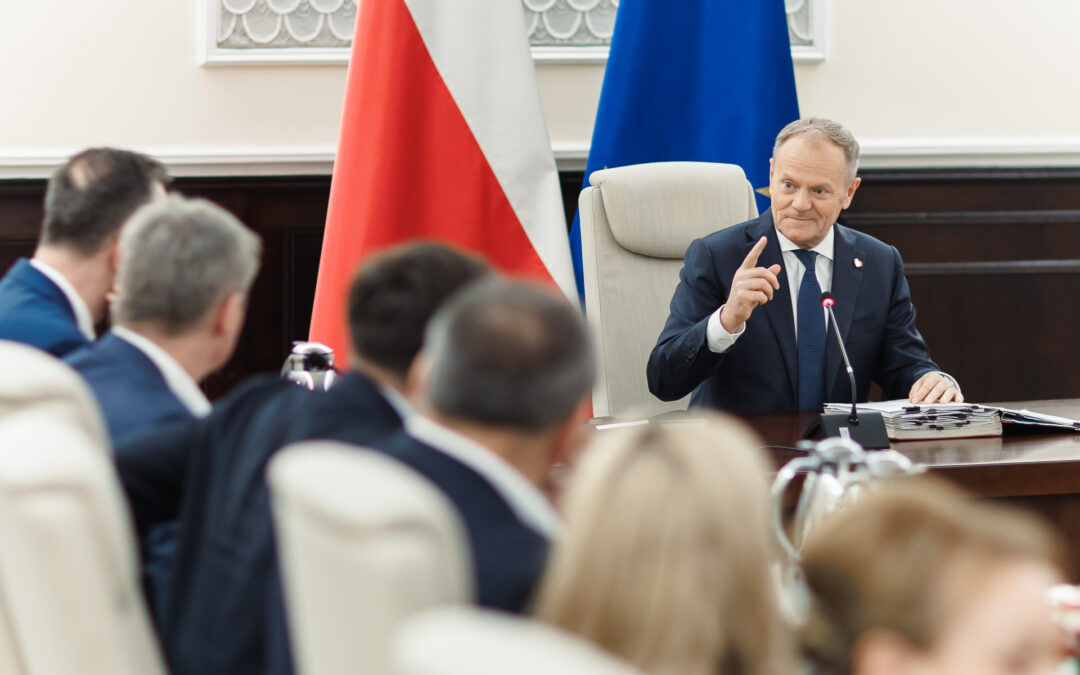
Main image credit: KPRM/Flickr (under CC BY-NC-ND 4.0)