Keep our news free from ads and paywalls by making a donation to support our work!

Notes from Poland is run by a small editorial team and is published by an independent, non-profit foundation that is funded through donations from our readers. We cannot do what we do without your support.
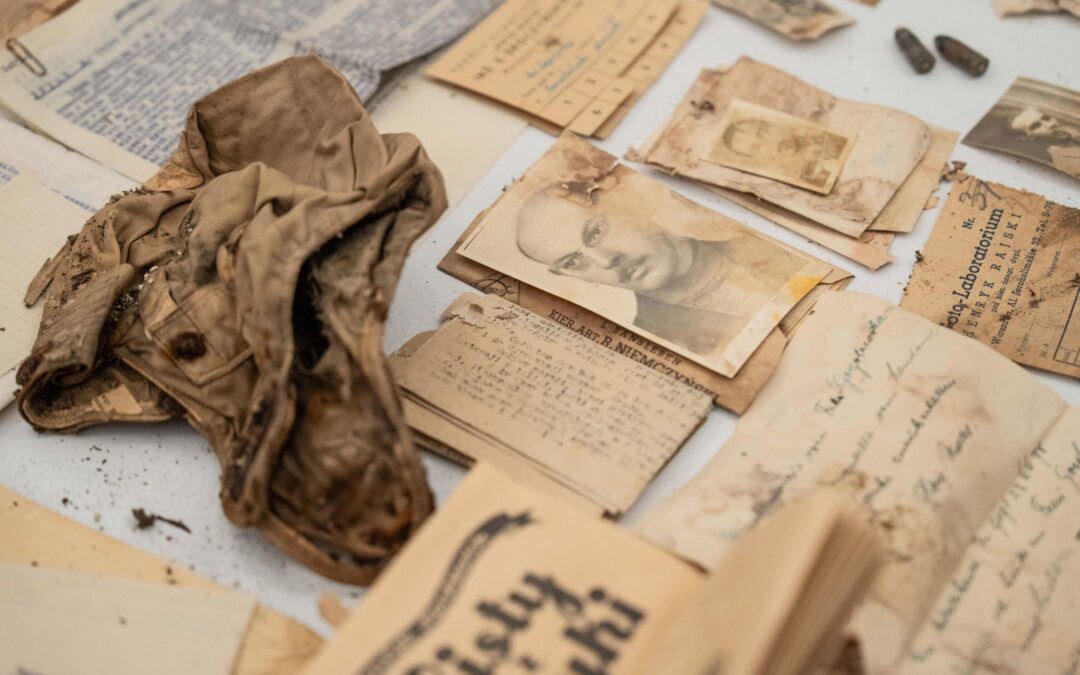
A large collection of documents from World War Two, many relating to Poland’s underground resistance, has been discovered under the floor in a historic tenement house in Warsaw that was undergoing renovation.
The city’s Warsaw Rising Museum says that the collection, which also includes the diary of a young woman living under the Nazi-German occupation, is of “exceptional historical value”.
The find was announced by the office of the provincial conservator of monuments, which also shared images of the find as it was presented to Warsaw mayor Rafał Trzaskowski.
The items were discovered during the renovation of a building in the city’s Saska Kępa district. The local conservation authorities were immediately called in to ensure the safe removal and preservation of the documents.
They include material produced at the headquarters of the Home Army (AK), Poland’s main underground resistance force, as well as blank German documents, maps, Polish newspapers published in the UK during the war, and training manuals.
The cache also includes a number of personal items, including photographs, ID cards, and a diary written in Polish by a young woman, whose identity has yet to be determined.
“Some [of the documents] describe the activities of the underground state, some are testimonies of everyday life under occupation, such as the prices of basic food products, and others are examples of work on preparing the state’s organisation after the war,” said Trzaskowski.
“Experts will continue to investigate this discovery, but it looks sensational,” added the mayor, who also thanked the workers who had discovered the collection and reported it to the appropriate authorities.
The conservators called in experts from the Warsaw Rising Museum, which is dedicated to the history of Poland’s wartime resistance, who “determined that the collection is of exceptional historical value”.
Once conservation work is complete, the items will be deposited in a museum collection, with the Warsaw Rising Museum already expressing interest in taking them.
Niesamowite znalezisko prosto z Pragi Południe. Musicie to zobaczyć! pic.twitter.com/ywVCcF20EG
— Rafał Trzaskowski (@trzaskowski_) November 28, 2025
The Home Army is believed by many historians to have been the largest underground force in German-occupied Europe, with estimates of its maximum size ranging between 200,000 and 600,000.
The AK functioned as part of a broader underground state created in occupied Poland. It held allegiance, and was in theory subordinate, to the government-in-exile, though in practice it often functioned independently.
The largest operation mounted by the AK – and indeed the largest single military effort undertaken by any European resistance movement during the war – was the Warsaw Uprising of 1944, which saw tens of thousands of fighters unsuccessfully seek to liberate the city from German occupation.
After the uprising was suppressed, the Germans proceeded to raze most of the city, meaning that relatively few prewar buildings still survive in Warsaw.
Germany’s president has asked Poles for forgiveness on the 80th anniversary of the Warsaw Uprising.
“German nationalism, imperialism and racism led to these brutal crimes,” he declared in a speech to veterans of the uprising https://t.co/p2LCA8r9xy
— Notes from Poland 🇵🇱 (@notesfrompoland) August 1, 2024
Notes from Poland is run by a small editorial team and published by an independent, non-profit foundation that is funded through donations from our readers. We cannot do what we do without your support.
Main image credit: UM Warszawa

Daniel Tilles is editor-in-chief of Notes from Poland. He has written on Polish affairs for a wide range of publications, including Foreign Policy, POLITICO Europe, EUobserver and Dziennik Gazeta Prawna.