Keep our news free from ads and paywalls by making a donation to support our work!

Notes from Poland is run by a small editorial team and is published by an independent, non-profit foundation that is funded through donations from our readers. We cannot do what we do without your support.
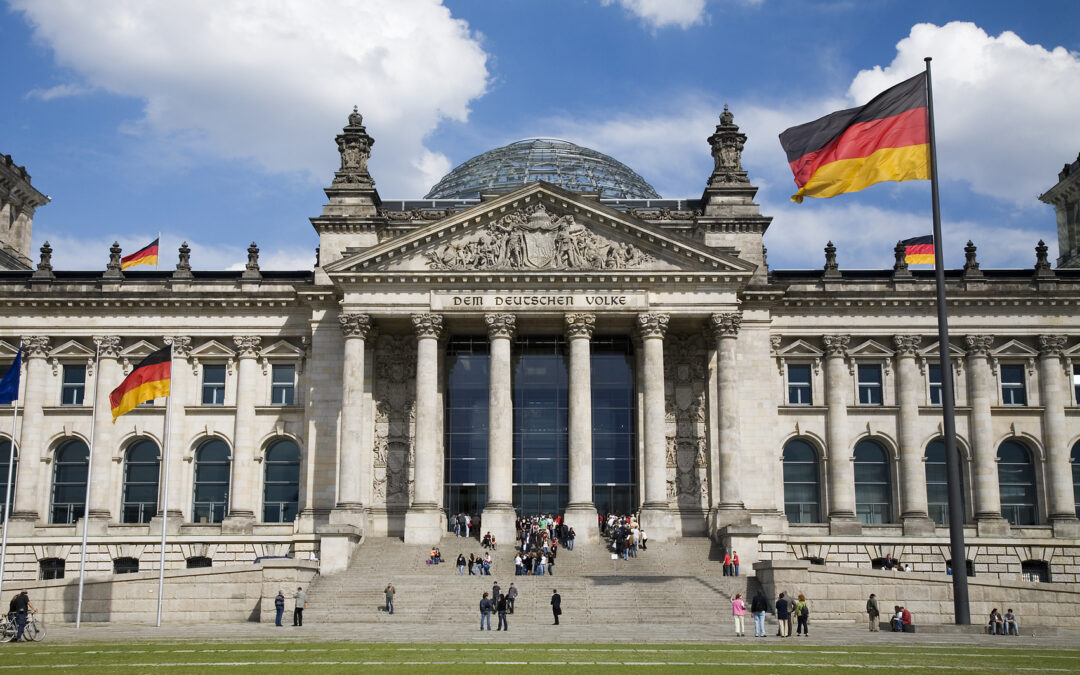
Germany’s federal parliament, the Bundestag, has passed a motion calling on the government to establish a permanent memorial in Berlin to Polish victims of the German-Nazi occupation. The measure was approved by all parties apart from the far-right Alternative for Germany (AfD).
The idea has been discussed for years, and was previously approved by the Bundestag in 2020. In June, a temporary memorial was erected. But some in Poland criticised the form that it took – a simple stone boulder – saying that it was underwhelming and undignified given the scale of Polish suffering in the war.
A temporary memorial to Polish victims of the Nazi-German occupation of World War Two has been unveiled in Berlin in the form of a large boulder.
It has been criticised by opposition PiS politicians as a "blunder" and "grotesque".https://t.co/P3MvC1qAYp
— Notes from Poland 🇵🇱 (@notesfrompoland) June 17, 2025
Today’s resolution, which was proposed by Germany’s two ruling groups, the CDU/CSU and SPD, obliges the federal government to launch a competition to design the permanent memorial with the involvement of Polish experts, reports the Onet news website.
It also identifies the location of the temporary memorial – which sits at the former site of the former Kroll Opera House – as the most appropriate place for the permanent one. It was there, on 1 September 1939, that Hitler announced the invasion of Poland.
As well as the CDU/CSU and SPD, the Greens and The Left also voted in favour of the motion. However, two members of the far-right AfD, which is the largest opposition party, voted against it while the remainder abstained.
The co-leader of the AfD, Tino Chrupalla, recently said that Poland is as great a threat to Germany as Russia. Previous statements by leading AfD figures downplaying Nazi crimes have provoked anger in Poland
On Monday this week, during intergovernmental talks between Poland and Germany in Berlin, the issue of a permanent memorial was raised by German Chancellor Friedrich Merz.
“Yes, the German-Polish agenda should point toward the future. But we cannot and we do not want to erase history,” said Merz, speaking alongside his Polish counterpart Donald Tusk. “We must keep memory alive, even the painful memories.”
“We are initiating the construction of a permanent memorial to the Polish citizens who were victims of Nazi tyranny and the Second World War from 1939 to 1945,” he continued. “The corresponding tenders on the German side will now begin.”
Donald Tusk has hailed Poland’s “exceptionally good” relations with Germany but urged Berlin to "hurry up" fulfilling a pledge to support surviving Polish WW2 victims
Friedrich Merz revealed that the two countries aim to sign a defence agreement next year https://t.co/8AnsTKtjMf
— Notes from Poland 🇵🇱 (@notesfrompoland) December 1, 2025
Knut Abraham, the German government’s representative for cooperation with Poland, told the Polish Press Agency (PAP) that the competition to design a permanent memorial will be announced in early 2026 and that funding for completion of the project will be determined in the federal budget for 2027 or 2028.
In August 2023, the German culture ministry outlined plans for the memorial, which is to take the form of a “Polish-German House commemorating the suffering that took place in Poland in the years 1939-1945, as well as the cruel death of over five million Polish citizens, including approximately three million Jews”.
While focusing on wartime atrocities, the planned Polish-German House is also intended to show historical ties before and after the war, including Germany’s role in the partitions of Poland from the late 18th to early 20th century, the migration of Poles to German lands, and Poland’s integration into the EU and NATO.
The idea finally received approval from the German government in June 2024. After that, the project passed back to the Bundestag for implementation.
Germany has agreed to return to Poland a collection of 73 medieval documents that were looted during WWII.
The culture minister has hailed it as "the most important and valuable return of stolen cultural heritage in modern Polish history" https://t.co/GxHQ8A0jyr
— Notes from Poland 🇵🇱 (@notesfrompoland) December 1, 2025
Almost six million Polish civilians – around half of them Jews – are estimated to have died as a result of the Second World War. That represents 17% of Poland’s pre-war population, which is the highest proportional death toll of any country during the war.
The German occupiers also laid waste to many Polish cities – including the capital, Warsaw, which saw around 85% of its buildings destroyed – and plundered or destroyed much of Poland’s cultural heritage.
That painful legacy continues to cause tensions today, in particular over the twin questions of Germany restituting looted items and paying war reparations or some other form of compensation to Poland.
Germany's ambassador has told a member of the Polish opposition that their demands for Berlin to pay war reparations “create divisions that help only Putin”.
His comments sparked criticism, including from President Nawrocki's chief foreign-policy aide https://t.co/z76wvBPbbH
— Notes from Poland 🇵🇱 (@notesfrompoland) November 16, 2025
Notes from Poland is run by a small editorial team and published by an independent, non-profit foundation that is funded through donations from our readers. We cannot do what we do without your support.
Main image credit: Jorge RoyanWikimedia Commons (under CC BY-SA 3.0)

Daniel Tilles is editor-in-chief of Notes from Poland. He has written on Polish affairs for a wide range of publications, including Foreign Policy, POLITICO Europe, EUobserver and Dziennik Gazeta Prawna.