Keep our news free from ads and paywalls by making a donation to support our work!

Notes from Poland is run by a small editorial team and is published by an independent, non-profit foundation that is funded through donations from our readers. We cannot do what we do without your support.
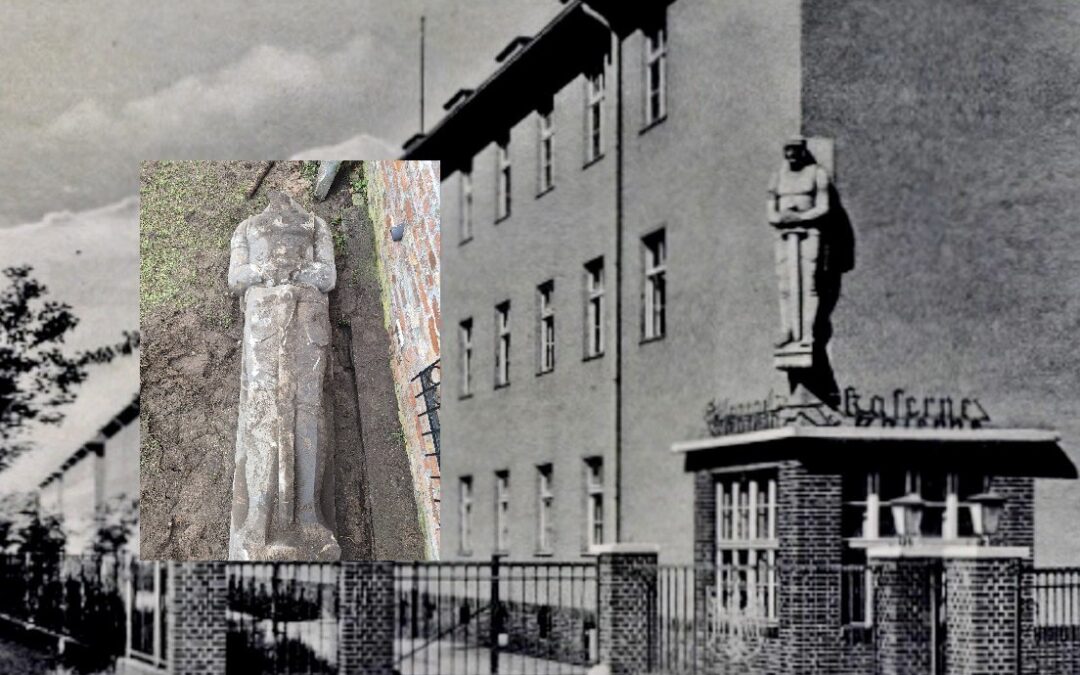
Construction workers building a supermarket in the Polish town of Kostrzyn nad Odrą have discovered a German-Nazi statue that went missing 80 years ago.
A local museum, which will now display the object, has jokingly dubbed it “Teutonkhamun” in reference to its Germanic origins, mysterious disappearance, and dramatic rediscovery.
During the interwar period, Kostrzyn nad Odrą, which now sits on Poland’s border with Germany, was part of Germany and known as Küstrin. In 1935, two years after Hitler came to power, a military barracks was built there to house Wehrmacht soldiers.
At the entrance to the building, above the guardhouse, a huge stone figure depicting a warrior with a sword in his hands was installed. However, in 1945, at the end of World War Two, when Kostrzyn nad Odrą was part of the German lands transferred to Poland, the statue disappeared.
“Rumours circulated that it had been thrown into a pit on the opposite side of the street and buried under rubble,” wrote the Kostrzyn Fortress Museum. “[Now] these reports have been confirmed.”
The site of the former barracks is now a housing estate and, last month, during excavation work to build a supermarket for Dino, a large Polish chain, workers came across fragments of the statue around 200 metres from the former barracks.
The museum was informed about the find by a local resident, and has now secured the surviving elements of the statue. Its face is almost completely missing and part of the sword has been removed, which the museum believes was done intentionally. There are also traces of rifle bullets.
The museum now plans to present the object in a lapidarium – a place where archaeological fragments are displayed – that it is in the process of building. “We have tentatively named it ‘Teutonkhamun’ and hope that its curse won’t reach us,” they wrote.
A group of detectorists in Poland have discovered parts of an Enigma machine used by Nazi Germany to encrypt messages.
It is likely to have been destroyed and buried by retreating German forces at the end of the war https://t.co/NsP0RyHQtP
— Notes from Poland 🇵🇱 (@notesfrompoland) December 16, 2024
Notes from Poland is run by a small editorial team and published by an independent, non-profit foundation that is funded through donations from our readers. We cannot do what we do without your support.
Main image credit: Muzeum Twierdzy Kostrzyn/Facebook

Daniel Tilles is editor-in-chief of Notes from Poland. He has written on Polish affairs for a wide range of publications, including Foreign Policy, POLITICO Europe, EUobserver and Dziennik Gazeta Prawna.