Keep our news free from ads and paywalls by making a donation to support our work!

Notes from Poland is run by a small editorial team and is published by an independent, non-profit foundation that is funded through donations from our readers. We cannot do what we do without your support.
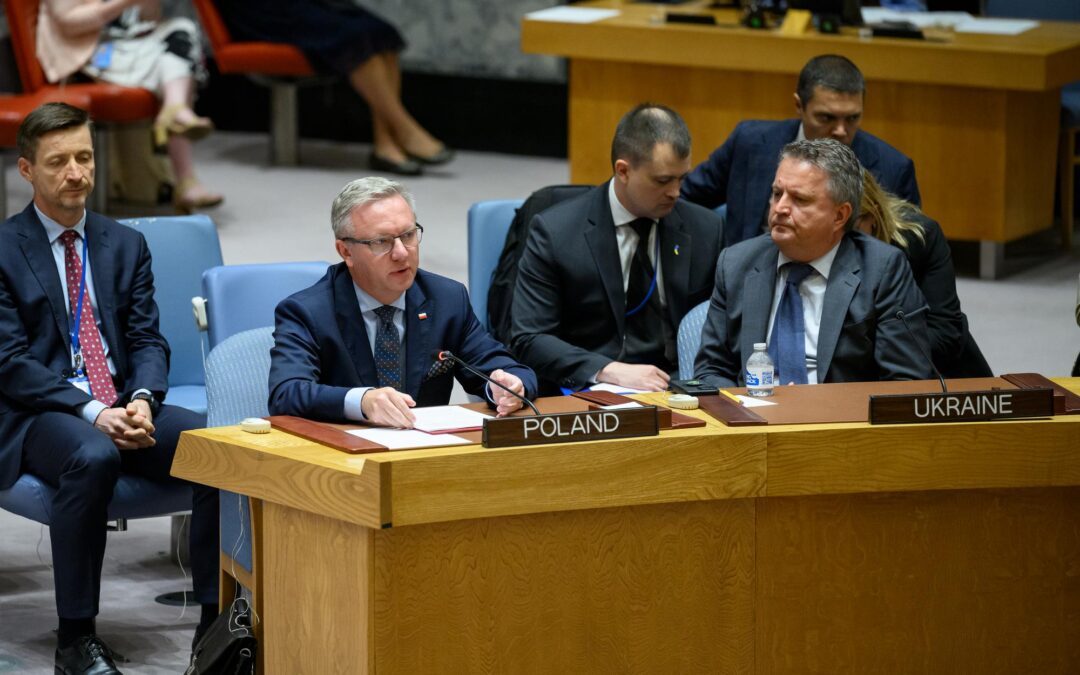
Poland’s ambassador to the United Nations, Krzysztof Szczerski, has resigned from his position, becoming the third Polish ambassador to do so since a government-backed move by a group of judges to take control of the Constitutional Tribunal (TK) in Warsaw.
All three of the departing ambassadors were previously aides or advisers to former President Andrzej Duda, who is aligned with the right-wing opposition Law and Justice (PiS) party. They have criticised the attempt to oust the TK’s chief justice, Bogdan Święczkowski, who was appointed to the court under PiS.
Following the resignations of Poland’s Ambassadors to China and Romania, Prof. Krzysztof Szczerski, Poland’s Permanent Representative to the United Nations, has also submitted his resignation.
All three are senior state officials and experienced diplomats who have served at the…
— Marcin Przydacz (@marcin_przydacz) November 2, 2026
On Monday afternoon, foreign ministry spokesman Maciej Wewiór announced that Szczerski had “submitted a request to shorten his diplomatic mission at the UN”, where he has served as ambassador since 2021.
Szczerski’s resignation followed those of Jakub Kumoch, Poland’s ambassador to China, and Paweł Soloch, the Polish envoy to Romania, who quit their posts on Friday and Saturday, respectively.
While Szczerski has not yet commented on the reasons for his departure, Kumoch and Soloch made clear that their decisions were motivated by Friday’s move to suspend Święczkowski from the TK.
Soloch wrote that the “attempt to unlawfully take over the Constitutional Tribunal” left him with “no possibility of continuing to serve as ambassador”. Kumoch said his decision was a “matter of conscience”, as “there are certain things I cannot explain abroad without losing face, and I have no intention of speaking ill of Poland”.
There is chaos at Poland's constitutional court tonight as a group of government-backed judges moved to take control from the opposition-aligned chief justice.
Riot police have surrounded the court and were seen preventing the chief justice from entering https://t.co/xpkp3sjPFn
— Notes from Poland 🇵🇱 (@notesfrompoland) October 30, 2026
Szczerski previously served as a member of the European Parliament for PIS. In 2015, he joined the chancellery of PiS-aligned President Duda, later becoming the head of his cabinet and then head of his International Policy Bureau.
Kumoch was a member of Duda’s National Development Council, an advisory body to the president, before serving as ambassador to Switzerland, Turkey, and then China. Soloch was the head of Duda’s National Security Bureau from 2015 to 2022.
On Monday, after Szczerski’s resignation, foreign minister Radosław Sikorski suggested that the three ambassadors had quit at the urging of the current president, Karol Nawrocki, who is also aligned with PiS.
Sikorski sardonically suggested that, in contrast to Polish ambassadors who quit in 1981 over the imposition of martial law despite “risking vengeance from the communist regime”, the newly resigned trio “will surely be handsomely rewarded for their heroic deeds”.
The developments are part of a much broader fallout from the crisis around the TK, which began on Friday evening when large numbers of riot police appeared outside the court.
It soon transpired that a group of eight judges appointed by parliament to the TK this year – but five of whom Nawrocki has refused to swear in – had entered the court and declared that Święczkowski had been suspended from his position for failing to fulfil his duties.
Święczkowski, who before becoming a TK judge previously served as a member of the former PiS government, declared their actions unlawful and an attempted “coup d’état”. He has been backed by the six other justices appointed when PiS was in government.
Święczkowski has also been supported by Nawrocki, who dramatically entered the court in the early hours of Saturday morning, clashing physically and verbally with the self-proclaimed acting head of the court, Anna Korwin-Piotrowska.
During a visit to the Constitutional Tribunal last night, President Nawrocki clashed physically and verbally with judges involved in an attempt to take control of the court.
The president is today seeking talks with political leaders to discuss the crisis https://t.co/7HmBnuIaDG
— Notes from Poland 🇵🇱 (@notesfrompoland) October 31, 2026
The developments have created an unprecedented situation at the TK. However, the court has been in crisis since 2015, when Duda and the then-PiS government – which came to power that year – unlawfully rejected three judges appointed by the former parliament and replaced them with three of their own.
The current government, a broad coalition led by Prime Minister Donald Tusk, does not recognise the TK due to those illegitimate judges and has ignored its rulings since replacing PiS in power in December 2023.
This year, Tusk’s coalition began appointing judges to fill vacancies on the court. It has condemned Nawrocki and Święczkowski for refusing to accept those judges, saying that their actions are unlawful.
Given those circumstances, Tusk and his government have argued that tough action is necessary to restore the legitimacy of the TK. On Saturday evening, Tusk gave an address to the nation declaring that there can be “no compromise” over the rule of law.
"On some issues, there can be no compromise," declared Prime Minister @donaldtusk in an address to the nation on the crisis around the constitutional court.
He condemned the actions of President Karol Nawrocki, accusing him of "intimidating judges" https://t.co/RPyt87mcFO
— Notes from Poland 🇵🇱 (@notesfrompoland) October 31, 2026
However, a number of legal experts – including many who were highly critical of PiS’s policies towards the TK and other courts – have expressed doubts over the manner in which Korwin-Piotrowska and her colleagues have sought to take control of the tribunal.
Further developments are expected on Tuesday, when Korwin-Piotrowska has called a general assembly of the tribunal. However, it is uncertain that she will obtain the necessary quorum of 10 judges normally required for the assembly to be valid.
While the eight judges appointed by the ruling coalition this year are all expected to attend, those appointed under the PiS government appear likely not to.
Notes from Poland is run by a small editorial team and published by an independent, non-profit foundation that is funded through donations from our readers. We cannot do what we do without your support.
Main image credit: Poland in the UN (under CC BY 3.0 PL)

Daniel Tilles is editor-in-chief of Notes from Poland. He has written on Polish affairs for a wide range of publications, including Foreign Policy, POLITICO Europe, EUobserver and Dziennik Gazeta Prawna.