Keep our news free from ads and paywalls by making a donation to support our work!

Notes from Poland is run by a small editorial team and is published by an independent, non-profit foundation that is funded through donations from our readers. We cannot do what we do without your support.
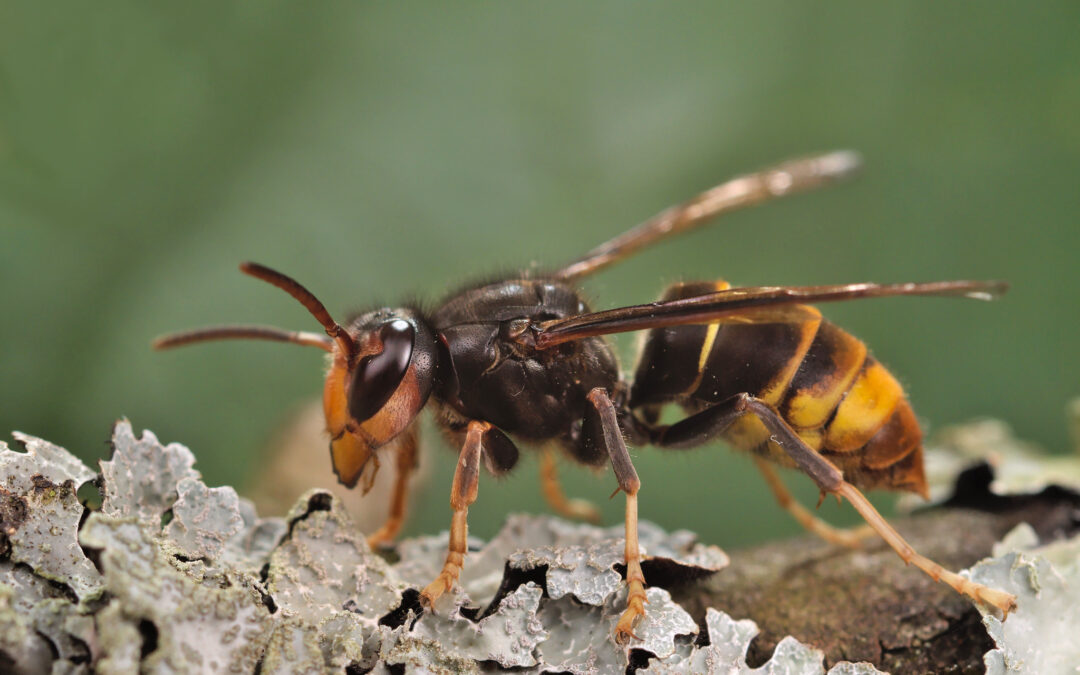
Poland’s first-ever nest of Asian hornets, an invasive species seen as a particular threat because it preys on honeybees, has been eliminated. But scientists who have studied the colony say that it is likely more will be found next year.
Since arriving in France in 2004, Asian hornets have gradually spread to other European countries.
The first confirmed nest to be found in Poland was sighted in a tree in the village of Wielka Wieś near Kraków in mid-October, with individual hornets also being spotted at the apiary of the city’s AGH University of Science and Technology.
The nest was removed last week and sent to be studied by a team of scientists at Wrocław University of Environmental and Life Sciences, reports the Polish Press Agency (PAP).
Paweł Migdał, from the university’s faculty of biology and animal science, told PAP that the nest was “fairly large” considering the Polish climate, containing around 1,000 workers and several dozen queens and males.
The scientists’ assessment of the nest revealed that it contained eggs and larvae, indicating that the hornets inhabiting it were still feeding, he added.
“I think we’ll find more of these nests,” Migdał told PAP. “They’re often built in the treetops, which means they’re invisible until the leaves fall in the autumn.”
Young queens had already left the nest to establish new ones after overwintering, and have greater chances of surviving the longer and warmer the Polish autumn is, he explained. They seek shelter in warm, dry places, such as underground or in storage areas.
With queens measuring 30mm and males about 24mm, Asian hornets, also known as the yellow-legged hornet, are smaller than the European variety, and no more dangerous to humans than European hornets or wasps.
The major concern over their arrival relates to their tendency to seek out beehives and prey on honeybees.
“Besides killing honeybees, their presence also causes bees in apiaries to stop working,” explained Migdał. “With the European hornet, the bees recognise the threat but, in a sense, continue working. However, the yellow-legged hornet presents a completely new threat to them.”
The number of bee colonies in Poland has risen 54% over the last decade to reach two million, thanks in part to a state programme supporting beekeepers.
Bees' value to the ecosystem as pollinators is estimated to be worth 5bn zloty (€1.1bn) https://t.co/ElISOc2o2T
— Notes from Poland 🇵🇱 (@notesfrompoland) May 30, 2022
The scale of the species’ invasiveness is shown by the fact that it releases an average of 150 young queens from its nest, and sometimes even 500 – each of which can potentially create its own nest – while European hornets release just 50, Migdał pointed out.
The location of the first nest found in Poland surprised scientists as the closest previously known was in Opava, around 150 km away in the Czech Republic. The hornets therefore probably travelled in a vehicle, although Migdał noted a potential concern that other populations might be found between the two sites.
Notes from Poland is run by a small editorial team and published by an independent, non-profit foundation that is funded through donations from our readers. We cannot do what we do without your support.
Main image credit: Gilles San Martin/Flickr (under CC BY-SA 2.0)

Ben Koschalka is a translator, lecturer, and senior editor at Notes from Poland. Originally from Britain, he has lived in Kraków since 2005.