Keep our news free from ads and paywalls by making a donation to support our work!

Notes from Poland is run by a small editorial team and is published by an independent, non-profit foundation that is funded through donations from our readers. We cannot do what we do without your support.
This is a breaking news story and may be updated as it develops.
Poland’s Constitutional Tribunal (TK) was plunged into chaos on Friday evening as one group of judges, backed by the government, moved to take control of the court from its chief justice, who is aligned with the right-wing opposition and President Karol Nawrocki.
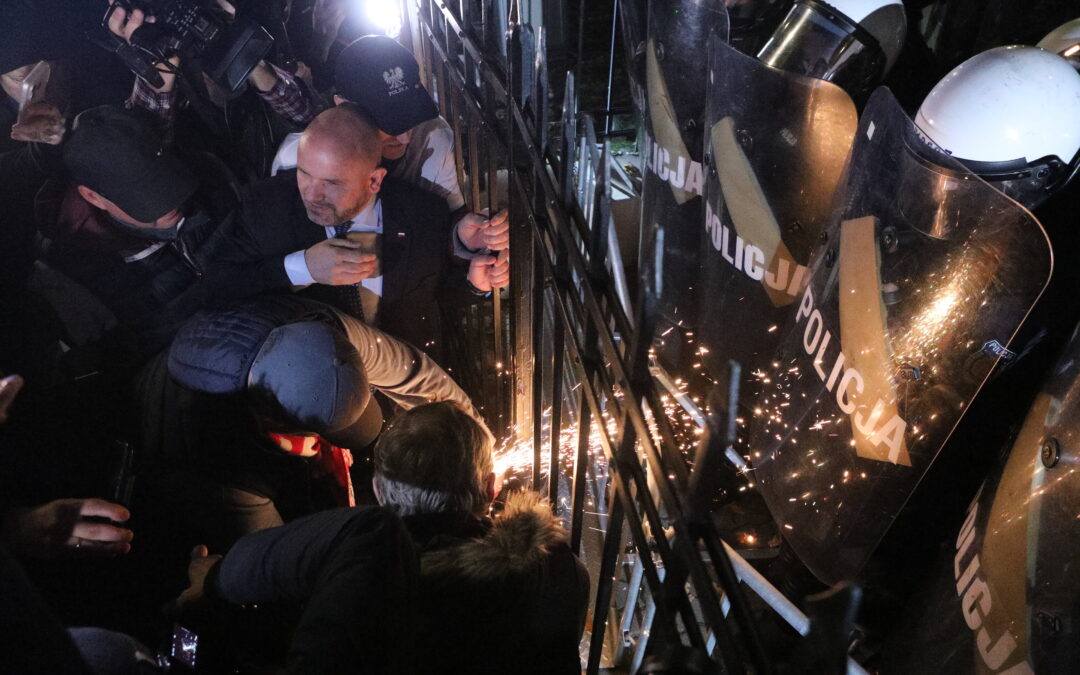
One of the government-backed judges said that she had suspended the chief justice, Bogdan Święczkowski, from his duties. Police have surrounded the court and were seen preventing Święczkowski from entering the grounds after his supporters had cut through the fence with a power tool.
Święczkowski and the opposition claim that an illegal “coup d’etat” is underway. Nawrocki, who had been flying to Senegal for a state visit, ordered his plane to turn around and return to Warsaw.
Prezes Świeczkowski wraz z grupą posłów przeciął łańcuchy i próbuje dostać się do trybunału konstytucyjnego.
Policja nie chce go przepuścić!
Przecież to bezprawie! pic.twitter.com/XbIXigwIi3
— Jan Molski 🇵🇱 (@JanMolski) October 30, 2026
The dramatic events follow a years-long crisis around the TK. Since the current government – a coalition ranging from left to centre right led by Prime Minister Donald Tusk – came to power in 2023, it has refused to recognise the court’s legitimacy.
That is because three of its judges were unlawfully appointed under the former national-conservative Law and Justice (PiS) government, which was widely seen to have brought the court under political control.
As a result, Tusk’s government has ignored the TK’s rulings and, until this year, refused to even nominate new judges to fill vacancies that arose on the court’s 15-person bench.
‘
That changed in March, when the ruling coalition began filling the backlog of empty seats. So far this year, parliament has chosen eight new judges, meaning that its nominees in theory now have a majority on the court.
However, under Polish law, although new TK judges are chosen by parliament, they must swear an oath “before the president”. Nawrocki, who is aligned with PiS, has refused to swear in five of those eight new judges, citing concerns over how they were chosen or their qualifications.
Those five judges arranged their own swearing-in ceremonies in parliament and submitted their oaths to the president’s office. However, Święczkowski, who before being appointed as a TK judge had served in the former PiS government, refused to accept those five judges on the court.
In doing so, he ignored an order by the European Court of Human Rights that the judges be allowed to take up their positions. Święczkowski argued that the ECHR had no authority to issue such a ruling.
The standoff between the government and president over Poland’s constitutional court deepened today, as Maciej Berek, whom the prime minister recently described as his “right-hand man”, took his oath as a new judge without the presence of the president https://t.co/MrExiJRsEN
— Notes from Poland 🇵🇱 (@notesfrompoland) October 14, 2026
Rumours have long swirled that the government would introduce those judges onto the court by force. PiS supporters have been camped outside the TK grounds for weeks with the aim of preventing that from happening.
On Friday evening, large numbers of riot police were deployed around the TK. On the court’s website, a brief statement appeared, saying that a “break in the activities” of Święczkowski and his deputy chief justice, Bartłomiej Sochański, had been ordered.
The statement did not say who had ordered that break, but it cited article 130 of the law on common courts, under which the president of a court or the justice minister can order an immediate break in a judge’s official duties if they are caught in the act of committing an offence.
However, Marcin Matczak, a prominent scholar of constitutional law who was also a critic of PiS’ judicial reforms, wrote on social media, that, while the justice minister exercises oversight over common courts, he cannot do so over the TK.
“I consider Bogdan Święczkowski to be the worst person to serve as the president of the TK,” wrote Matczak. “I never thought I’d end up defending him, but this legal basis [for suspending Święczkowski] is nonexistent for a million reasons.”
Ze szczątkowych informacji, na jakiej podstawie zawieszono B. Święczkowskiego, wynika, że ma to być art. 19 ustawy o statusie sędziów TK, który mówi, że do spraw nieuregulowanych w tej ustawie stosuje się „przepisy dotyczące praw i obowiązków sędziów SN” i art. 130 ustawy o SN,…
— Marcin Matczak (@wsamraz) October 30, 2026
Meanwhile, Waldemar Żurek, the justice minister and prosecutor general, issued a statement announcing that he had submitted motions to the TK to waive the immunity from prosecution of Świeczkowski and Sochański.
He said that the documents had been “delivered to the longest-serving judge of the Constitutional Tribunal”.
That was a reference to Anna Korwin-Piotrowska, one of the TK judges whom Nawrocki has refused to swear in. She told state broadcaster TVP that it was she who had issued the order to suspend Święczkowski from his duties.
She justified her action by accusing Święczkowski of blocking judges from taking up their positions and of overseeing irregularities in the assignment of judges to cases, reports Polskie Radio.
Korwin-Piotrowska’s claim to have the longest tenure among TK judges relates not to her service on tribunal itself, but to the fact that she first began her judicial career in 1995.
🗣️ “Bogdan Święczkowski narusza zasady funkcjonowania TK. (…) Nie było innego wyjścia”
– sędzia Anna Korwin-Piotrowska w TVP Info. pic.twitter.com/22FYJJbQAC
— tvp.info 🇵🇱 (@tvp_info) October 30, 2026
While the TK website appears to now be under the control of Korwin-Piotrowska, the court’s account on social media service X issued a statement saying that “an unlawful takeover of the TK’s website has occurred”, that “Bogdan Święczkowski remains chief justice”, and that “Korwin-Piotrowska is not a TK judge”.
“All persons participating in these actions are committing the crime of a coup d’état,” it added.
Nastąpiło bezprawne przejęcie strony internetowej Trybunału Konstytucyjnego.
Prezesem @TK_GOV_PL jest nadal Bogdan Święczkowski, a Wiceprezesem Bartłomiej Sochański.
Pani Anna Korwin-Piotrowska nie jest sędzią Trybunału Konstytucyjnego.
Wszystkie osoby uczestniczące w…
— Trybunał Konstytucyjny (@TK_GOV_PL) October 30, 2026
The court’s spokeswoman, Weronika Ścibor, told broadcaster Kanał Zero that “seven people elected as [TK] judges this year” had been escorted into the building by officers from the State Protection Service (SOP), a body responsible for protecting state officials. SOP is subordinate to the interior minister.
She said they had entered the grounds of the court through a gate that leads from the prime minister’s chancellery, rather than the main entrance from the street where protesters are gathered.
Korwin-Piotrowska also confirmed to TVP that she was one of seven judges who were inside the TK on Friday evening.
Rzeczniczka Trybunału Konstytucyjnego Weronika Ścibor komentuje sytuację w TK.
Według jej relacji siedem osób wybranych na sędziów weszło do budynku w asyście funkcjonariuszy SOP, natomiast wiceprezes Bartłomiej Sochański nie został wpuszczony na teren Trybunału. pic.twitter.com/VwxU4UrYuz
— OficjalneZero (@OficjalneZero) October 30, 2026
The developments at the court prompted outrage from the opposition. PiS leader Jarosław Kaczyński declared outside the court that “as of today, Poland has become a police state, and from there it’s a straight path to authoritarianism, and then to totalitarianism”.
Kaczyński called on Nawrocki to return to Poland from his state visit to Senegal and defend the court. The president himself quickly confirmed that he had done so, with flight trackers showing his plane turning around in midair and heading back to Poland.
Meanwhile, Zbigniew Kapiński, the chief justice of the Supreme Court – a separate entity from the Constitutional Tribunal – told Kanał Zero that he was “appalled” by what was happening, which was “undoubtedly a coup d’etat”.
Our most tracked flight right now: A Polish government aircraft en route to Senegal is now returning to Warsaw. https://t.co/YdLhQmV8pl pic.twitter.com/Dz9KPgI3eI
— Flightradar24 (@flightradar24) October 30, 2026
Tusk, however, issued a statement on social media defending what was taking place at the TK.
“Restoring the rule of law is our duty,” he wrote. “After years of PiS-led lawlessness, this is a difficult process, sometimes painful, and it requires decisive action. There is no other way.”
Notes from Poland is run by a small editorial team and published by an independent, non-profit foundation that is funded through donations from our readers. We cannot do what we do without your support.
Main image credit: Michal Borowczyk / Agencja Wyborcza.pl

Daniel Tilles is editor-in-chief of Notes from Poland. He has written on Polish affairs for a wide range of publications, including Foreign Policy, POLITICO Europe, EUobserver and Dziennik Gazeta Prawna.