Keep our news free from ads and paywalls by making a donation to support our work!

Notes from Poland is run by a small editorial team and is published by an independent, non-profit foundation that is funded through donations from our readers. We cannot do what we do without your support.
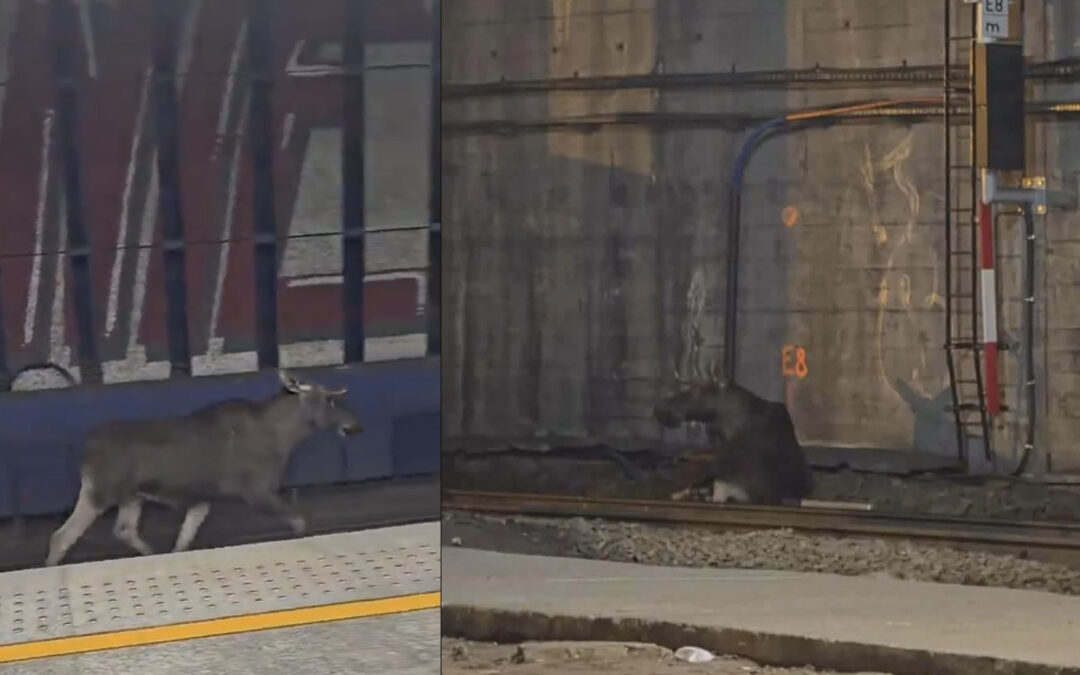
A moose wandered onto the tracks at Warsaw Central Station on Sunday evening, disrupting rail services in the Polish capital for more than 80 minutes before it was safely removed.
The animal first appeared on a platform before moving onto the tracks, forcing Polish Railway Lines (PLK), the company responsible for Poland’s rail infrastructure, to suspend, cancel and divert several train services.
View this post on Instagram
Videos and photographs shared online showed the moose lying on the tracks and running along the railway line at Warsaw Central, the capital’s busiest station, which is mainly underground and therefore not easy for such a large animal to access.
Police do not know how the moose ended up at the station, reports broadcaster TVN24. Officers were first alerted at 7:10 pm on Sunday and cordoned off the platform where the animal was located.
When emergency services arrived, the moose was tranquilised. It was then placed on a large sheet and carried out of the station by police officers and emergency workers before being loaded onto a specialist vehicle to be returned to a forested area.
PLK, which named the moose Emil, later confirmed that the animal had been safely removed and that normal train services were being restored.
The company added that the disruptions lasted just over 80 minutes, using a pun combining the Polish words for moose (łoś) and 80 (osiemdziesiąt) to produce the word “łosiemdziesiąt”.
❗Aktualizacja❗Zwierze zostało bezpiecznie zabrane z torów. Przywracana jest rozkładowa organizacja ruchu pociągów. Utrudnienia trwały przeszło łosiemdziesiąt minut. https://t.co/Xui2B6SxyU
— PLK SA (@PKP_PLK_SA) September 13, 2026
The Eurasian moose (also known as the Eurasian elk) has long been native to Poland, but by the mid-20th century hunting and habitat loss had brought the species close to extinction in the country.
Its population subsequently recovered, reaching an estimated 6,000 animals by the 1980s and around 30,000 by 2019, helped by a moratorium on moose hunting introduced in 2001.
Several hundred live in the Kampinos national park on the northwestern outskirts of Warsaw. They are therefore relatively frequent visitors to the capital, according to the Interia news website, although venturing onto train lines in the centre is unusual.
The growth in the moose population, combined with urban expansion and changes to its habitat, has led to other high-profile encounters in areas inhabited by humans. In 2022, a moose was spotted on the roof of a shopping centre in the northern Polish city of Elbląg.
A moose was this morning spotted on the roof of a shopping centre in Poland.
The animal, which had got stuck in the rooftop car park, was safely sedated and will be released in a nearby forest https://t.co/lwL1gTFl7l
— Notes from Poland 🇵🇱 (@notesfrompoland) April 26, 2022
Notes from Poland is run by a small editorial team and published by an independent, non-profit foundation that is funded through donations from our readers. We cannot do what we do without your support.
Main image credits: @Lil_rzep/Tik Tok and PLK/X

Alicja Ptak is deputy editor-in-chief of Notes from Poland and a multimedia journalist. She has written for Clean Energy Wire and The Times, and she hosts her own podcast, The Warsaw Wire, on Poland’s economy and energy sector. She previously worked for Reuters.