Keep our news free from ads and paywalls by making a donation to support our work!

Notes from Poland is run by a small editorial team and is published by an independent, non-profit foundation that is funded through donations from our readers. We cannot do what we do without your support.
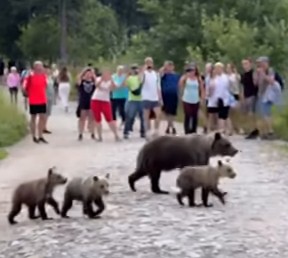
A female brown bear and her three cubs have been spotted in Poland’s Tatra mountains crossing a popular trail filled with hikers, with the animals coming unusually close to people.
According to an official from Tatra National Park, where the incident took place, the behaviour could be a survival strategy by the mother to protect her young from male bears, which can kill cubs but tend to avoid humans.
In a video posted on Sunday, the mother and three cubs were seen crossing the Chochołowska Valley trail in broad daylight, as crowds of people looked on.
Videos of the bear family have appeared increasingly often on social media, prompting questions about whether the animals are becoming less wary of people. But park officials say the female’s behaviour may have a biological explanation.
“As we know, male brown bears are infanticidal. They kill not only other bears’ cubs, but their own as well. So the females, to avoid contact with the males, tend to stay closer to people,” Tomasz Zwijacz-Kozica, a park official, told local newspaper Gazeta Krakowska.
“Females sense this instinctively and generally use the presence of people as a sort of shield to defend themselves against these males,” he added.
The park staff hope to gather more detailed data on the female bear’s movements and behaviour in the future by possibly fitting her with a telemetry collar. They note that similar behaviour has been seen before. Around 20 years ago, a female bear drew attention when hundreds of tourists photographed her.
They advise visitors to remain calm if they encounter a bear and to follow several basic rules, including staying calm and not running or making sudden movements, which may trigger a pursuit; not approaching the animals; and not attempting to take close-up photographs or use a flash.
If a bear is encountered, visitors should slowly retreat in the direction from which they came while maintaining eye contact with the animal. Particular caution is required when cubs are present.
Visitors should also avoid feeding bears or leaving rubbish behind. The smell of food can attract animals to trails and encourage behaviour that brings them into dangerous contact with people.
A woman has died after being attacked by a bear in a forest in southeastern Poland.
Such incidents are extremely rare, with the last fatal bear attack in the country reported in 2014 https://t.co/sAC2MPAvfh
— Notes from Poland 🇵🇱 (@notesfrompoland) April 23, 2026
Estimates of Poland’s brown bear population vary between 120 and 400, with most found in the southeastern Bieszczady mountains as well as the Tatras and Beskids further west. The population is thought to be growing, with a rise in reports of encounters with humans.
In April this year, a woman was killed in a bear attack, Poland’s first such fatality since 2014. Another bear attack earlier in the year in the same region left a man with head and limb injuries.
In March, the government launched a new 16 million zloty (€3.7 million) scheme aimed at both protecting bears and ensuring the safety of their human neighbours. It includes the creation of a special force to monitor and respond to bear sightings, including fitting the animals with tracking collars.
In 2022, the town of Zakopane, located at the foot of the Tatra mountains, installed bear-proof rubbish bins to prevent animals from foraging in them – and thereby coming closer to areas of human population.
Poland has launched a new programme to protect brown bears and ensure the safety of their human neighbours, amid growing reports of encounters.
A special force will be set up to respond to bear sightings and fit the animals with tracking collars https://t.co/GEOCpnEj70
— Notes from Poland 🇵🇱 (@notesfrompoland) March 21, 2026
Notes from Poland is run by a small editorial team and published by an independent, non-profit foundation that is funded through donations from our readers. We cannot do what we do without your support.
Main image credit: Tatry/Facebook

Alicja Ptak is deputy editor-in-chief of Notes from Poland and a multimedia journalist. She has written for Clean Energy Wire and The Times, and she hosts her own podcast, The Warsaw Wire, on Poland’s economy and energy sector. She previously worked for Reuters.