Keep our news free from ads and paywalls by making a donation to support our work!

Notes from Poland is run by a small editorial team and is published by an independent, non-profit foundation that is funded through donations from our readers. We cannot do what we do without your support.
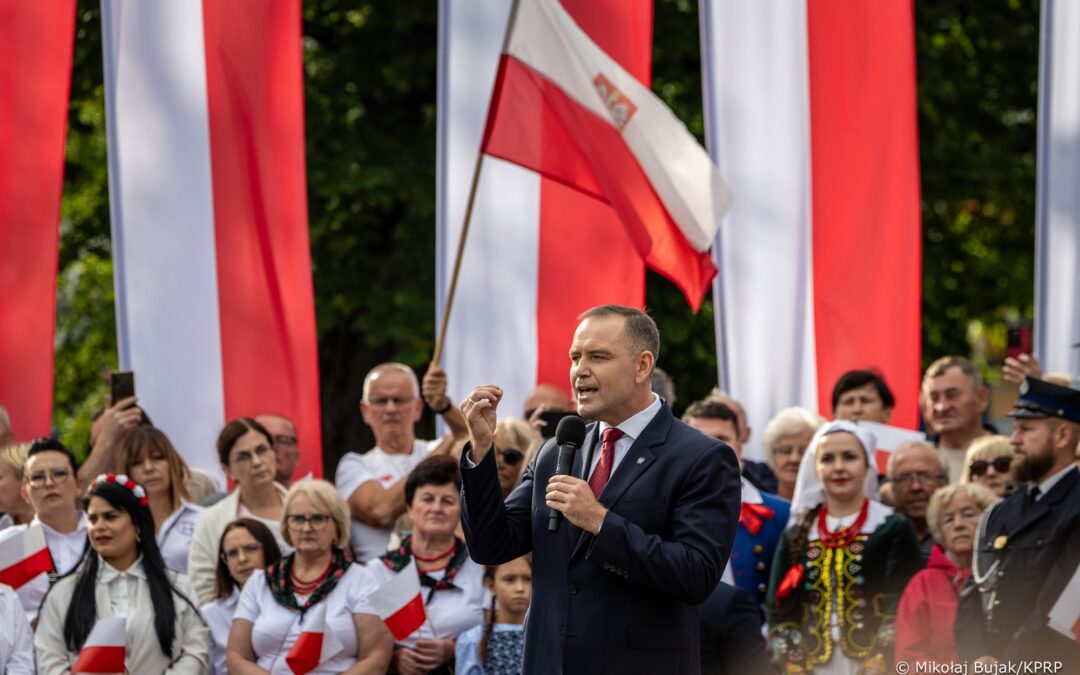
President Karol Nawrocki has submitted a second request to parliament for a nationwide referendum on whether Poland should continue implementing the European Union’s climate policies, which he argues are too costly.
Nawrocki, who is aligned with the right-wing opposition, first proposed a referendum in May. But it was rejected by the Senate, the upper house of parliament, where the more liberal government has a majority. Senators argued that the proposed referendum question was “absurd”.
The president has now submitted a revised proposal featuring a simplified question and again proposed holding the referendum on 27 September this year.
— Kancelaria Prezydenta RP (@prezydentpl) July 23, 2026
Nawrocki’s originally proposed question was: “Are you in favour of implementing EU climate policy, which has led to an increase in citizens’ cost of living, energy prices and the cost of running business and agricultural activity?”
However, following criticism in the Senate that the question was clearly intended to elicit a specific answer, this time he has proposed a more neutral one: “Are you in favour of Poland implementing the European Union’s climate policy?”
“I’m looking for compromises, looking for solutions,” said Nawrocki on Thursday while announcing the new referendum bid. “The Senate wasn’t satisfied with the [previous] question”, so “we prepared a different one…[that] does not suggest anything”.
However, the president has also proposed that the ballot paper would include information on what answering “yes” or “no” would mean in practice.
Voters would be told, for example, that maintaining EU climate policy would result in, among other things, “Poland bearing costs estimated at 3.5 trillion zloty by 2040”, “burdens on agriculture”, “increasing costs for industry” and “obligations for owners of buildings”.
By contrast, voting “no” would mean “negotiating exceptions and exemptions for Poland with the relevant EU bodies that will protect Polish industry and citizens from the burdens of climate policy”.
Poland's right-wing opposition wants to withdraw from the EU Emissions Trading System, saying it makes Poles "a cash machine for absurd leftist climate policies"@PStrzalkowski explains what costs ETS really brings, and what prospects there are for reform https://t.co/UxpMWpG1pE
— Notes from Poland 🇵🇱 (@notesfrompoland) May 4, 2026
Under Poland’s constitution, the president may call a referendum with the approval of a majority of senators in a vote where at least half of all members of the 100-seat chamber are present.
The ruling coalition of Prime Minister Donald Tusk controls 63 seats in the Senate, making approval of proposals brought forward by Nawrocki, who often clashes with the government and regularly vetoes its bills, unlikely.
While the government is generally pro-EU, it has also been critical of Brussels’ green policies, arguing that they place too great a burden on Poland.
After the European Commission last Friday unveiled changes intended to soften the impact of the Emissions Trading Scheme (ETS), the EU’s flagship climate policy, they were welcomed by the Polish government as a step in the right direction.
Dzisiaj robimy milowy krok w zmianie systemu ETS. Po raz pierwszy Komisja Europejska proponuje rozwiązania, które łagodzą, a nie zaostrzają wpływ systemu na gospodarkę i obywateli. To efekt konsekwentnych działań Polski i zbudowania silnej koalicji państw w UE. Dzisiejsza… pic.twitter.com/5AMd9KCBVa
— Ministerstwo Klimatu i Środowiska (@MKiS_GOV_PL) July 17, 2026
However, in his written justification for the new referendum proposal, Nawrocki wrote that, while he had “given the government time” in its push for ETS reform, the final result was simply “technical adjustments” that postpone some elements but do “not change the direction” or ultimate outcome.
“ETS will remain an increasingly expensive, increasingly extensive system, and increasingly burdensome for the Polish economy,” wrote the president.
The national-conservative Law and Justice (PiS), which is the main opposition and supported Nawrocki’s bid for the presidency last year, wants Poland to unilaterally withdraw from ETS. Government figures warn, however, that there is no way to do so without either accruing enormous fines or leaving the EU entirely.
When in power, PiS launched a revolution in Poland's energy transition. But now, in opposition, it has disowned those achievements and returned to an emphasis on coal.
This could be a missed opportunity to win back centrist voters, writes @OrzelBartlomiej https://t.co/8cGvubn7N2
— Notes from Poland 🇵🇱 (@notesfrompoland) June 29, 2026
Nawrocki’s new referendum proposal was met with criticism by figures from the ruling coalition. “There is no possibility of one country suspending part of EU law,” wrote Stanisław Gawłowski, a senator from Tusk’s Civic Coalition (KO) party. “This referendum is pure fraud.”
Foreign minister Radosław Sikorski, also from KO, wrote that, “as the Brits have learned, the Europhobe’s dream world, in which one enjoys all the privileges of EU membership without any obligations, does not exist”.
However, Nawrocki’s initiative was welcomed by Przemysław Czarnek, deputy leader of PiS, who wrote that, “on such fundamental matters as climate policy, Poles should decide, not Brussels bureaucrats”.
Zaproponowane przez @NawrockiKn pytanie referendalne jest wybiórcze. Kontrpropozycja: „Czy jesteś za likwidacją unijnych dopłat do inwestycji i dla rolników?”
Jak przekonali się Brytyjczycy, świat eurofoba, w którym ma się same przywileje członkostwa w UE, nie istnieje.— Radosław Sikorski 🇵🇱🇪🇺 (@sikorskiradek) July 23, 2026
Notes from Poland is run by a small editorial team and published by an independent, non-profit foundation that is funded through donations from our readers. We cannot do what we do without your support.
Main image credit: Mikołaj Bujak/KPRP

Alicja Ptak is deputy editor-in-chief of Notes from Poland and a multimedia journalist. She has written for Clean Energy Wire and The Times, and she hosts her own podcast, The Warsaw Wire, on Poland’s economy and energy sector. She previously worked for Reuters.