Keep our news free from ads and paywalls by making a donation to support our work!

Notes from Poland is run by a small editorial team and is published by an independent, non-profit foundation that is funded through donations from our readers. We cannot do what we do without your support.
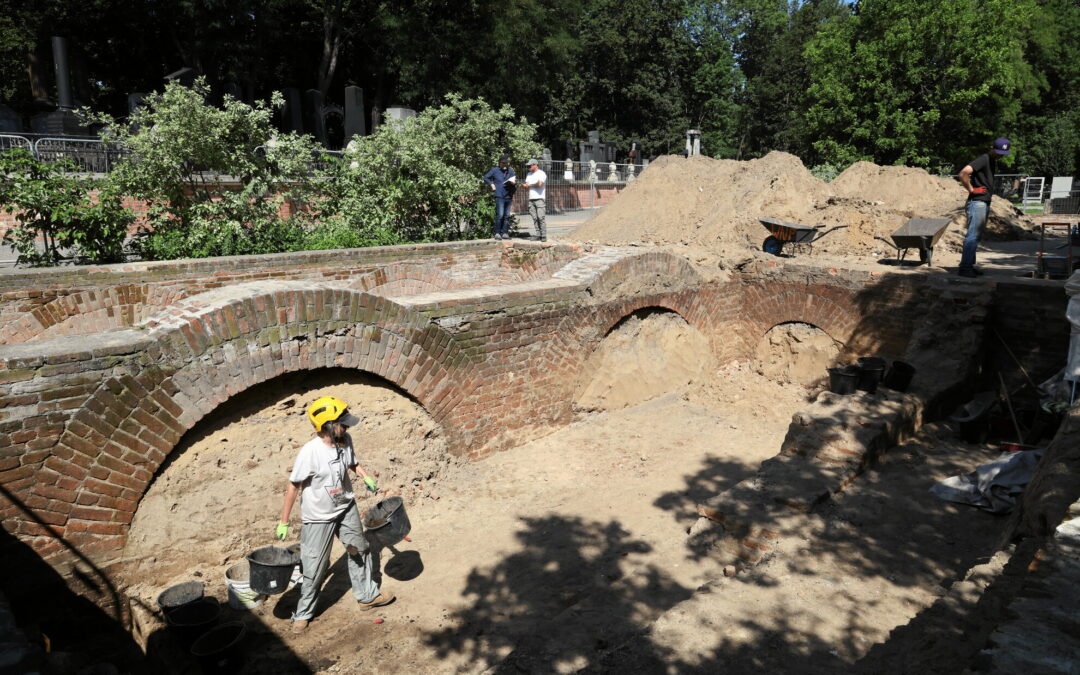
Archaeological work at a Jewish cemetery in Warsaw has uncovered the foundations of and many objects from a former synagogue and funeral home that was destroyed by the Nazi-German occupiers in 1943.
The finds were made at the cemetery on Okopowa Street, which, at around 33.5 hectares in size and with some 250,000 people buried there, is the second largest in Poland, after the Łódź Jewish cemetery, and one of the biggest anywhere in the world.
Following the Warsaw Ghetto Uprising of 1943, the Germans liquidated the ghetto, sending most of its remaining inhabitants to the gas chambers and destroying the buildings that remained there, including the synagogue and burial houses.
In June this year, archaeological work began at the site of the former synagogue, commissioned by Warsaw’s Jewish community, which owns and manages the cemetery.
The two-storey building, designed by architect Adolf Schimmelpfennig, a Pole of Dutch Lutheran descent, was constructed in 1877 and existed until 15 May 1943, when it was destroyed with explosives.
The archaeological work aims to “uncover, document and preserve the remains of this historic complex, maintaining the memory of this place and passing it on to future generations”, says the office of the conservator of monuments for Masovia, the province in which Warsaw is located and which is supervising the work.
Archaeologists have so far discovered numerous items that offer “silent testament to the daily life of the community that was connected to this site for decades”, says the conservator. They include ceramic floor and wall tiles, glass bottles and tiles from stoves used at the funeral home.
“Every discovered brick, fragment of flooring or piece of furniture helps reconstruct the history of one of the most important buildings in historic Warsaw,” adds the conservator.
Among the finds is an item that relates to a well-known and tragic story from the war, a door plaque from the office of the then-director of the cemetery, Abram Pozner.
Pozner brought members of his extended family to the funeral home at the start of the war, where they were initially able to remain in relative safety, away from the horrors of the ghetto that the occupiers forced Jews to live in.
As life became ever more brutal and dangerous for Jews, Pozner created an underground hideout within the cemetery. The Germans eventually found the bunker and killed most of those hiding there.
However, two of them managed to survive imprisonment in German labour camps, one of whom, Avraham Carmi, remains alive today and lives in Israel.
The current archaeological work is expected to be completed by the end of July, after which the foundations will be re-covered with earth. Warsaw’s Jewish community then hopes to restore the previous building, adapted to current conditions and needs, reports the Gazeta Wyborcza daily.
“The goal is to determine whether the funeral home could be rebuilt on these remains, or whether it would make more sense to display them as a monument within a newly constructed building, and also whether erecting a building on this site is even realistic,” cemetery director Witold Wrzosiński told the newspaper.
Archaeologist Szymon Lenarczyk, who has led the work at the site, says he has proposed that the structure of a future building should feature an underground room where discovered artefacts can be displayed.
Before World War Two, Warsaw was home to around 350,000 Jews, a third of its population and more than any city in the world other than New York. However, the vast majority were killed in the Holocaust, meaning that only a small Jewish community remains today.
Notes from Poland is run by a small editorial team and published by an independent, non-profit foundation that is funded through donations from our readers. We cannot do what we do without your support.
Main image credit: Robert Kowalewski / Agencja Wyborcza.pl

Daniel Tilles is editor-in-chief of Notes from Poland. He has written on Polish affairs for a wide range of publications, including Foreign Policy, POLITICO Europe, EUobserver and Dziennik Gazeta Prawna.