Keep our news free from ads and paywalls by making a donation to support our work!

Notes from Poland is run by a small editorial team and is published by an independent, non-profit foundation that is funded through donations from our readers. We cannot do what we do without your support.
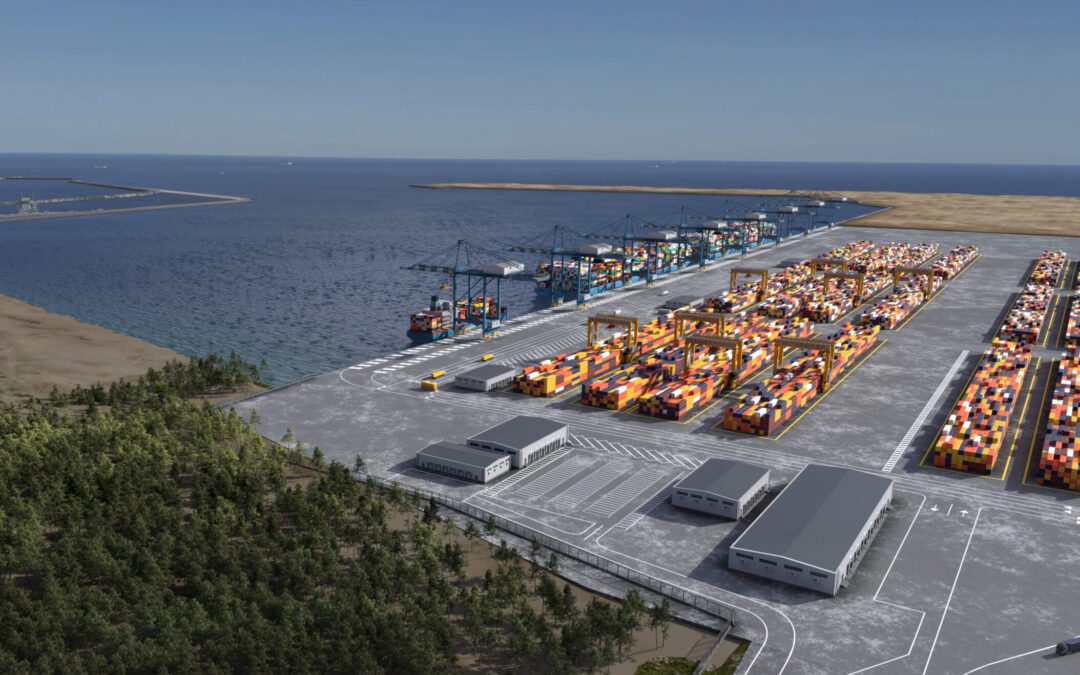
Poland has begun construction of a 10 billion zloty (€2.3 billion) deepwater port and container terminal in the city of Świnoujście, near the German border.
Named Cape Pomerania, the project is intended to strengthen Poland’s role in European maritime trade and create a major container hub for Central and Eastern Europe. The facility will also be designed for both civilian and defence use.
⚓ Startujemy z największą portową inwestycją w Polsce.
🚢Rozpoczyna się realizacja Projektu Przylądek Pomerania – największej inwestycji w ponad 75-letniej historii Zarządu Morskich Portów Szczecin i Świnoujście oraz jednej z największych inwestycji portowych realizowanych… pic.twitter.com/r2gJ9DjAb5
— Ministerstwo Infrastruktury (@MI_GOV_PL) July 13, 2026
Speaking at the launch of construction on Monday, infrastructure minister Dariusz Klimczak hailed Cape Pomerania as “the largest port investment in Poland’s recent history”, saying that it would help the country “compete with Europe’s leading ports”
Deputy infrastructure minister Arkadiusz Marchewka said the terminal would serve not only Poland but also markets including eastern Germany as well as the landlocked Czech Republic, Slovakia, Austria and Hungary, reports Business Insider Polska.
The port, which was first planned under the former Law and Justice (PiS) government, will include a 17-metre-deep basin and a 1.3-km-long main quay capable of handling up to three ocean-going container ships at the same time, including two vessels measuring up to 400 metres in length.
It is expected to have an annual handling capacity of 2 million twenty-foot equivalent units (TEU), the standard measure of container capacity. For comparison, all current Polish ports handled a combined 3.9 million TEU in 2025, which was a record level.
In December last year, Poland’s largest port, in the city of Gdańsk, completed an expansion of its own, increasing its annual capacity by almost 1.5 million TEUs to reach 4.5 million TEUs.
Poland's ports handled a record amount of cargo in 2025, driven by strong growth in container traffic (which was up 18%) and imports of liquefied natural gas (up 32%) https://t.co/nOFmqaB0Wj
— Notes from Poland 🇵🇱 (@notesfrompoland) January 28, 2026
The planned port in Świnoujście will use zero-emission cargo-handling technologies and shore power systems to reduce emissions and noise. It will also be built to support both civilian and military operations, reports the Polish Press Agency (PAP).
Construction has begun with the building of a technical access road and supporting infrastructure. The work, which will provide access for heavy equipment and construction crews to the offshore site, is expected to take 10 months. Construction of the terminal is then scheduled to be completed in 2030.
Associated infrastructure work includes deepening the 70-km approach channel, building more than 3 km of new railway infrastructure and creating 186 hectares of reclaimed land in the Bay of Pomerania.
Gdańsk in Poland has become the EU’s fifth-busiest port, overtaking Algeciras in Spain and HAROPA in France, the latest @EU_Eurostat data show.
Meanwhile, national data show that Poland’s ports reported record financial and operational results in 2024 https://t.co/q4QFf8df2G
— Notes from Poland 🇵🇱 (@notesfrompoland) January 15, 2025
However, the project, which is located within a protected natural area, has also faced some opposition from environmental groups and local residents on both the Polish and the German sides of the border.
Last year, a Warsaw court rejected a legal challenge from German and Polish green groups, which had argued that the port could cause significant environmental damage.
Monday’s inauguration of construction work was met with a small protest from Świnoujście residents, who said the port could threaten tourist attractions in the coastal city.
Demonstrators carried banners calling for an end to the “concreting of the Baltic Sea”, while one of them told local broadcaster Radio Szczecin that the project would “barbarically destroy the most valuable areas on the right bank of Świnoujście”.
A German group, Lebensraum Vorpommern, has filed a further legal challenge against Poland's plans to construct a deepwater shipping terminal near the border with Germany.
It claims the project "will lead to an environmental catastrophe"
https://t.co/vIg1qjt1Jq— Notes from Poland 🇵🇱 (@notesfrompoland) March 28, 2025
Notes from Poland is run by a small editorial team and published by an independent, non-profit foundation that is funded through donations from our readers. We cannot do what we do without your support.
Main image credit: Przylądek Pomerania materials

Alicja Ptak is deputy editor-in-chief of Notes from Poland and a multimedia journalist. She has written for Clean Energy Wire and The Times, and she hosts her own podcast, The Warsaw Wire, on Poland’s economy and energy sector. She previously worked for Reuters.