Keep our news free from ads and paywalls by making a donation to support our work!

Notes from Poland is run by a small editorial team and is published by an independent, non-profit foundation that is funded through donations from our readers. We cannot do what we do without your support.
The Polish authorities have detained a man suspected of carrying out the murder of a Russian dissident, Semyon Skrepetsky, who was shot dead this week near his home in Poland.
The arrest was announced by Prime Minister Donald Tusk, who said that the suspect was using a Georgian passport. Speaking earlier, Tusk said that all evidence indicates the murder was a “political assassination” and that, if it was ordered by Russia, it would represent “state terrorism”.
Podejrzewany o udział w zabójstwie Rosjanina w Białej Podlaskiej zatrzymany przez lubelskich policjantów i ABW! Posługuje się gruzińskim paszportem. Służby pracują nad ustaleniem zleceniodawcy.
— Donald Tusk (@donaldtusk) June 18, 2026
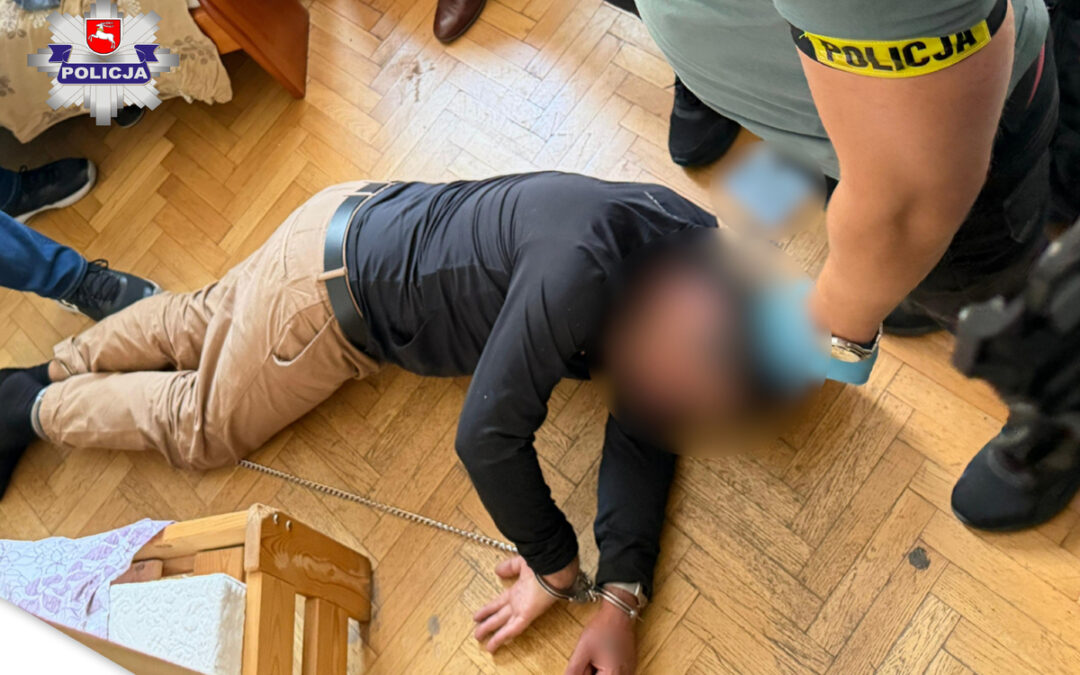
In a separate statement on Thursday, Polish police confirmed that they had “arrested a man near Warsaw suspected of murdering [Skrepetsky]” and shared an image of the suspect being detained at a hostel where he had been staying. They added that he “is using a passport issued to a 36-year-old Georgian citizen”.
At a subsequent press conference, the minister responsible for the security services, Tomasz Siemoniak, said that the suspect had been identified through analysis of surveillance footage, communications and witness statements.
Speaking alongside Siemoniak, interior minister Marcin Kierwiński revealed that the detained man was also suspected of carrying out other crimes in Poland, dating back to 2022. However, he offered no further details of the nature of those offences.
Prosecutors have confirmed that the man shot dead in Poland yesterday was a Russian dissident who went by the name Semyon Skrepetsky.
They also announced that two Belarusians have been detained in relation to the incident https://t.co/mumkh56sd6
— Notes from Poland 🇵🇱 (@notesfrompoland) June 16, 2026
Both Tusk and Kierwiński said that investigators are now also seeking to determine upon whose orders Skrepetsky (whose real name was Robert Kuzovkov) was killed.
“This may be a method used by foreign [security] services to hire criminals for various activities,” said Siemoniak. “We’ve seen this in previous years, although it did not involve murders; it involved the committing of assaults.”
Siemoniak noted that “assassinations have been carried out recently in various countries, for example in Germany a few years ago, at the behest of Russian intelligence agencies”.
“So we must seriously assume that if someone who is an open critic of Putin and Kadyrov dies in this manner, it is a plausible hypothesis,” he added. “But it needs to be supported by evidence.”
Skrepetsky was shot five times near his home in the eastern Polish town of Biała Podlaska on Monday morning.
He was an artist whose work focused on creating satirical cartoons mocking Russian leader Vladimir Putin. He had fled Russia in 2021 due to fear of political prosecution. Days before his death, Skrepetsky had held a protest outside the Russian embassy in Berlin.
Skrepetsky had reported on social media that he had received death threats from supporters of Chechen leader and Putin ally Ramzan Kadyrov, who had also been the subject of the artist’s satirical cartoons.
After his death, local police immediately began a manhunt for the perpetrator, as a result of which they detained two Belarusians, aged 33 and 37, near the Belarusian consulate in Biała Podlaska. However, Kierwiński confirmed today that they “had no connection with the murder” and had been released.
Podejrzewany o zabójstwo 44-letniego obywatela Rosji w Białej Podlaskiej zatrzymany❗️
Do zatrzymania doszło dzisiaj rano pod Warszawą przez policjantów @PolicjaLubelska, we współpracy z funkcjonariuszami @ABW_GOV_PL.
Zatrzymany mężczyzna posługuje się paszportem wystawionym na… pic.twitter.com/D7v7QLPJNr
— Polska Policja 🇵🇱 (@PolskaPolicja) June 18, 2026
On Wednesday, before today’s arrest of the Georgian suspect, Tusk said that “everything points to this being a political assassination”, but that it is necessary to “wait for more concrete evidence”. However, he added that, if Russia’s involvement in the murder is confirmed, it would point to “state terrorism”.
Tusk also noted that both the police and the Internal Security Agency (ABW) had offered Skrepetsky protection. “For reasons unknown to them, he refused,” Tusk told reporters.
In recent years, Poland has become a primary target for Russia’s campaign of so-called “hybrid warfare”, including sabotage, arson, disinformation and cyberattacks, as well as drone incursions.
Poland is the "primary focus" of Russia's sabotage campaign in Europe, finds a new report by the International Centre for Counter-Terrorism.
Among 151 incidents identified since 2022, 31 of them took place in Poland – more than in any other country https://t.co/QXfSI00FD6
— Notes from Poland 🇵🇱 (@notesfrompoland) March 3, 2026
Notes from Poland is run by a small editorial team and published by an independent, non-profit foundation that is funded through donations from our readers. We cannot do what we do without your support.
Main image credit: Policja Lubelska (under CC BY-SA 4.0)
Alicja Ptak is deputy editor-in-chief of Notes from Poland and a multimedia journalist. She has written for Clean Energy Wire and The Times, and she hosts her own podcast, The Warsaw Wire, on Poland’s economy and energy sector. She previously worked for Reuters.