Keep our news free from ads and paywalls by making a donation to support our work!

Notes from Poland is run by a small editorial team and is published by an independent, non-profit foundation that is funded through donations from our readers. We cannot do what we do without your support.
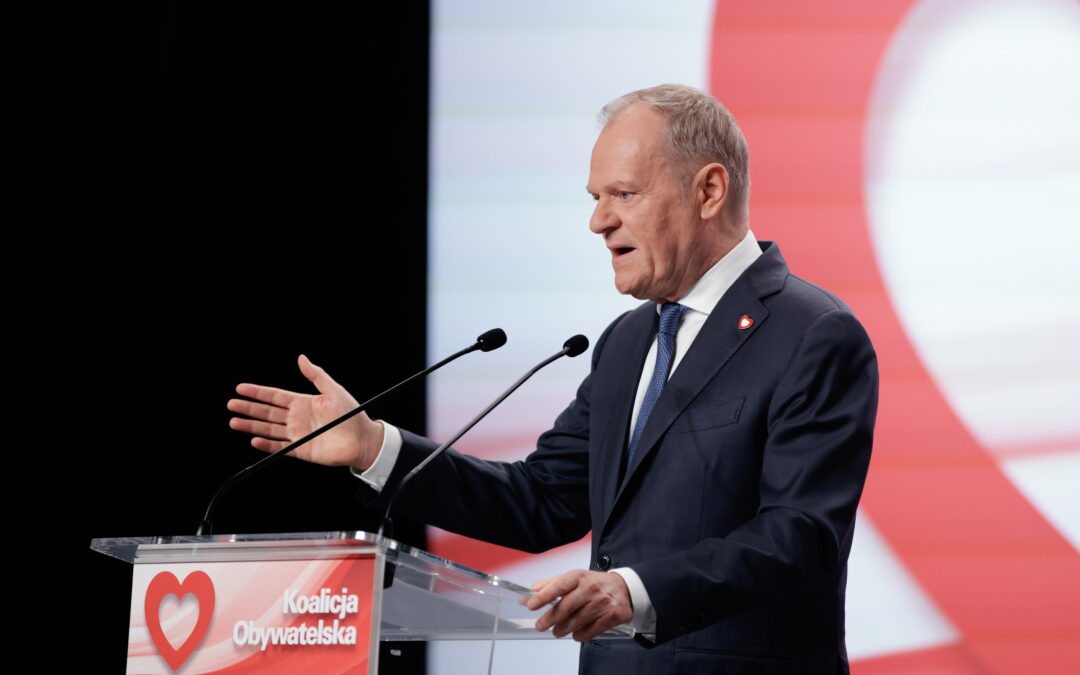
Polish Prime Minister Donald Tusk has accused his country’s own president, Karol Nawrocki, and the right-wing opposition of being part of a “Putinist front” that serves Russia’s interests by harming relations with the European Union and Ukraine and undermining democratic institutions.
Meanwhile, during the same speech at a congress of his centrist Civic Coalition (KO) on Saturday, the prime minister also unveiled a group of ten figures from the party who will “lead us into battle” at next year’s parliamentary elections, and potentially beyond once Tusk steps down as leader.
Wszędzie tam, gdzie widzimy realizację interesów Putina, widzimy ludzi PiSu i Konfederacji❗
💬 Premier @DonaldTusk 👇 pic.twitter.com/5jJc5fszmm
— Koalicja Obywatelska (@Obywatelska_KO) April 11, 2026
Tusk declared that Putin has a five-point plan for Poland that involves “weakening and breaking up the EU”; “dividing Poland from Ukraine”; “setting Poland against Germany”; preventing Poland from bolstering its military readiness; and “destroying the institutions of a democratic state”.
He argued that these aims are identical to those of Jarosław Kaczyński, the leader of the national-conservative Law and Justice (PiS), Poland’s main opposition party. PiS also backed Nawrocki’s successful bid for the presidency last year and is closely aligned with him.
PiS and Nawrocki regularly criticise the EU and Germany, have recently become more critical of Ukraine, have sought to prevent Poland from taking EU loans for defence spending, and have created chaos in key institutions such as the constitutional court, argued Tusk. “Putin’s five [aims] are [also] Kaczyński’s five.”
Jarosław Kaczyński says it is vital for Viktor Orbán to win re-election so that the European right can fight "German neo-imperialism".
He also defended Orbán’s ties with Russia, saying he “has no choice” because of Hungary’s dependence on Russian energyhttps://t.co/CXqAsUAvzk
— Notes from Poland 🇵🇱 (@notesfrompoland) March 30, 2026
The prime minister described the opposition, which also includes the far-right Confederation (Konfederacja), as a “modern Targowica”, referring to a group of 18th-century Polish nobles aligned with Russia whose actions helped cause the dismemberment of Poland. The term has become synonymous with being a traitor.
Tusk noted that, across Europe, in the actions of right-wing and far-right leaders we can see “a Putinist front – and here we [also] see Kaczyński, Nawrocki and Confederation in this Russian activity in Europe”.
“Wherever we see Putin and Moscow’s political interests being pursued, Kaczyński’s, Nawrocki’s and [Confederation leader Sławomir] Mentzen’s people appear as well.”
PiS and Nawrocki are, in fact, ardently anti-Russian in their rhetoric. Nawrocki often proudly notes that he is on a Russian wanted list for his work leading efforts to demolish Soviet-era monuments in Poland. When in government, PiS strongly supported Ukraine and ended almost all Russian energy imports.
But Tusk said he is “completely uninterested” in whether members of the Polish right are working in Russia’s interests consciously or simply through “stupidity”. “What truly matters is the consequence of their actions.”
As one example of PiS’s alignment with Russia’s interests, Tusk noted that politicians from the party have gone to Budapest this weekend to support Moscow-friendly Prime Minister Viktor Orbán in his campaign for today’s parliamentary elections.
The prime minister also pointed to the fact that PiS, Confederation and Nawrocki have prevented the government from introducing tougher regulation of the crypto-assets market, which he claimed is used by Russia to channel “dirty money” in Europe, including to fund sabotage actions in Poland.
Given the threat posed by the opposition, next year’s Polish parliamentary elections in Poland will be a “final battle for Poland’s independence, security, unity, and position in Europe”, declared Tusk, “a confrontation between evil and good, east and west, two different civilisations”.
The national-conservative opposition PiS party has named its candidate to be prime minister if it wins next year’s parliamentary elections.
Przemysław Czarnek is a hardline conservative who played a prominent role in PiS's campaign against "LGBT ideology" https://t.co/sSJLON00hW
— Notes from Poland 🇵🇱 (@notesfrompoland) March 7, 2026
Tusk then unveiled a group of ten politicians from his party whom he has tasked with preparing the campaign for the elections, which are due to take place in autumn 2027, but also with charting the party’s longer-term path, including when Tusk, now aged 68, steps down.
“No one lasts forever, so I also need to think about those who will be able to continue this great work of defending and building the republic,” said the prime minister.
The group of ten include finance minister Andrzej Domański, government spokesman Adam Szłapka, and five deputy government ministers: Aleksandra Gajewska (labour), Cezary Tomczyk (defence), Arkadiusz Marchewka (infrastructure), Maciej Wróbel (culture), and Małgorzata Gromadzka (agriculture).
The remaining three are KO members of parliament without a current government position: Monika Rosa, Maciej Tomczykiewicz and Paweł Bliźniuk. All ten of the group are aged in their 30s or 40s.
Oto nasza #10NaWybory❗️ pic.twitter.com/Jbhng0mKTZ
— Koalicja Obywatelska (@Obywatelska_KO) April 11, 2026
Last month, PiS unveiled the figurehead of its own election campaign, Przemysław Czarnek, whom the party says it wants to become prime minister if it wins enough seats to form a new government.
PiS has itself regularly accused Tusk of representing Russian interests, pointing to his more cordial relations with Moscow during his first term as prime minister from 2007 to 2014.
In 2023, a commission to investigate Russian influence in Poland, set up when PiS was in office, issued a report recommending that Tusk not be allowed to hold public office because he had allowed the Military Counterintelligence Service (SKW) to fall under Russian influence when he served as head of government.
When PiS lost elections that same year to a coalition led by Tusk, Kaczyński claimed that Germany and Russia stood behind the new government. He has also accused Tusk’s previous government of helping cover up Russian involvement in the plane crash that killed his twin brother, President Lech Kaczyński.
In his first remarks since the ruling party lost its majority at Sunday's elections, Jarosław Kaczyński has suggested that "external forces" – especially Germany and Russia – are behind the opposition parties now set to form a new government https://t.co/iHuHEMmUik
— Notes from Poland 🇵🇱 (@notesfrompoland) October 21, 2023
Notes from Poland is run by a small editorial team and published by an independent, non-profit foundation that is funded through donations from our readers. We cannot do what we do without your support.
Main image credit: Dawid Zuchowicz / Agencja Wyborcza.pl

Daniel Tilles is editor-in-chief of Notes from Poland. He has written on Polish affairs for a wide range of publications, including Foreign Policy, POLITICO Europe, EUobserver and Dziennik Gazeta Prawna.