Keep our news free from ads and paywalls by making a donation to support our work!

Notes from Poland is run by a small editorial team and is published by an independent, non-profit foundation that is funded through donations from our readers. We cannot do what we do without your support.
By Aleks Szczerbiak
The right-wing Polish president’s veto of an EU defence loan programme ignited a fierce clash with the liberal-centrist-led government, crystallising deep divides over military modernisation and EU relations. While the president minimised the anticipated political costs, the dispute sharpened polarisation and turbocharged the ruling coalition’s “Polexit” and security narratives.
A politically explosive veto
Last month, Polish President Karol Nawrocki – who is aligned with the right-wing Law and Justice (PiS) party, the country’s main opposition grouping – vetoed government legislation creating a financial instrument enabling Poland to access its €43.7 million allocation from the EU’s Security Action for Europe (SAFE) defence procurement initiative.
The loan programme, of which Poland is the largest beneficiary, is aimed at strengthening military capabilities across the bloc amid heightened concerns about the security of NATO’s eastern flank.
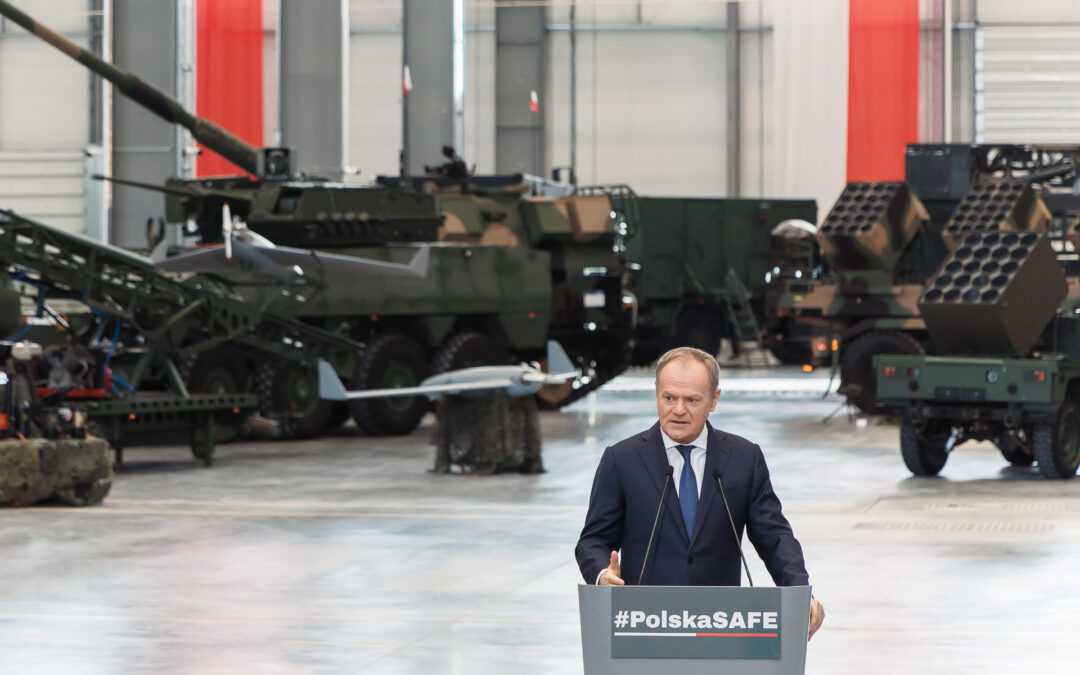
The ruling coalition – headed up by Prime Minister Donald Tusk, leader of the liberal-centrist Civic Coalition (KO) party – lacks the three-fifths parliamentary majority required to overturn a presidential veto.
President Nawrocki has vetoed a government bill intended to facilitate Poland's receipt of €44bn in loans for defence spending from the EU's SAFE programme.
He argued that the loans would indebt Poles for decades and threaten national sovereignty https://t.co/XSDjR8f6CX
— Notes from Poland 🇵🇱 (@notesfrompoland) March 12, 2026
The controversial veto and stand-off over how to finance Poland’s military modernisation dominated Polish politics for several weeks, escalating the bitter feud between the government and president that has been running since Nawrocki took office last summer.
It triggered condemnation from the Tusk administration, which argued that the funds were essential for bolstering Poland’s national security in the face of a rising Russian threat, and offered much more favourable long-term financing than the country could secure by relying exclusively on domestic borrowing.
The government argued that the programme would strengthen the domestic arms industry because, they claimed, nearly 90% of the SAFE funds would be spent on Polish military manufacturers, thereby supporting employment and boosting economic growth.
The veto also appeared to run counter to the views of the military, as senior generals spoke out in favour of SAFE as an opportunity to facilitate urgent military modernisation.
After Nawrocki vetoed the SAFE law, the government insisted that it would press ahead with the programme anyway and responded with a “plan B” workaround that would still allow Poland to receive some of the EU funds.
Poland’s government has launched its “plan B” to obtain €44bn in loans for defence spending from the EU's SAFE programme, after opposition-aligned President Nawrocki yesterday vetoed a law intended to facilitate the funds https://t.co/NLVjLRift5
— Notes from Poland 🇵🇱 (@notesfrompoland) March 13, 2026
Nonetheless, notwithstanding the fact that the opposition argues that proceeding in this way without legislation is unconstitutional, the presidential veto means that it will not be possible for the government to access the SAFE funds designated for non-military projects such as the border guard, security services and infrastructure construction.
Protecting Polish defence sovereignty?
Nawrocki and the right-wing opposition, on the other hand, argued that the SAFE programme would saddle future generations of Poles with a huge, long-term foreign currency debt obligation, exposing the country to exchange-rate risks for decades to come, and interest costs equal to the value of the loan itself.
They also said that the veto protected Polish national sovereignty, arguing that the SAFE deal allowed Brussels to exert undue pressure on Warsaw through a conditionality mechanism whereby the EU could suspend the disbursement of funds under certain circumstances while Poland would still have to continue repaying the debt.
The Tusk government argued that this would only involve situations where the funds were spent unlawfully or if the expenditure was not accompanied by appropriate control mechanisms.
However, the president and opposition said that the experience of the previous PiS-led government’s clashes with Brussels over withheld EU funds suggested that more arbitrary political conditions could be imposed if a Eurosceptic government takes power in Poland.
Giving external actors such as the EU too much control over national defence strategy and military modernisation plans would, they argued, violate Poland’s constitution.
The right-wing opposition also expressed concerns about the short time span available to sign procurement contracts, which made it difficult to align these with a coherent military logic, together with the fact that most of the funds had to be spent on European suppliers (in practice, French and German firms), which was too restrictive for a country like Poland whose rearmament has relied heavily on US and South Korean suppliers.
Indeed, while the Tusk government has pushed for greater Polish and European strategic independence from Washington, Nawrocki has cultivated the closest possible ties with the Trump administration.
The SAFE programme was felt to risk damaging relations with the USA, which most Poles still regard as the country’s only credible military security guarantor.
A “sovereign” domestic alternative?
As an alternative, Nawrocki and National Bank of Poland (NBP) president Adam Glapiński, who was appointed by and closely aligned with the previous PiS government, proposed a “sovereign”, domestic alternative to the EU programme which they dubbed “Polish SAFE 0%”.
This, they said, would provide the same money for defence spending with the use of national resources but involve no loans or interest payments. Their proposal, they argued, would guarantee 185 billion zloty (€43 billion) of investment, sourced domestically by transferring profits from the purchase and sale of the central bank’s reserves, that could be spent more flexibly than the EU loans.
Poland’s president and central bank governor, both of whom are associated with the right-wing opposition, have proposed a “sovereign Polish” alternative to the government’s plan to borrow €44 billion for defence spending through the EU's SAFE programme https://t.co/UuT4YIh9Ma
— Notes from Poland 🇵🇱 (@notesfrompoland) March 4, 2026
The government’s response was that while it was open to additional instruments for financing the armed forces, it saw the president’s proposal as complementary, not an alternative, to SAFE.
The EU scheme, it argued, provided the fastest and most reliable measure for urgently modernising the Polish military.
It also expressed scepticism about how the funds would be generated in practice, arguing that the president’s proposal lacked few specific details and could be excessively risky.
Nonetheless, Nawrocki regained the political initiative and did not lose out on his veto as much as government supporters had originally hoped for and envisaged. Although most polls still show majority support for the SAFE programme, a number conducted after the veto suggested that the margins had narrowed considerably.
Surveys carried out by the CBOS agency, for example, found support for SAFE falling from a 52% to 35% margin at the end of February to only 43% to 39% by mid-March.
Nawrocki was clearly able to consolidate and maintain the loyalty of his core electoral base, and the main political effect of the debate surrounding his veto appears to have been reinforced polarisation between the government and opposition camps.
Leveraging the Polexit narrative
However, not only will the government continue to highlight every new investment funded by the SAFE programme and argue that the president tried to block it, but it has also tried to use Nawrocki’s veto as a pretext to leverage its Polexit narrative: portraying the right-wing opposition as an existential threat to Poland’s continued membership of the EU.
The government has attempted to reframe the presidential veto – and, indeed, every opposition criticism of the EU – not as a legitimate sovereignty dispute but as evidence of a deliberate but hidden radical Eurosceptic agenda that could end in Polexit.
The debate over Nawrocki’s veto thereby served as the perfect accelerant for the government’s Polexit narrative, translating an abstract warning about opposition Euroscepticism into an apparently strong, tangible, high-stakes security-related proof-point.
This was a deliberate framing tactic by the government in its ongoing confrontation with Nawrocki and right-wing opposition, trying explicitly to turn the next parliamentary election, scheduled for autumn 2027, into a de facto binary referendum on Poland’s future EU membership.
Classic “wedge” politics
The Tusk government’s narrative, that the ruling collation is the only guarantor of Polish EU membership, is classic “wedge” politics, putting the opposition on the backfoot on a highly divisive topic while simultaneously energising its own supporters, and serves several interlocking political purposes.
It aims to leverage the broad pro-EU consensus as an electoral asset by putting their opponents on the wrong side of public opinion. Poland remains one of the most pro-membership countries in the bloc with around 70% favouring staying within the Union.
A quarter of Poles now favour leaving the EU, a much higher figure than before, according to a new poll.
Among supporters of the right-wing opposition, 43% now favour "Polexit" while 44% want to remain in the EU https://t.co/UHyHDwygnN
— Notes from Poland 🇵🇱 (@notesfrompoland) December 22, 2025
It is potentially a very difficult issue for the two main right-wing opposition parties, PiS and the radical-right Confederation (Konfederacja), because their voters are far more Eurosceptic than the average Pole and almost equally divided on the EU membership issue.
This puts these parties, especially PiS, on the defensive because it forces them to explain themselves and issue constant denials that, in spite of their Eurosceptic rhetoric and sovereignty-first stance, they do not want Poland to leave the EU.
It also unifies and provides a powerful turnout driver for government supporters who might be dissatisfied with the more problematic aspects of the Tusk administration’s record and that its promised flagship reforms have not been introduced at the hoped-for pace, but can be mobilised around the issue of defending Poland’s EU membership.
The SAFE veto issue and the government’s Polexit offensive also tied in with its broader “security” narrative, which involves framing the geopolitical choice facing Poland in Manichean terms between east and west.
The ruling coalition argues that, by undermining EU unity, PiS and other Eurosceptics are playing into Russian hands and threatening the whole of the continent’s security architecture.
The Polish government has asked the EU to take action against TikTok over a series of videos showing AI-generated young women calling for Poland to leave the EU.
"There is no doubt this is Russian disinformation," says government spokesman @adamSzlapka https://t.co/GrS1xUIWUc
— Notes from Poland 🇵🇱 (@notesfrompoland) December 31, 2025
It also involves presenting the Tusk government as pragmatic and security-focused, while portraying Nawrocki’s frequent use of presidential vetoes, with the SAFE loans programme legislation as an apparently perfect illustration, and independent foreign policy initiatives as destructive and undermining the unity of the Polish state.
For their part, PiS leaders and the president’s supporters dismiss the ruling coalition’s Polexit narrative as a classic scare tactic and manufacturing a non-existent issue to distract from the government’s problems and delays on reforms.
They treat parallels with a UK Brexit-style referendum as a straw man, insisting that Eurosceptic rhetoric defending Polish interests is about normal democratic criticism and fixing the EU and not an anti-European slippery scope to leaving the union.
PiS and Nawrocki argue that they favour a “Europe of nations” looser confederation of sovereign states model, rather than further transfers of power to Brussels, supranational courts and “ever closer union”.
The real danger to EU membership is, they say, Tusk’s subservience to the union’s political establishment and major European powers which, they argue, ultimately strengthens the very forces that the government is trying to marginalise.
A politically risky escalation?
Although the EU’s SAFE programme was designed initially as a technical instrument to finance Europe’s rearmament, in Poland it very quickly turned into an explosive political conflict and one of the sharpest clashes to date between the president and government.
As well as calling into question the extent of the EU’s control over the defence decisions of member states, it exposed a wider political and strategic divide over how Poland should fund its military build-up and the country’s relationship with the union at a moment when security questions dominate European politics.
However, escalating a governance deadlock over a specific policy veto into an existential EU membership crisis to attack Nawrocki and the right-wing opposition ahead of the 2027 election is politically risky and could backfire on the Tusk government.
The ruling coalition is gambling that voters will prioritise Polexit over domestic frustrations and not feel that the issue is being used as a distraction from other government failings.
The opposition PiS party has called for Poland to leave the EU's Emissions Trading System, which it says makes Poles a "cash machine for absurd leftist climate policy".
But the government warns that the only way to leave ETS is to exit the EU entirely https://t.co/mRRBH09uAc
— Notes from Poland 🇵🇱 (@notesfrompoland) March 16, 2026
Turning policy disagreements into a binary loyalty test and escalating a conflict without evidence of a credible threat risks coming across as hyperbolic and cynical. This makes it easier for the opposition to portray the government as manufacturing crises rather than solving them, thereby eroding the Tusk administration’s credibility.
It also assumes that the public will rally against any sovereignty push as “Polexit in disguise”. In fact, data shows that Poles have serious concerns about whether deeper European integration necessarily serves Poland’s interests – or, indeed, already restricts Polish sovereignty too much.
Many of those who favour EU membership in principle are also sovereignty-conscious and have serious concerns about what they see as union over-reach on specific issues such as migration and climate policy.
Turning the SAFE veto clash into an existential showdown over EU membership could work in the Tusk government’s favour, but also risks unpredictable electoral consequences.
Notes from Poland is run by a small editorial team and published by an independent, non-profit foundation that is funded through donations from our readers. We cannot do what we do without your support.
Main image credit: Kancelaria Premiera (under CC BY-NC-ND 4.0)