Keep our news free from ads and paywalls by making a donation to support our work!

Notes from Poland is run by a small editorial team and is published by an independent, non-profit foundation that is funded through donations from our readers. We cannot do what we do without your support.
Polish state defence group PGZ has signed an agreement with Estonia’s Frankenburg Technologies to jointly establish a facility in Poland that will produce up to 10,000 low-cost anti-drone missiles a year.
“Estonia is a leader in new technologies, so we want to capitalise on this,” said Polish defence minister Władysław Kosiniak-Kamysz following a meeting with his Estonian counterpart Hanno Pevkur. “This is very important today in the face of threats from Russia.”
🇵🇱🤝🇪🇪 Współpraca @PGZ_pl i @FrankenburgTech będzie koncentrować się https://t.co/n8NRkOVDT6. na systemach obrony powietrznej bardzo krótkiego zasięgu, w tym na rozwoju i produkcji systemu rakietowego MARK I, przeznaczonego do zwalczania bezzałogowych statków powietrznych.
🚀 W… pic.twitter.com/NlqkMrm7jC
— Polska Grupa Zbrojeniowa🇵🇱 (@PGZ_pl) March 27, 2026
The two ministers attended the signing of a framework agreement on “long‑term cooperation in the development and production of modern defence solutions” between PGZ and Frankenburg, which specialises in anti-drone missile systems.
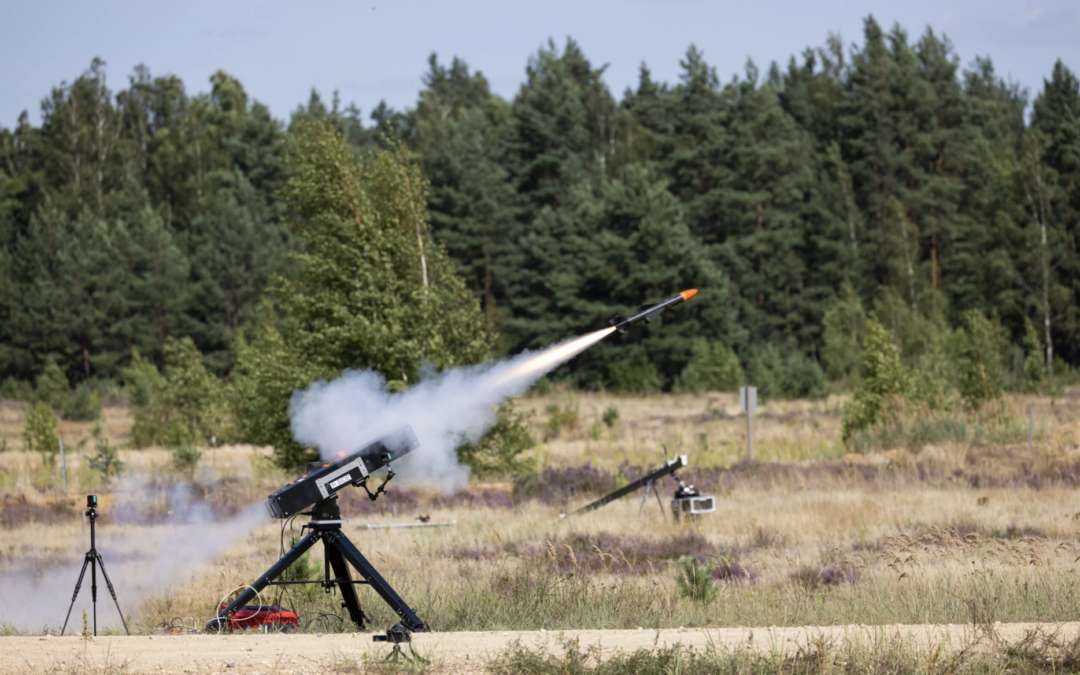
A primary focus will be on very short-range air defence technologies, including developing Frankenburg’s Mark I missile system for countering unmanned aerial vehicles, which has a range of up to 2 km. They will also seek to develop a longer-range Mark II anti-drone system, with a range of 5-8 km.
As part of their partnership, the two companies plan to “establish production capabilities…in Poland, including a facility with a planned capacity of up to 10,000 missiles per year”.
“Lessons learned from the war in Ukraine clearly demonstrate that attacks carried out by dangerous yet inexpensive drones are widespread,” said PGZ’s CEO, Adam Leszkiewicz. “Countering them with advanced – and therefore more costly – air defence systems is operationally and economically unjustified.”
“Cooperation with Frankenburg will enable us to jointly produce and offer the Polish armed forces and other customers the most economically advantageous effector to date for countering this specific category of drone threats,” he added.
The urgency of developing such anti-drone systems was emphasised last September, when around 20 Russian drones entered Polish airspace in an unprecedented violation. Some were shot down using expensive air-to-air missiles, while others hit the ground without being intercepted.
Frankenburg’s anti-drone systems are specifically designed to offer a less expensive and even more effective defence against such threats.
Poland has signed an agreement for a new anti-drone system that it claims will be the first of its kind in Europe.
The network is intended to protect Poland’s eastern borders, where last year around 20 Russian drones crossed in an unprecedented incursion https://t.co/WhWhJxDwXA
— Notes from Poland 🇵🇱 (@notesfrompoland) January 30, 2026
In January, PGZ was part of a Polish-Norwegian consortium that signed an agreement with the Polish government to develop a new anti-drone network, known as SAN, which they said would be the first of its kind in Europe.
PGZ’s vice president, Marcin Idzik, says they are now considering integrating Frankenburg’s systems into SAN. Because Frankenberg is a European entity, it may be possible to fund the project through the EU’s SAFE programme, which is providing Poland with €44 billion in loans for defence spending.
Last month, a representative of Frankenburg told Ukrainian news service Militarnyi that the company hoped to begin testing its Mark 1 anti-drone missiles in Ukraine in the second quarter of this year.
Following his talks with Pevkur, Kosiniak-Kamysz also revealed that Poland and Estonia hope to sign a new security cooperation agreement soon and that Estonia has invited Poland to take part in joint exercises.
Notes from Poland is run by a small editorial team and published by an independent, non-profit foundation that is funded through donations from our readers. We cannot do what we do without your support.
Main image credit: Frankenburg Technologies (press materials)

Daniel Tilles is editor-in-chief of Notes from Poland. He has written on Polish affairs for a wide range of publications, including Foreign Policy, POLITICO Europe, EUobserver and Dziennik Gazeta Prawna.