Keep our news free from ads and paywalls by making a donation to support our work!

Notes from Poland is run by a small editorial team and is published by an independent, non-profit foundation that is funded through donations from our readers. We cannot do what we do without your support.
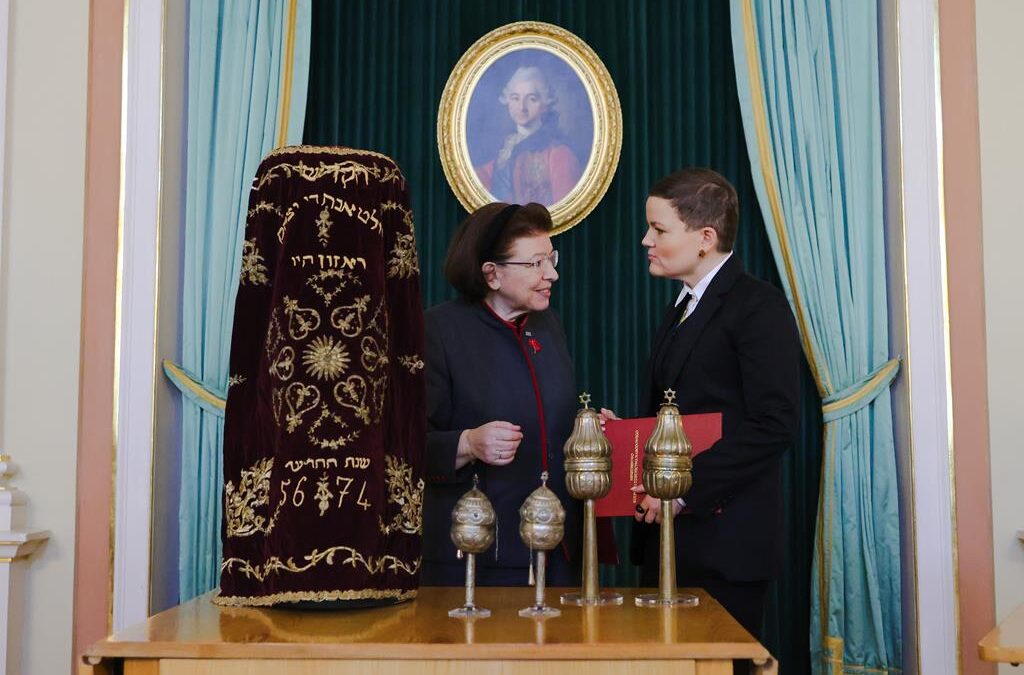
Poland has returned 91 Jewish religious objects to Greece that were stolen by the Germans from Greek Jews during the Holocaust.
The handover marks the first time that Poland, which actively pursues the restitution of its own looted property, has returned historical objects following a request from a foreign country under Polish restitution law.
Kolekcja judaików wraca do Grecji.
Historyczna kolekcja 91 greckich judaików, skradzionych w czasie II wojny światowej obywatelom Grecji i z greckich synagog przez niemiecką organizację Einsatzstab Reichsleiter Rosenberg, a odnalezionych w Polsce po wojnie, powraca do kraju… pic.twitter.com/eyJ4M4MEJZ
— Ministerstwo Kultury i Dziedzictwa Narodowego (@kultura_gov_pl) March 4, 2026
“These items, which were removed from synagogues throughout Greece during the Second World War, are today on their way back to their homeland,” said Greek culture minister Lina Mendoni at the handover ceremony in Warsaw on Wednesday.
“They not only have historical and artistic value; they are part of the living memory of my country and of the Jewish Greeks,” she added.
“For the first time, Poland is restituting cultural assets under its care. This gesture is significant not only legally but also morally…Today’s event is proof of cooperation, mutual respect, and shared responsibility for memory.”
Before World War Two, there were around 75,000 Jews in Greece. In 1941, Nazi Germany and its allies occupied the country and, in 1943, they began deporting Jews to be killed at the extermination camps Auschwitz and Treblinka, located around 1,500 kilometres away in German-occupied Poland.
By the end of the war, around 82-90% of Greece’s Jews had been killed. The Nazis also looted and destroyed huge amounts of Jewish property. The collection of items now being returned is assembled from such plundered possessions.
It includes 17 pairs of rimonim, decorative finials that sit atop the ends of the rollers in Torah scrolls, as well as nine further individual rimonim or fragments of them. The rest of the collection is made up of 46 fabrics and one pair of pendants.
Poland’s culture ministry, which oversaw the return of the items, noted that such items were stolen from Greek synagogues and Greek citizens by the Reichsleiter Rosenberg Taskforce, a Nazi organisation dedicated to plundering cultural property in occupied territories.
Shortly after the war, the collection was discovered in the central museum repository of the Polish culture ministry at Bożków palace in southwestern Poland. The location was used to store artistic and cultural items recovered from the surrounding area of Lower Silesia.
The items were then transferred in 1951 and 1952 to the Jewish Historical Institute (ŻIH) in Warsaw, where they had remained until now.
However, in December 2024, Greece submitted a request to Poland for the collection to be returned. In doing so, it became the first foreign country to use a special restitution procedure established under a Polish law on the return of cultural property introduced in 2017.
The World Jewish Restitution Organization, which supports Jewish individuals and communities seeking to recover property lost during the Holocaust, assisted in the process, alongside the Polish and Greek culture ministries and ŻIH.
Speaking at Wednesday’s handover ceremony, Poland’s culture minister, Marta Cienkowska, noted that “for Poland, a country deprived of its statehood for over 100 years and then severely impacted by the atrocities of World War Two, the restitution of cultural property is a special issue”.
“For years, we have been finding and successfully recovering cultural property looted in Poland and taken all over the world,” she continued. “Therefore, I understand even more the immense significance of today’s event for the citizens of Greece.”
Poland has secured the return of a painting that disappeared in the aftermath of WWII.
It was recovered after recently appearing at auction in Denmark, with its owners agreeing to hand the artwork back to Poland after learning its provenance https://t.co/lWg3Z6u4Z6
— Notes from Poland 🇵🇱 (@notesfrompoland) October 27, 2025
The brutal Nazi-German occupation of Poland from 1939 to 1945 resulted in the deaths of millions of Polish citizens, including almost 90% of its Jewish population, which before the war had been the second-largest in the world.
The German occupiers also looted and destroyed hundreds of thousands of artistic, historical and scientific items held in Polish collections. Many of them remain unaccounted for, with the culture ministry’s public database of works it has identified as missing still containing around 70,000 items.
When such objects are identified – for example, in the collections of museums, archives and galleries, or when they come up for sale at auction – the Polish government seeks their return.
In December, for example, Germany agreed to return 73 medieval documents that were looted during World War Two.
Germany has agreed to return to Poland a collection of 73 medieval documents that were looted during WWII.
The culture minister has hailed it as "the most important and valuable return of stolen cultural heritage in modern Polish history" https://t.co/GxHQ8A0jyr
— Notes from Poland 🇵🇱 (@notesfrompoland) December 1, 2025
Notes from Poland is run by a small editorial team and published by an independent, non-profit foundation that is funded through donations from our readers. We cannot do what we do without your support.
Main image credit: MKIDN (under CC BY-SA 4.0)

Daniel Tilles is editor-in-chief of Notes from Poland. He has written on Polish affairs for a wide range of publications, including Foreign Policy, POLITICO Europe, EUobserver and Dziennik Gazeta Prawna.