Keep our news free from ads and paywalls by making a donation to support our work!

Notes from Poland is run by a small editorial team and is published by an independent, non-profit foundation that is funded through donations from our readers. We cannot do what we do without your support.
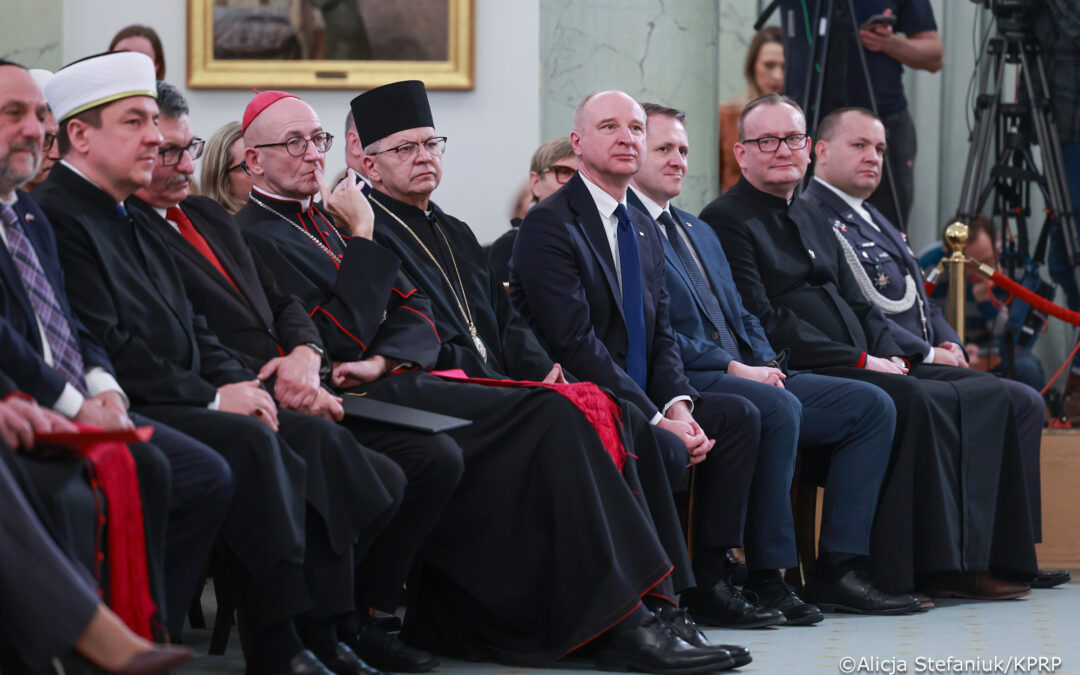
President Karol Nawrocki has hosted a meeting with representatives of Poland’s ethnic and religious minorities. Referring to Poland’s multicultural past, he insisted that the country remains open to all communities.
It is an annual tradition for the Polish president to invite leaders of the country’s traditional minority groups to the presidential palace in January. On Wednesday, Nawrocki, a conservative who took office in August last year, upheld that custom.
Among those to attend were representatives of the Jewish and Muslim communities; leaders of various Christian denominations, including Protestant, Greek Catholic and Orthodox, as well as Poland’s dominant Roman Catholic church; and members of recognised national and ethnic minority groups.
W Pałacu Prezydenckim Prezydent RP @NawrockiKn i Pierwsza Dama Marta Nawrocka spotkali się z przedstawicielami kościołów i związków wyznaniowych oraz mniejszości narodowych i etnicznych w Polsce. pic.twitter.com/O3UXqoebNu
— Kancelaria Prezydenta RP (@prezydentpl) January 14, 2026
Addressing the participants, Nawrocki said that Poland’s “genotype” is characterised by two sets of values. The first is the national attachment to freedom and sovereignty, but the second is “a tremendous openness”.
The president pointed to the fact that the First Polish Republic, which was a union between Poland and Lithuania that existed from the 16th to the 18th centuries, was “a mosaic of ethnicities and religions” and it was “this that allowed it to be a great power” of the time.
Likewise, during the Second Polish Republic, which existed between the First and Second World Wars, Poland was home to “millions of Polish Jews, millions of Polish Ukrainians, to Belarusians, Polish Armenians, to Polish Tatars”, recalled Nawrocki.
The president, an academic historian and former head of the World War Two Museum in Gdańsk, said that he was always moved when visiting Polish war cemeteries to see “Latin crosses on one side and Orthodox crosses on the other, as well as crescents and Stars of David”.
“This means that there were representatives of national minorities who viewed Poland as their homeland, regardless of the fact that they prayed in other languages or in other places of worship,” said Nawrocki, who himself is Catholic.
This history is “binding on me as president of Poland, despite the fact that today’s demographic structure of the Polish state is completely different”. The horrors of World War Two and then postwar border changes mean that modern Poland is far more ethnically and religiously uniform than before.
Karol Nawrocki has become Poland’s first president to attend the annual pilgrimage of football fans to the country’s holiest Catholic shrine, where he called for a “Poland without illegal immigrants” and "defence of the slogan: God, honour, fatherland" https://t.co/ESXRrYViLQ
— Notes from Poland 🇵🇱 (@notesfrompoland) January 11, 2026
Poland is therefore no longer “a state in which national minorities play such a significant role, those million-strong national minorities”, said Nawrocki. But “Poland remains open to national minorities and all the [religious] denominations you represent today”.
“I feel responsible for all citizens of Poland, regardless of where they pray to God or the national minority they come from,” he added.
On a personal note, Nawrocki revealed that his two closest childhood friends are Olgierd Chazbijewicz, a Polish Tatar and head of the Muslim religious communist in Gdańsk, and another man, whom Nawrocki did not name, who is a non-Catholic Christian.
“I believe that this personal, individual example can also serve as a foundation for our cooperation in caring for Poland and the mutual relations between churches in Poland.”
Poland's Muslim community, which is one of the oldest in Europe, has launched a new website to educate on Islam and challenge stereotypes about the religion and its followers https://t.co/g9O588eIx0
— Notes from Poland 🇵🇱 (@notesfrompoland) June 1, 2020
Nawrocki’s remarks were echoed by the religious leaders present. “Of course, we have a different path to God, but that’s not a problem; it’s a blessing, it’s the richness of our country,” said Poland’s chief rabbi, Michael Schudrich, quoted by the Polish Press Agency (PAP).
“The affairs of the republic should always be conducted in a spirit of responsibility for the common good, respect for the dignity of every citizen and concern for the unity of the nation,” said Tadeusz Wojda, the head of the Roman Catholic episcopate in Poland.
Last month, however, Nawrocki stirred controversy by ending a longstanding practice by his predecessors of inviting Jewish leaders to celebrate Hanukkah at the presidential palace.
Poland’s new president, Karol Nawrocki, has not organised a ceremony to celebrate the Jewish festival of Hanukkah, which begins tomorrow.
That breaks a tradition followed by each of his three predecessors, starting with President Lech Kaczyński in 2006 https://t.co/Xc93aFH57l
— Notes from Poland 🇵🇱 (@notesfrompoland) December 13, 2025
Notes from Poland is run by a small editorial team and published by an independent, non-profit foundation that is funded through donations from our readers. We cannot do what we do without your support.
Main image credit: Marek Borawski/KPRP

Daniel Tilles is editor-in-chief of Notes from Poland. He has written on Polish affairs for a wide range of publications, including Foreign Policy, POLITICO Europe, EUobserver and Dziennik Gazeta Prawna.