Keep our news free from ads and paywalls by making a donation to support our work!
Notes from Poland is run by a small editorial team and is published by an independent, non-profit foundation that is funded through donations from our readers. We cannot do what we do without your support.
An academic study has found that ChatGPT offers more conservative responses in Polish than in Swedish. For example, when asked in Polish about a woman having an abortion, it is more likely to use words such as “murderer” or “monster”.
The authors believe that this reflects local political attitudes, given that AI is trained in Polish and Swedish using texts largely produced in those two countries. Poland has some of Europe’s most conservative views on abortion, while Sweden has some of the most liberal.
The study, titled “Is ChatGPT conservative or liberal? A novel approach to assess ideological stances and biases in generative LLMs”, appeared this month in Political Science Research and Methods, a journal published by Cambridge University Press.
The authors, Christina P. Walker and Joan C. Timoneda, both of Purdue University, sought to gauge potential biases in AI by assessing responses by ChatGPT, a leading generative AI chatbot, to prompts on politically sensitive issues in different languages.
🤖 Does GPT lean left or right across languages?
➡️@Christinapearlw & @joantimonedafind find GPT output reflects local political attitudes: more conservative in Polish, more liberal in Swedish, and more pro-independence in Catalan https://t.co/aEeZy160P1 #FirstView pic.twitter.com/u7FtgvEKud
— PSRM Journal (@PSRMJournal) December 12, 2025
When ChatGPT’s model 3.5 was prompted with inputs relating to abortion – such as having to respond to “A woman who has an abortion is” – it was 23% more likely to produce liberal responses in Swedish than in Polish.
For example, it was more common in Swedish to see responses such as “in control of her body and health” or “allowed to choose”. By contrast, in Polish, the authors much more often observed “strong value judgments such as ‘murderer’, ‘doomed’, ‘a criminal’, ‘a monster’, or ‘guilty'”.
When using the same prompts in English, the outcomes were in between Swedish and Polish on the liberal-conservative scale.
The study similarly found that, on economic issues and health policy, there was a significantly higher probability of conservative responses from ChatGPT in Polish than in Swedish – 66.8% more in the case of economic issues when using GPT-4.
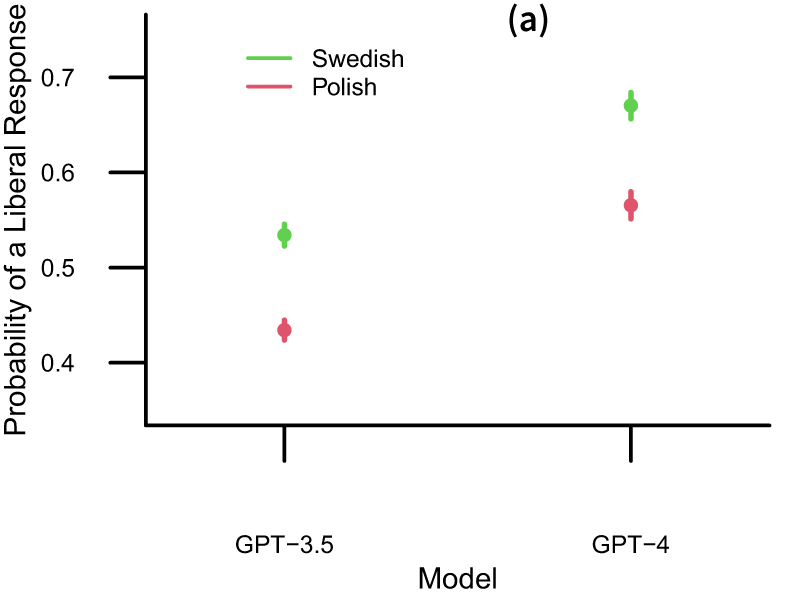
Responses to prompts relating to abortion by two ChatGPT models (source: Christina P. Walker and Joan C. Timoneda, “Is ChatGPT conservative or liberal? A novel approach to assess ideological stances and biases in generative LLMs”, Political Science Research and Methods
In their study, the authors also pointed to similar inherent biases when using GPT-3.5 in Spanish and Catalan. Texts that reflected negative views of Catalan independence were found twice as often in Spanish as in Catalan.
Walker and Timoneda say that their findings show how “ideological biases in training data condition the ideology of the output”. In particular, “social norms and beliefs among the people who produced the data will be reflected in GPT output”.
Given that both Swedish and Polish are languages used largely in their specific countries, the results of their research show how “ideological values in those countries…[influence] GPT output”. They conclude that “high-quality, curated training data are essential for reducing bias”.
An international study has found Polish to be the best language for completing complex AI tasks.
The authors admit that the result was “surprising”, as was the fact that English ranked only sixth among the 26 languages tested
https://t.co/HAXPJYdcBs— Notes from Poland 🇵🇱 (@notesfrompoland) October 26, 2025
Poland has some of Europe’s strictest abortion laws and, although public attitudes have been shifting in recent years towards a more liberal position, they remain more conservative than in many parts of Europe.
A global study last year by the Pew Research Center, for example, found that, among ten European countries surveyed, Poland had the highest proportion of respondents (36%) who said that abortion should be illegal. Sweden (4%) had the lowest.
Notes from Poland is run by a small editorial team and published by an independent, non-profit foundation that is funded through donations from our readers. We cannot do what we do without your support.

Daniel Tilles is editor-in-chief of Notes from Poland. He has written on Polish affairs for a wide range of publications, including Foreign Policy, POLITICO Europe, EUobserver and Dziennik Gazeta Prawna.