The presidents of Poland, Lithuania, Latvia and Estonia have today visited Kyiv, where they met with Ukrainian counterpart Volodymyr Zelensky to express support for his country in its fight against Russian aggression.
Zelensky welcomed the decision by Andrzej Duda and his Baltic counterparts – Alar Karis, Egils Levits and Gitanas Nausėda – saying that such visits are “particularly important as a show of European support in our struggle for freedom”.
“Poland, Lithuania, Latvia and Estonia have always been the first to help Ukraine,” declared Zelensky at a joint press conference of the five presidents this evening following their meeting.
In Kyiv with the Presidents of 🇵🇱 🇪🇪 🇱🇻 we expressed our full support to @ZelenskyyUa🇺🇦.
We will continue advocating for Ukraine's membership in the 🇪🇺& helping this heroic nation overcome the horrors of war.
Unity is our strength. We will stand with #Ukraine🇺🇦until victory. pic.twitter.com/WFfhx8MLPc
— Gitanas Nausėda (@GitanasNauseda) April 13, 2022
The Polish and Baltic leaders had yesterday met in the Polish city of Rzeszów to discuss the war in Ukraine. This morning, Duda’s chancellery then announced that the four presidents had boarded a train to Kyiv, in a trip organised by the Polish authorities.
“The purpose of the visit is to support Ukraine in every respect: symbolic, material and political,” said Duda’s chief of staff, Paweł Szrot, who added that the leaders would be offering Ukraine “humanitarian and other support”.
German President Frank-Walter Steinmeier, who yesterday visited Warsaw to meet with Duda, had also hoped to join the trip. But he withdrew after Ukraine made clear he “wasn’t wanted”, said Steinmeier. The Ukrainian government remains unhappy at the German president’s previous close ties to Russia, sources told Bild.
Borodianka – zaledwie kilkadziesiąt minut jazdy od Kijowa. Prezydenci 🇵🇱🇱🇹🇱🇻🇪🇪 obejrzeli świat, który narodom wokół proponuje Rosja. Nie ma na to słów. pic.twitter.com/bbtW9Jjwcc
— Jakub Kumoch (@JakubKumoch) April 13, 2022
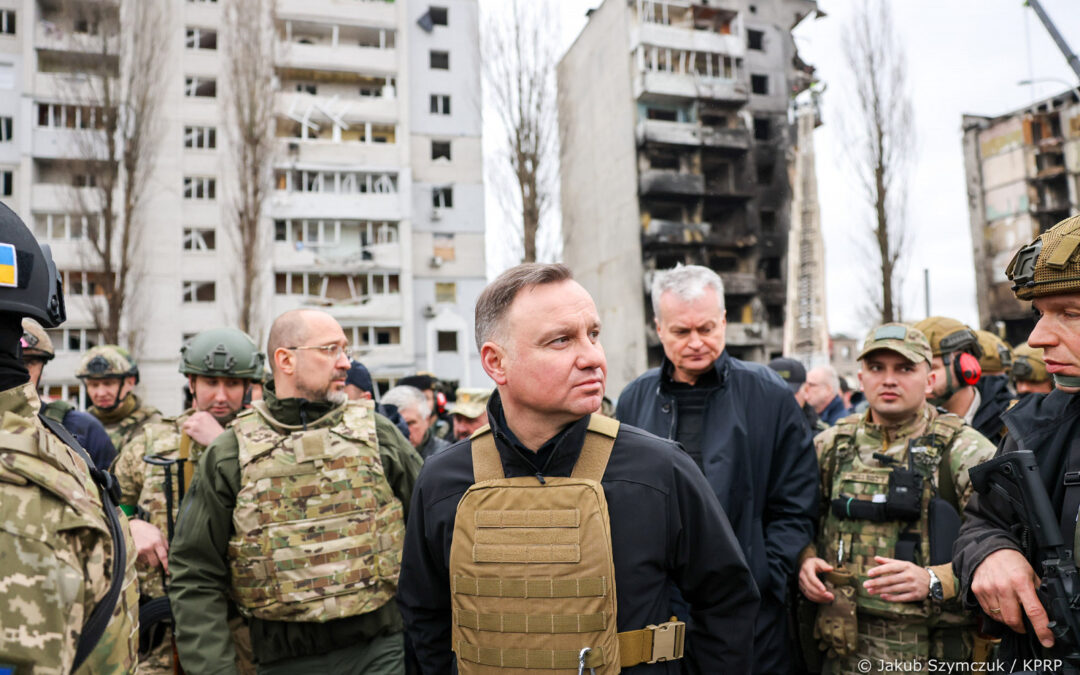
Shortly after midday today, Duda’s office confirmed that he, Karis, Levits and Nausėda had arrived in Kyiv. They were later pictured alongside Ukrainian Prime Minister Denys Shmyhal visiting civilian buildings in Borodianka, a settlement near Kyiv, that were damaged by Russian attacks.
Duda also visited Irpin, another city near Kyiv recently liberated from Russian occupation. Later, the four presidents met with Zelensky, who was pictured embracing Duda.
Spotkanie Prezydentów Polski i Ukrainy, @AndrzejDuda i @ZelenskyyUa. pic.twitter.com/vIPmY95eHj
— Kancelaria Prezydenta (@prezydentpl) April 13, 2022
After their meeting, the Polish president reiterated his country’s calls for tougher sanctions to be placed on Russia and for the “perpetrators of crimes… [against] civilians to be tried by international tribunals”, reports Wprost.
“We neighbours of Ukraine know from history what Russian occupation means, what Russian terror means, we know that no change has taken place in Russia in this respect,” said Duda, before adding his hope that “Ukraine will soon become part of the European Union”.
Prezydent @AndrzejDuda w #Kijów: Mam nadzieję, że Ukraina stanie się niedługo częścią Unii Europejskiej jako wolne i suwerenne państwo samo podejmujące o sobie decyzje. pic.twitter.com/12jar1kf4b
— Kancelaria Prezydenta (@prezydentpl) April 13, 2022
Since Russia’s invasion, Poland has been one of Ukraine’s most vocal advocates on the international stage. It has pushed for tougher sanctions to be introduced against Moscow as well as greater humanitarian and military support to be provided to Kyiv.
Last month, Poland’s prime minister, Mateusz Morawiecki, and his Czech and Slovenian counterparts became the first foreign heads of government to visit Kyiv since Russia’s invasion.
The Polish authorities, including Duda, have also warned from the earliest stages of the war that Russia’s actions in Ukraine amount to genocide, and have pushed for international investigations and legal action against those responsible.
Meanwhile, Poland has been the primary destination for refugees fleeing Ukraine, with around 2.7 million people crossing the border since the outbreak of war. The majority of those remain in Poland, where they have been supported by the national and local authorities, NGOs, religious organisations, and individual Poles.
Main image credit: Jakub Szymczuk/KPRP

Daniel Tilles is editor-in-chief of Notes from Poland. He has written on Polish affairs for a wide range of publications, including Foreign Policy, POLITICO Europe, EUobserver and Dziennik Gazeta Prawna.