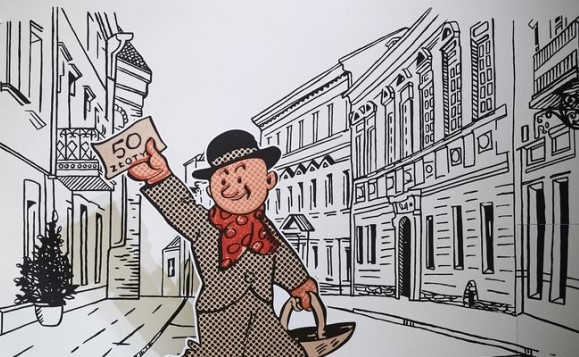
An exhibition that could become Poland’s first museum devoted to comics will open in Kraków this week. Its founders will initially be displaying 180 works in a private townhouse, but hope to later open a full-size exhibit with state support.
Among them is Wojciech Jama, a comics enthusiast who was one of the organisers of the “Comics now!” exhibition at the National Museum in Kraków in 2018, Poland’s first exhibition of its kind.
At Krakow's exciting Teraz Komiks! (Comics Now!) exhibition @MNKrk more pics https://t.co/R8KRD7mHcN pic.twitter.com/ria6ZFhIwT
— Sally Kindberg (@SKindbergia) July 10, 2018
Jama’s collection – the largest in Poland, he told Gazeta Wyborcza – will be exhibited from this Friday, 3 September, at 7 Sarego Street. The site will also showcase the history of Polish comics, organise meetings with illustrators, and feature a reading room.
Next year, the foundation set up to run the museum hopes to expand with its own publishing house about the history of the medium.
In addition to displaying well-known comics, it hopes to also present the works of lesser-known artists from the interwar period as well as the communist era. There will also be collectable figurines, porcelain products used to promote comics before the war, and everyday items featuring cartoon characters.
Before the war, famous publications for children included The Adventures of Matołek the Billy-Goat and Fiki-Miki the Monkey by Marian Walentynowicz and Kornel Makuszyński.
The two heavyweights of Polish comics in the communist era were Janusz Christa and Henryk Jerzy Chmielewski (aka Papcio Chmiel). Last year, Netflix made a new animated series about Christa’s two fictional Slavic warriors, Kajko and Kokosz.
Chmielewski’s famous series was Tytus, Romek and A’Tomek about two boy scouts and their chimpanzee. Individual books sold up to 300,000 copies each.
A Foreigner's Guide to Polish Comics#Poland #Polishcomics #stripes #bandedssinee
https://t.co/PxPM0kzN5f— Embassy of Poland BE (@PLinBelgium) October 20, 2019
As the communist authorities noticed the propaganda potential of comics – which had initially been discouraged – they began publishing their own titles, including Kapitan Żbik (Captain Żbik) and Pilot śmigłowca (Chopper Pilot). Jama, who worked as a police officer in Kraków, says Captain Żbik’s exploits were a factor in his decision to join the force.
Jama has also championed television “bedtime” cartoons (known as dobranocka in Polish, a play on “good night”), which are aired daily before the evening news. That led to the founding of a museum dedicated to them in 2009 in the city of Rzeszów.
Looking back to his own memories of the daily cartoons, Jama told Gazeta Wyborcza: “You waited all day for these 10 minutes of an evening fairytale. And as not everyone had television sets back then, the programme was often watched in groups, visiting family or friends.”
Main image credit: MNK press materials

Maria Wilczek is deputy editor of Notes from Poland. She is a regular writer for The Times, The Economist and Al Jazeera English, and has also featured in Foreign Policy, Politico Europe, The Spectator and Gazeta Wyborcza.