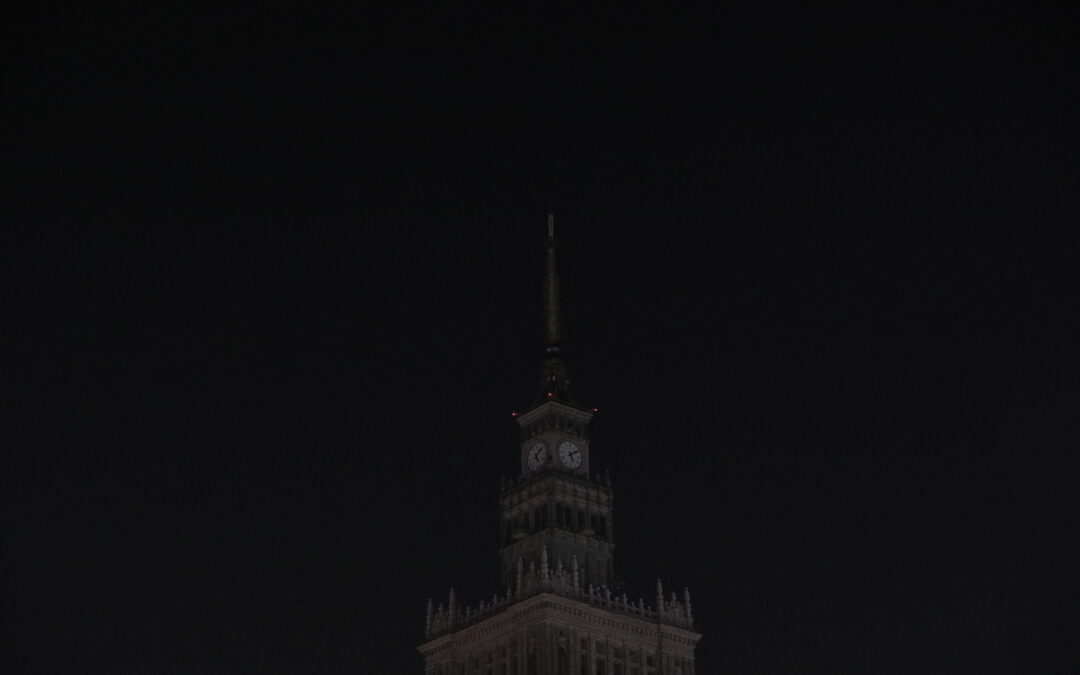
Almost 50 Polish cities this evening turned off the lights at famous landmarks in protest against the government’s blocking of the European Union’s budget and coronavirus recovery fund, as well as against a bill that would reduce the share of tax revenue going to local authorities.
The aim was to “show that, without the funds, we are left in the dark,” said Jacek Karnowski, mayor of the seaside city of Sopot and head of the association of local governments behind the protest, reports Gazeta.pl.
The coordinated action began at 5 p.m. In Kraków, the central All Saints’ Square and Wielopolski Palace went dark. In nearby Wieliczka, lights were switched off around the famous salt mines, a UNESCO World Heritage Site.
Aleja Zwycięstwa teraz #ProtestSamorządów pic.twitter.com/11sq9vl7Br
— Arkadiusz Chęciński (@ChecinskiPrez) December 1, 2020
The city of Kielce also turned off illuminations at five facilities that were built with the use of EU funds, including the city’s main stadium and Geopark Kielce, an education centre.
“Development will not be possible without the involvement of EU funds,” said Bogdan Wenta, Kielce’s mayor, quoted by RMF24. “If we were to turn off the lighting on all investments carried out with EU funding, it would be a poignant picture.”
The lights also went out on Skwer Kościuszki, a central square in Gdynia, as well as the nearby Sopot pier, a famous landmark. Gdańsk turned off the illuminations at its Neptune fountain, Saint Mary’s Basilica and other landmarks.
#ProtestSamorządów #protestsamorzadow https://t.co/MyitWv2wdM
— Mario Rebel #SilniRazem (@MarioRebeliant) December 1, 2020
All of Poland’s ten largest cities joined the blackout, including Wrocław, Łódź and Poznań. Among the smaller cities taking part was Sosnowiec, which switched off part of its EU-funded street light grid.
The protest was also supported by the mayor Warsaw, Rafał Trzaskowski, who said it was meant to “show everyone that there is a position [on the EU budget] that is different from that of the government”.
In the capital, illuminations were turned off on five bridges, while the lights also went out at the city’s iconic Palace of Culture and Science.
1.12 odbędzie się #ProtestSamorządów. W miastach w całej Polsce symbolicznie zgasną światła w proteście przeciw rosnącej finansowej presji wywieranej na lokalne budżety przez rząd. W @warszawa wyłączymy iluminację kilku miejsc – symbolicznie, bez zagrożenia dla bezpieczeństwa. pic.twitter.com/4z2VE2JWiU
— Rafał Trzaskowski (@trzaskowski_) November 30, 2020
The Polish government – along with Hungary’s – has been blocking the EU budget in protest against the linking of funds to the rule of law. They argue that the mechanism would be used in a “political” way to “arbitrarily” punish certain countries.
The Polish government has been found by a wide range of institutions and expert bodies to have repeatedly violated the rule of law and Poland’s own constitution. A poll earlier this year showed that a majority of Poles regard the government’s overhaul of the judiciary as an attempt to violate the rule of law.
Cities, which are mostly under opposition control, have also expressed concern at a move by the central government to cut the share of tax revenue allocated to local budgets. A bill to that effect was passed by the lower house of parliament on 28 October.
Main image credit: Jedrzej Nowicki / Agencja Gazeta

Maria Wilczek is deputy editor of Notes from Poland. She is a regular writer for The Times, The Economist and Al Jazeera English, and has also featured in Foreign Policy, Politico Europe, The Spectator and Gazeta Wyborcza.