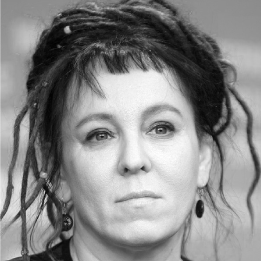
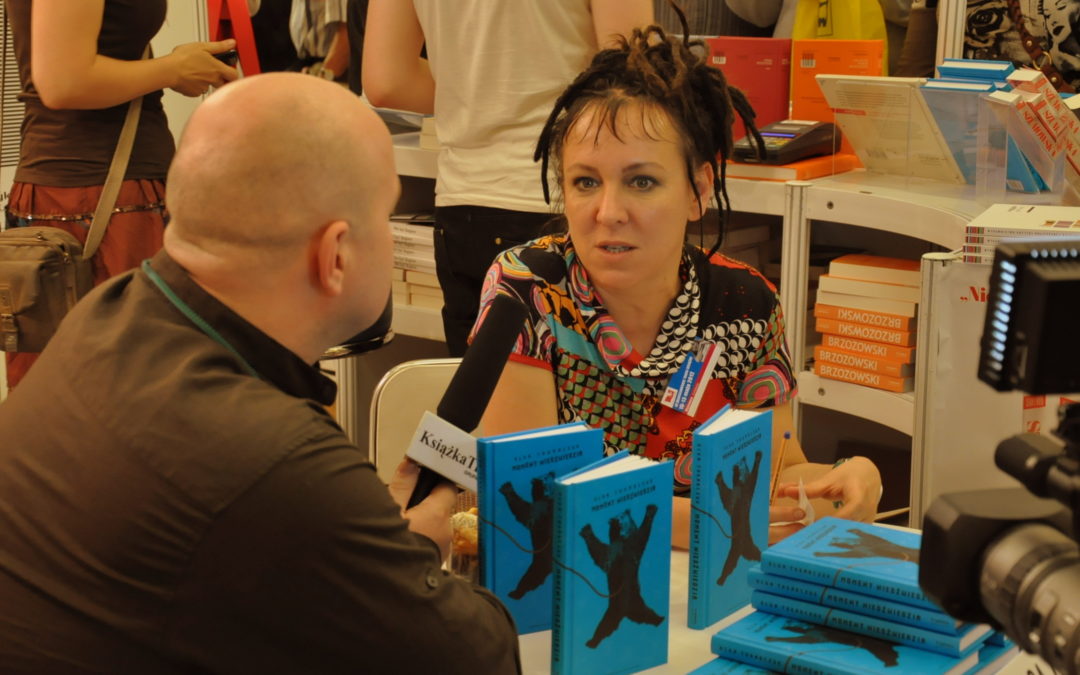
Olga Tokarczuk, recently awarded the Nobel Prize in Literature, has been feted back in her native Poland, where she attended the Conrad Festival of literature in Kraków.
On Sunday, hundreds queued for hours outside the city’s Wydawnictwo Literackie publishing house to get Tokarczuk’s autograph, with the earliest fans arriving at 4 a.m. Among them was a 90-year-old woman who had come specially from Sweden with her 70-year-old daughter. Similar scenes met Tokarczuk on a recent visit to Wrocław, her home city, where a huge queue formed to see her.
Gigantyczna kolejka chętnych po autograf Olgi Tokarczuk [ZDJĘCIA].https://t.co/04tcIIdgKT pic.twitter.com/hqVnV78sFj
— Wyborcza.pl Kraków (@Wyborcza_Krakow) October 27, 2019
On Saturday night, a crowd of 2,000 packed into Kraków’s ICE Congress Centre to hear Tokarczuk speak, welcoming her with a standing ovation. During the talk, Tokarczuk spoke about how women have been excluded in the writing of history, or are acknowledged only through their social roles (as housewives, mothers and so on) rather than as individuals. She argued that “literature [can be] a space to restore memory to women”.
Tokarczuk also made a thinly veiled political appeal, using a literary allusion. Asked a question about Poland’s future, Tokarczuk said that the situation is rather like a traditional fairy tale in which the hero must choose one of three paths, left, right or centre. “He usually chooses the the path to the left. And although it is a difficult one, there is usually a reward awaiting at the end.”
Spotkanie z laureatką Literackiej Nagrody Nobla Olgą Tokarczuk w ramach #ConradFestival #Kraków pic.twitter.com/8dVC1BT3NY
— joanna marczok (@jo__ma__) October 26, 2019
Tokarczuk has come to represent many of the ideas and values held by liberals and the left in Poland. After being awarded the Nobel Prize earlier this month, just three days before Polish parliamentary elections, Tokarczuk made a rare direct comment on politics. She used her first meeting with the media to express concern about “democracy in my country” and to call on “people in Poland [to] vote in the right way for democracy”.
As a consequence of her views, Tokarczuk has attracted criticism from conservative politicians and commentators. When the Senate, the upper house of Poland’s parliament, debated a resolution to congratulate Tokarczuk on her Nobel Prize, one right-wing senator condemned her as anti-Polish (calling her literally a “Pole-eater”, polakożerca, a term used to refer to those who hate and seek to do harm to Poland). Although the resolution passed, two out of the 100 senators voted against it and 12 abstained.
Tokarczuk, who also won the Man Booker International Prize last year for her work Flights (Bieguni), is the sixth winner of the Nobel Prize in Literature from Poland. Another, Władysław Reymont, is the subject of a recent article on Notes from Poland.
Main image credit: Plogi/Wikimedia Commons (under CC BY-SA 3.0)

Daniel Tilles is editor-in-chief of Notes from Poland. He has written on Polish affairs for a wide range of publications, including Foreign Policy, POLITICO Europe, EUobserver and Dziennik Gazeta Prawna.