Keep our news free from ads and paywalls by making a donation to support our work!

Notes from Poland is run by a small editorial team and is published by an independent, non-profit foundation that is funded through donations from our readers. We cannot do what we do without your support.
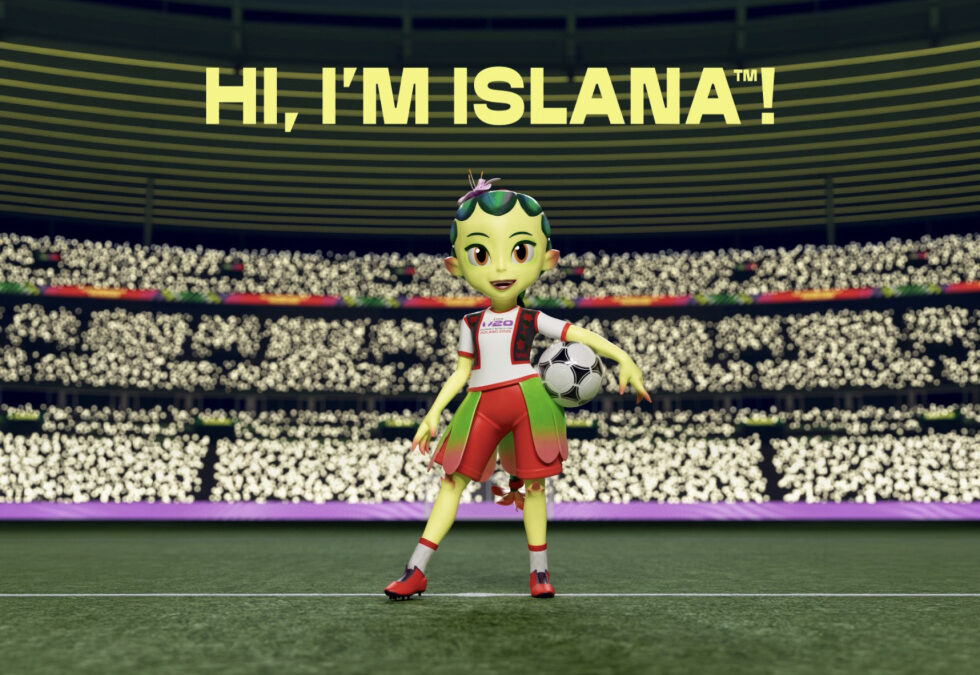
A character inspired by Slavic folklore has been unveiled as the official mascot of the FIFA Under-20 Women’s World Cup, which will take place in Poland this year.
The event, to be contested by 24 national teams across four Polish cities in September, will be only the second time Poland has hosted a FIFA tournament and the country’s first global women’s competition, amid a rapid recent growth in women’s football there.
Ready to play with heart and courage. 👊
Introducing Islana™, the Official Mascot of the #U20WWC Poland 2026!— FIFA Women's World Cup (@FIFAWWC) May 5, 2026
The mascot, named Islana, is described by FIFA, world football’s governing body, as a “cousin” of rusalka, a water spirit associated with lakes and rivers in Slavic mythology. She is “a guardian of nature blessed with a playful and uplifting spirit”.
Islana was reportedly raised in a forest and on the banks of Gopło, a lake in north-central Poland, where one night she became entranced with a football dancing on the water. This experience inspired her to watch over young footballers.
In Slavic folklore, the rusalka figure is often seen as ambivalent or even malicious towards humans. The Polish versions were even known to kill their victims by tickling them to death or forcing them to perform a frenzied dance. But FIFA hopes that the mascot for this year’s tournament will have a more benign effect.
“Together with Islana, FIFA is ready to welcome and encourage all the young players who will come together in Poland to showcase their great skills,” said Roberto Grassi, head of youth tournaments for the federation.
The under-20 women’s tournament, held every two years and taking place for the 12th time this year, “plays a defining role in giving young women a taste of what it is like to play at the highest level and inspiring future generations of girls to believe that football is a possibility for all”, added Grassi.
As hosts, the Polish team qualified automatically for the tournament, which will be its first time participating. They will join the current champions, North Korea, along with 22 other teams from around the world, with the draw for the event due to take place on 15 May.
The World Cup will run from 5 to 27 September in Łódź in central Poland, as well as Katowice, Sosnowiec and Bielsko-Biała in the south of the country.
Poland’s team for @Paris2024 Olympics contains more female athletes than male ones for the first time in history https://t.co/tsmARaHwAl
— Notes from Poland 🇵🇱 (@notesfrompoland) July 16, 2024
Poland also hosted the men’s Under-20 World Cup in 2019. At the senior level, the country was co-host, along with Ukraine, for the 2012 European Championships, which is organised by UEFA, the European governing body, rather than FIFA.
Women’s football in Poland has been growing in popularity in recent years. More than 25,000 women were playing the game in 2023, compared to just 3,000 a decade earlier, according to data from the Polish Football Association (PZPN).
In this year’s edition of the Tymbark Cup, which is hosted annually in Poland and is Europe’s biggest children’s football competition, a quarter of the 15,000 teams registered were girls’ teams.
The Polish government has approved a bill providing greater financial support to elite female athletes after they give birth.
It also includes measures to provide sports referees with the same level of protection as public officials https://t.co/4TI73VjQP5
— Notes from Poland 🇵🇱 (@notesfrompoland) January 9, 2026
Last year, the Polish senior women’s team appeared at a major tournament for the first time at the UEFA Women’s Euro 2025 in Switzerland. Though Poland beat Denmark, losses to Germany and Sweden meant they did not qualify from the group stage.
After the tournament, Miłosz Stępiński, former national team coach, told Polsat Sport that he had “no hesitation in saying that the year 2025 is a turning point for women’s football in Poland”. By December, the senior women’s team had achieved its highest-ever world ranking of 24th.
Star striker Ewa Pajor, who has scored 71 goals in 109 appearances for the national team, is currently the joint-leading scorer in this year’s UEFA Women’s Champions League and will play in the final later this month for her club side Barcelona.
Millions of Poles tuned in to watch their country's first-ever appearance at the Women's Euro this month.
The tournament "has changed the perception of women’s football in the country forever", writes @Sruubka for the @guardian https://t.co/mhjtLZTFrx
— Notes from Poland 🇵🇱 (@notesfrompoland) July 15, 2025
Notes from Poland is run by a small editorial team and published by an independent, non-profit foundation that is funded through donations from our readers. We cannot do what we do without your support.
Main image credit: FIFA/press materials
Ben Koschalka is a translator, lecturer, and senior editor at Notes from Poland. Originally from Britain, he has lived in Kraków since 2005.