Keep our news free from ads and paywalls by making a donation to support our work!

Notes from Poland is run by a small editorial team and is published by an independent, non-profit foundation that is funded through donations from our readers. We cannot do what we do without your support.
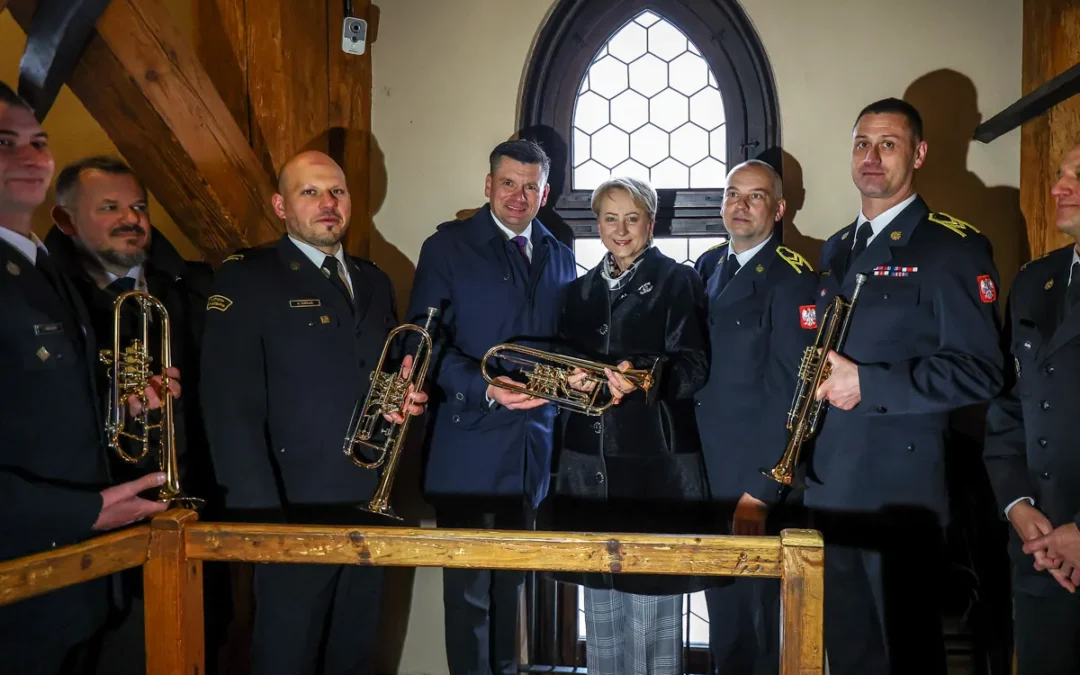
The trumpeters who play Kraków’s iconic bugle call every hour from the top of St Mary’s Basilica on the city’s main market square have received a set of new instruments.
The eight trumpets were purchased at a cost of around 100,000 zloty (€23,500) by the Kraków Philharmonic with support from the regional authorities in Małopolska, the province where the city is located.
“The St Mary’s trumpet call has been one of the most important symbols of the city and the whole of Małopolska for over 600 years,” wrote Łukasz Smółka, head of the provincial government. “For centuries it has set Kraków’s rhythm, reminded us of its history and connected generations of residents and visitors.”
🎺 Krakowski hejnał od ponad 600 lat jest jednym z najważniejszych symboli miasta i całej Małopolski. pic.twitter.com/ATGRxPdTSg
— Łukasz Smółka (@Smolka_Lukasz) April 8, 2026
The trumpet call is played from the north tower of St Mary’s Basilica every hour in four directions: towards Wawel Royal Castle, to symbolise playing for the king; to the market square, for city councillors; to the Florian Gate, for guests; and finally to the fire brigade headquarters, responsible for maintaining the tradition.
The piece, known in Polish as hejnał mariacki, cuts off abruptly mid-tune in reference to a local legend that a city bugler who was warning of an attack by Mongol invaders in 1241 was hit by an arrow while sounding the alarm.
While that story likely arose only in the 20th century, there are records of buglers playing from the church tower dating back to at least the 14th century.
Historically, the practice was used to warn residents about fires or invasions, as well as marking the opening and closing of the city gates. It only became an hourly tradition much more recently.
Today, the tradition is maintained by a seven-strong team of buglers, who usually work in pairs in a 24-hour-shift. They were delighted to receive the new instruments, reports the Polish Press Agency (PAP).
As the hejnał is played 96 times a day, the previous set was somewhat worn out after more than a decade of use, noted one of them, Jakub Imielski.
“We try to play as nicely as we can for Cracovians, as usual,” added his colleague, Michał Kołton, noting that the trumpets’ golden colour ensured that people watching from the square below could easily spot the musicians appearing in the tower window.
“These are top-class Austrian instruments,” said Mateusz Prendota, director of the Kraków Philharmonic. “We are pleased that in this way we are able to promote the philharmonic and the public service performed by the gentlemen from the St Mary’s tower.”
Smółka also noted that next year marks the 100th anniversary of Polish public radio’s first broadcast of the hejnał, a tradition which continues every day at midday.
The bugle call has also been used as a national symbol, and was played in 1944 in the monastery ruins at Monte Cassino in Italy to announce the Allied victory at the battle there, a key breakthrough in which Polish units played a central part.
Now it is also a popular attraction for visitors to Kraków, which is Poland’s second-largest city and also its main tourist hub. Last year, Kraków was named as the best city break destination in Europe for the fifth time by members of leading British consumer association and magazine Which?.
Kraków is advertising for a new bugler to perform the city's famous "hejnał mariacki", an hourly trumpet call that has been played from a church tower on the market square since the 14th century https://t.co/Ai7ZZRYqBN
— Notes from Poland 🇵🇱 (@notesfrompoland) December 28, 2020
Notes from Poland is run by a small editorial team and published by an independent, non-profit foundation that is funded through donations from our readers. We cannot do what we do without your support.
Main image credit: UMWM
Ben Koschalka is a translator, lecturer, and senior editor at Notes from Poland. Originally from Britain, he has lived in Kraków since 2005.