
Keep our news free from ads and paywalls by making a donation to support our work!

Notes from Poland is run by a small editorial team and is published by an independent, non-profit foundation that is funded through donations from our readers. We cannot do what we do without your support.
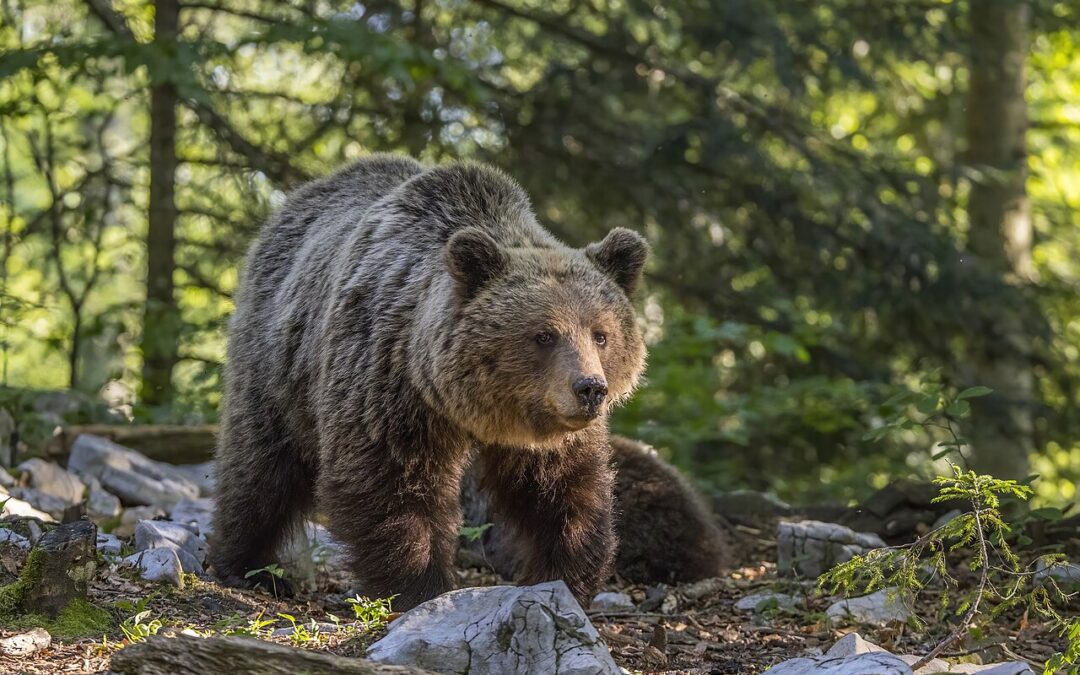
Poland’s government has unveiled a new 16 million zloty (€3.7 million) scheme to protect brown bears and ensure the safety of their human neighbours. A special force will be set up to monitor and respond to bear sightings, including fitting the animals with tracking collars.
Estimates of Poland’s brown bear population vary between 120 and 400, with most found in the southeastern Bieszczady mountains as well as the Tatras and Beskids further west. The population is thought to be growing, with a rise in reports of encounters with humans.
Earlier this month, a man was bitten and knocked to the ground by a bear on a forest trail 300 metres from a village in Podkarpacie. Encounters with humans become likelier at this time of year as bears wake from hibernation.
Bezpieczeństwo ludzi i ochrona przyrody mogą iść w parze.
Nowy program ochrony niedźwiedzia brunatnego w Małopolsce i na Podkarpaciu opiera się na prewencji, monitoringu i edukacji – zamiast tylko na doraźnych działaniach.To przede wszystkim:
– ograniczanie dostępu do odpadów
-… pic.twitter.com/ogl2UTkzTc— Ministerstwo Klimatu i Środowiska (@MKiS_GOV_PL) March 19, 2026
The new programme, which is mostly financed from EU funds, is the first systematic response to the issue, reports broadcaster TOK FM. Launching the scheme, climate minister Paulina Hennig-Kloska said its main objective is to increase the safety of both humans and animals in their sometimes conflicting relations.
Actions are planned in three areas: conflict prevention, rapid responses to dangerous situations, and education of local residents.
A 20-person-strong team will monitor bears day and night and be ready to intervene when necessary. Specialists will catch animals venturing too close to human settlements, immobilise them, and fit them with tracking collars.
“This will allow us to follow their movements and scare them away so they do not enter built-up areas,” said Hennig-Kloska. “We want to protect people’s health and lives by scaring the bears away, not killing them.”
While the current law only allows paintball guns to be used on bears, the government is working on legislation to allow the intervention team to use smoothbore weapons, the minister added.
In summer 2023, a police unit tasked with scaring away bears from populated areas was launched in the Bieszczady mountains, albeit on a smaller scale.
The new programme will also include the installation of around 1,500 special bear-proof rubbish bins to discourage the animals from seeking food in populated areas.
“Bears look for an easy meal,” Hennig-Kloska explained. “On the one hand, we want to restore the food supply in the mountains by planting native species of fruit trees and bushes, and on the other, to close off their access to rubbish bins.”
In 2022, the town of Zakopane at the foot of the Tatra mountains installed similar bins designed to prevent bears and other wild animals from foraging in them.
A special police unit tasked with scaring away bears from populated areas is to be launched next week around the Bieszczady mountains, which are home to Poland's largest population of brown bears https://t.co/hwGOYfbFJN
— Notes from Poland 🇵🇱 (@notesfrompoland) July 11, 2023
The new programme “is a first step that the Bieszczady and residents of municipalities struggling with this problem for a few years have been waiting for,” Dariusz Wethacz, the mayor of Cisna, one of the two bases for the response team, told TOK FM.
But it is also crucial to establish the scale of the bear-related incidents, he added. “Without knowing the problem, we can’t talk about solving it.”
Hennig-Kloska admitted that a new bear census might be necessary, given how widely estimates of their number vary. But “what we do know is that we are witnessing an increase in the number of individuals”, she added.
If someone comes across a bear, they should slowly retreat but avoid running away, as a bear will be provoked to chase and, reaching speeds of 50 km/h, is the likely winner, Tomasz Zając from Tatra National Park told Polskie Radio. Hikers should also stick to trails and avoid leaving waste behind.
The mountain resort town of Zakopane has installed new rubbish bins designed to prevent wild animals, including bears, from foraging for food in them.
The initiative, a collaboration with Tatra National Park, is intended to protect both animals and humans https://t.co/7PW0SatYxg
— Notes from Poland 🇵🇱 (@notesfrompoland) August 1, 2022
Notes from Poland is run by a small editorial team and published by an independent, non-profit foundation that is funded through donations from our readers. We cannot do what we do without your support.
Main image credit: Wikimedia/Charles J. Sharp (under CC BY-SA 4.0)

Ben Koschalka is a translator, lecturer, and senior editor at Notes from Poland. Originally from Britain, he has lived in Kraków since 2005.



















_female_1.jpg)